
 ChatGPT
 Perplexity
 Claude
 Grok

You work in sales, financial control, or administration; you know Excel inside and out; and you’re wondering if you could become a data engineer. The short answer: yes, but rarely through a direct path. This is a typical career for people switching fields, but it requires programming skills—and you can’t build those up in just a few weeks. Here, you’ll learn what fundamentals you need, the three paths into the field, how AI is changing the entry requirements, and which path best suits your current situation.
You can become a data engineer without having studied computer science, because there are several paths to this career, and it’s possible to switch into the field from another background. The requirements include a solid knowledge of SQL and Python, an understanding of data pipelines and cloud platforms, and at least one project you can showcase.
Is it possible to become a data engineer without a college degree?
Yes. A degree in computer science, mathematics, or engineering is helpful, but it is only one of several ways, in addition to online courses and project-based learning. Certificates alone are rarely enough; you also need practical experience. What employers really look for is whether you can reliably get data from point A to point B, and the best way to demonstrate that is through projects and code.
Anyone who wants a formal degree can do so through a IT Training or a Retraining as an IT Specialist for Data and Process Analysis enroll in a program that culminates in an IHK exam. A third option is a Distance Learning in Computer Science or Data Science. All three paths take significantly longer than continuing education.
The real bottleneck is programming. A data analyst often gets by with Excel, SQL, and Power BI. A data engineer writes code that runs on its own at night, catches errors, and requires maintenance. If you’ve never programmed before, you’ll need more time for this than many guides promise, and fixed weekly estimates aren’t very helpful. It’s easier to plan for Milestones you can check off one by one.
Is this job a good fit for you?
A Data Engineer constantly switches between building and repairing: On good days, you design new pipelines and data models; on bad days, something goes down overnight, and you troubleshoot the issue before analysts and business units start working with incorrect numbers. Good work usually goes unnoticed, but an outage stands out immediately. Data Engineers write code that runs in production, and if a pipeline fails at night, she receives a notification.
If you enjoy systematically narrowing down problems, aren’t bothered by changing priorities, and enjoy building things that run reliably in the background, this is the right place for you. If, on the other hand, you need a lot of visible recognition for your work, you should think more carefully about whether a data analyst or a data scientist is a better fit for you.
What qualifications do you really need?
The channels “Data with Baraa” and “Luke Barousse,” both run by data engineers, largely follow the same basic sequence: first SQL and Python, then Git, then the cloud and Spark. In addition, there are two pieces of advice that we agree with: learn one topic at a time, and practice significantly more than you watch. Baraa Khatib-Salkini recommends a ratio of about 80 to 20.
| Basis | What You Need Them For | How far |
|---|---|---|
| SQL | Retrieve, link, and transform data | Sure: Joins, aggregations, window functions |
| Python | Import data, write pipelines, handle errors | Functions, Files, Error Handling, Database and API Integration |
| Git and Terminal | Version Control and Execution of Code | Basics: Commit, Push, Pull, Simple Commands |
| Cloud (e.g., Azure) | Storing Data and Running Pipelines (according to Bitkom (86 percent of companies use cloud services) | Concepts and a practical service |
| Data modeling | Design tables so that analyses run quickly | Star Schema, Facts, and Dimensions |
| Spark, Lakehouse, and Orchestration | process large amounts of data, streamline workflows with tools such as Airflow plan | Basics: reading, processing, writing |
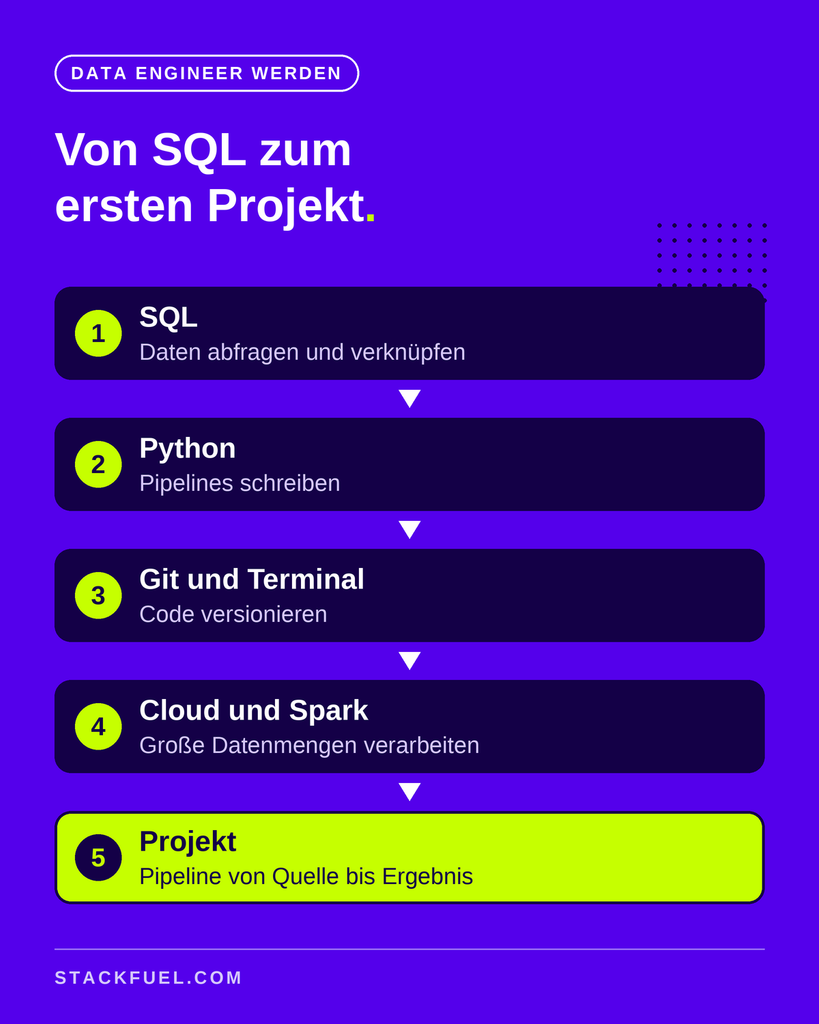
You won't learn much of this from theory. Instead, start building small pipelines early on that retrieve, clean, and store real data—even if they're a bit rough around the edges at first.
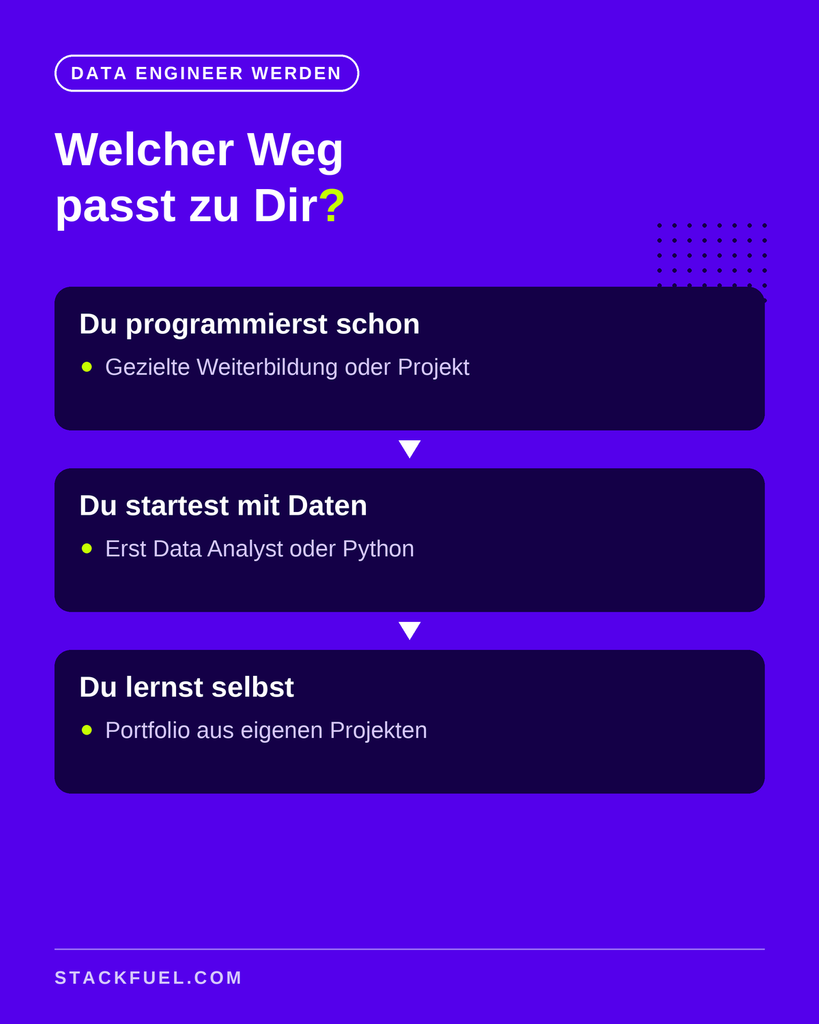
What are the three paths to a career?
Option 1: You're already programming or analyzing. If you have a background in software development or database administration, or if you already work with large datasets, the transition will be the easiest. You’ll likely lack experience with the cloud, data modeling, and pipeline thinking. In this case, targeted continuing education or a self-initiated project is worthwhile. Even a compact A boot camp can be worthwhile if you already have a solid grasp of Python and SQL.
Option 2: You start as a data analyst or by learning Python. If you don't have any programming experience, taking the detour through data analysis is often a more realistic option. As a data analyst, you'll learn SQL, Python, and how to work with real data without having to manage systems right away, and You can get started even without a college degree. The next step is to transition to a data engineer role.
Option 3: You learn on your own and build a portfolio. Free courses and videos are enough to cover the basics. The real cost is discipline: Without feedback, gaps in your knowledge often go unnoticed, and without a degree, you’ll have to prove your skills through projects.
Projects or Certificates: What Matters When Applying?
Both help, but to varying degrees. Baraa Khatib-Salkini places more weight on projects than on certificates because a project shows how you approach a task. A single Platform certificate, such as for Azure or Databricks, can be added if it fits your path. He considers collecting a lot of certificates a waste of time. That's his opinion.
A good portfolio project has a few key components. It starts with a clear question, uses a real, publicly available data source, and processes the data through transparent layers—from raw to cleaned to ready for analysis—for example, in a lakehouse. This includes tests that catch erroneous data, a schedule that allows the pipeline to run on its own, and an output that someone can use—for example, a table or a dashboard. You’ll post the code and a brief description with an architectural sketch on GitHub.
If you have a background in data analysis, software development, or a data-related field, you’re probably already familiar with this pattern: question, data, solution, result. It is the same structure as in a data analyst's portfolio. For a data engineer, however, the focus is on the process from the source to the finished table, rather than on the final analysis.
When applying for a job, here’s the rule: Don’t wait until you feel 100 percent ready. There’s always a tool you haven’t discovered yet. What matters is that you can explain a pipeline, from the source to the result.
What is the market like for beginners?
According to Bitkom In 2026, there were approximately 79,000 open positions for IT professionals, down from 149,000 in 2023. The market has thus eased. However, 97 percent of companies with open IT positions continue to struggle to fill them. For newcomers, this means there’s demand, but entry-level positions are more sought-after than senior roles. So apply to a wide range of jobs and don’t expect your first job to be perfect. Those who start as juniors learn on the job what no course can teach—such as how to handle system outages and deal with colleagues who are waiting for your data.
Is it worth getting started when AI builds pipelines?
Today, AI assistants can write an SQL query or draft a pipeline in seconds. Using a an open standard called the Model Context Protocol They can be connected directly to databases and tools, allowing even non-IT departments to ask their questions about the data via chat. For career changers, this is good news at first: it lowers the barrier to writing your first piece of executable code.
In contrast, the demand for sound judgment has increased. According to a a representative Bitkom survey conducted in September 2026 57 percent of companies in Germany use AI; 11 percent are already using AI agents, and another 29 percent plan to do so. AI users cite data preparation and integration into existing systems as the main cost drivers. An agent can only deliver results as good as the data it sees, and someone has to determine what data it is allowed to access. That is the job of data engineers.
For your learning journey, this means: The fundamentals remain the same, but you’re learning them to read and review code, not just to write it. Data modeling, testing, and understanding what a metric means in a business context become increasingly important. So practice with AI assistants from the start, but verify every result yourself. It is precisely this shift from writing to testing that is the reason why AI Does Not Replace the Data Engineer.
Where does StackFuel's Data Engineering training program fit in?
Our Data Engineering Training Builds on prior experience. It is classified as advanced and requires professional experience in advanced Python programming or in the analysis of large datasets. It consists of eight modules and takes 9 to 10 months to complete full-time, or 18 to 19 months part-time. You’ll learn the data engineering lifecycle, build solutions in Azure Pipelines as well as data warehouse and lakehouse solutions, and complete three mini-projects and one end-to-end capstone project. Live sessions and coaches will guide you throughout the program.
If you lack programming skills, the best approach is to use the Data Analysis Training or the Python Programmer usually makes more sense. Those who are already more familiar with the topic will also find Subsidized intensive courses offered by other providers, some of which last only a few weeks.
Regarding financing: If you are registered as unemployed or a job seeker, the Employment Agency or Job Center may cover the costs with an education voucher. Beforehand, the agency will determine during a consultation whether You meet the requirements and whether the course and provider are accredited. As an employee, you can receive funding for continuing education through the Qualification Opportunities Act in collaboration with your employer.
Conclusion
You don't become a data engineer overnight, but you can do it without a college degree. What you'll gain:
- This is a typical career for people changing fields, but programming skills are the main hurdle.
- The order is SQL, Python, Git, Cloud, and Spark, with plenty of hands-on practice for each.
- There are three paths to take: directly with prior experience, via a Data Analyst or Python track, or through self-study with a portfolio.
- AI lowers the barrier to writing code and raises it when it comes to testing. Learn both.
- A well-executed project is worth more than a lot of certificates.
Want to know which path is right for your situation? StackFuel has been AZAV-certified since 2020, Over 8,000 graduates have completed continuing education programs in data and AI with us, with a completion rate of 93 percent. Together, we’ll review your prior knowledge, your goals, and funding options. Simply schedule your free consultation.
Frequently Asked Questions About Becoming a Data Engineer
Is it possible to become a data engineer without a college degree?
Yes. There are several paths to this career, and it's possible to switch into it from another field. Employers look for programming skills, an understanding of data pipelines, and projects you can showcase.
Do I need programming skills?
Yes, especially SQL and Python. People who have never programmed before usually start with the basics or by learning about the role of a data analyst, and build on that from there.
Should I become a data analyst first?
If you don't have any programming experience yet, this is often the more realistic path. You'll learn SQL, Python, and how to work with data, and you can transition into data engineering later on. If you have programming experience, you can get started right away.
How long does it take to become a data engineer?
That depends on your prior knowledge and how much time you devote to it each week. As a general guide: Our Data Engineering training program lasts 9 to 10 months full-time or 18 to 19 months part-time and requires prior experience.
Is training to become a data engineer subsidized?
If you are registered as unemployed or a job seeker, the Employment Agency or Job Center may cover the costs with an education voucher. Employees can take advantage of the Qualification Opportunities Act.
How much do entry-level employees earn?
According to our analysis of salary websites, the average starting salary for data engineers in Germany is approximately 61,000 euros gross per year. This figure varies significantly depending on the industry and region.