
 ChatGPT
 Perplexity
 Claude
 Grok

If you’re looking for an apprenticeship as a data engineer, you won’t find any listings in the apprenticeship catalog. This isn’t a dead end—it’s simply a matter of choosing the right path: The profession is new, and so are the paths to it. Here, you’ll learn which vocational training program comes closest to this profession, what a college degree offers, and how adults with professional experience can break into the field.
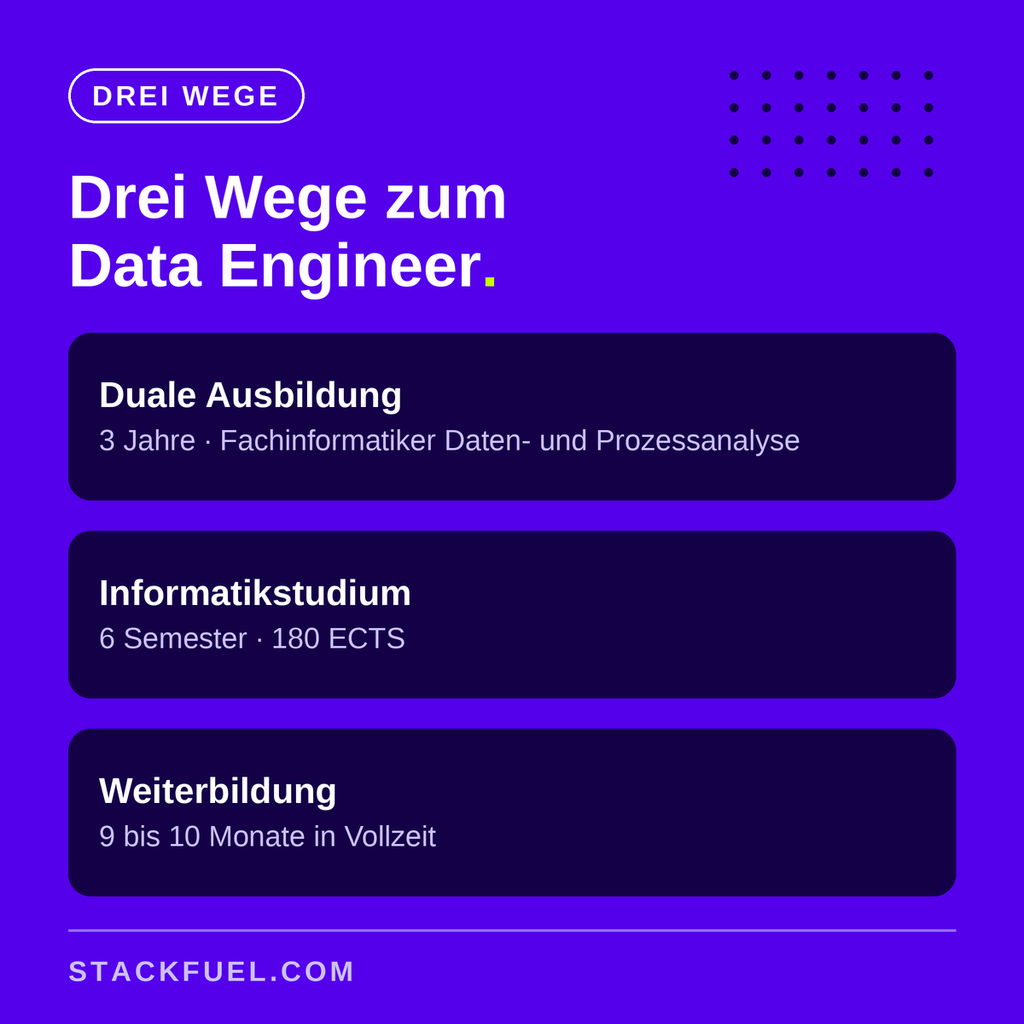
There is no specific training program for data engineers. The closest option is the three-year dual training program to become an IT specialist for data and process analysis. Other paths include a degree in computer science or, with professional experience, continuing education. Which option is right for you depends on your age, prior knowledge, and goals.
Why isn't there a training program for data engineers?
Recognized apprenticeship occupations are established when the business community, labor unions, and the federal government agree on a training regulation. The Federal Institute for Vocational Education and Training (BIBB) oversees this process. Based on our review of the BIBB’s occupation search, there is no recognized apprenticeship occupation called “Data Engineer.” The position itself, however, has existed for quite some time. Companies post job openings for it, and it is usually filled by people who have studied computer science or come from a related field.
In practice, this means: Build pipelines that reliably deliver data from the source to the analysis stage. This requires knowledge of SQL, Python, cloud platforms, and an understanding of data models. Some of this is taught in IT training programs, while other aspects are learned on the job.
What type of education is most relevant for a data engineer?
The best fit is the training program to become an IT specialist, specializing in data and process analysis. The BIBB has aligned this program with the modernized IT occupations to Introduced on August 1, 2020. According to the BIBB’s description, professionals in this field ensure the availability, quality, and quantity of data and develop IT solutions for digital production and business processes. This sounds similar to the work of a data engineer, but it is not the same thing.
The training program lasts three years and follows a dual-track system: You work at a company and attend vocational school. The final exam is spread out over time and takes place in two separate parts. Upon completion, you will receive a state-recognized vocational degree.
There are two points you should consider objectively. First, the apprenticeship provides a broader education than a data engineering job requires: IT security, data protection, and process analysis are all part of it. Spark, cloud data platforms, and orchestration depend heavily on what your training company uses. Second, a position as a data engineer isn’t automatically your first job after completing the training program. Many start as data analysts, in IT administration, or in software development and work their way up through continuing education. This is our assessment, not a statistic.
Who is this for? For high school graduates and anyone who has decided to pursue an initial vocational training program again. If you already have a vocational degree and are simply looking to change fields, you should check out the next sections. According to [source], a follow-up training program is Stuttgart Region Chamber of Industry and Commerce Under the same conditions as an initial apprenticeship, which means you'll receive an apprenticeship stipend instead of a salary.
Is going to college the better option?
Many data engineers have studied computer science, business informatics, mathematics, or a related field. This isn’t a requirement, but it’s the most common path to landing these jobs. A college degree provides a theoretical foundation in algorithms, databases, and software engineering—knowledge that’s difficult to acquire later on.
Anyone who wants to study while working can pursue a bachelor's degree in computer science through distance learning. The Hagen Distance Learning University It specifies a standard duration of six semesters for the B.Sc. in Computer Science as a full-time program, with 180 ECTS credits; the part-time program takes correspondingly longer. It estimates the total cost at around 2,100 euros. Private universities such as IU offer Distance learning programs with flexible schedules, but significantly higher tuition fees.
The cost of a degree program is time. Six semesters of full-time study amount to three years; part-time study takes significantly longer. The curriculum is broad and only partially focused on data engineering. As a rule of thumb: A degree program is worth it if you want an academic degree anyway, and less so if your sole goal is to change jobs. If you already have a bachelor’s degree in another field, you usually don’t need a second degree—instead, you need targeted programming practice and data tools. That’s where continuing education comes in.
How do you get started if you're already working?
For adults with work experience, there are two paths that are shorter than an initial vocational training program. The first is a retraining program that leads to a recognized certification, such as that of an IT specialist. It usually lasts two years and may be eligible for funding from the Employment Agency. The second is a continuing education program specifically tailored to the job profile but does not lead to a professional certification from a professional association.
Our Data Engineering Training is one such track. It is classified as advanced and requires professional experience with advanced Python or analyzing large datasets. Over the course of eight modules, you’ll learn to work with Azure, Snowflake, Synapse, and Spark in Databricks, and you’ll complete three mini-projects and one capstone project. The program lasts 9 to 10 months full-time or 18 to 19 months part-time.
If you apply later on, you’ll usually be asked about projects, not course syllabi. A completed pipeline with a description on GitHub often makes a stronger impression than a transcript—that’s our observation, not a formal measurement. The difference from a traditional apprenticeship lies in the qualification: You receive a certificate, not a professional license. In return, you’ll get hands-on experience much faster—the kind employers describe in data engineering roles. If you still lack programming skills, start with SQL and Python as the First Milestone.
How is AI changing these approaches?
Whether it's vocational training, college, or continuing education: Every educational path today must also teach students how to work with AI. AI assistants often write the first draft of SQL queries and pipelines, and through the Model Context Protocol, an open standard, they access databases directly. There is still a need for people to verify such results and ensure the reliability of the underlying data. According to a a representative Bitkom survey conducted in September 2026 Companies that use AI cite data processing (50 percent) and integration into existing systems (41 percent) as major cost drivers, while software licenses account for only 21 percent.
So, for each program, check whether data modeling, testing, and working with AI tools are part of the curriculum. Training regulations change more slowly than tools, and in dual training programs, a lot depends on the company. That’s our assessment. One thing is certain: AI is transforming the profession rather than making it obsolete.
Is there financial assistance available for this?
The Employment Agency may issue an education voucher for continuing education and retraining. According to Federal Employment Agency, that continuing education is necessary to end or prevent unemployment, and that the provider and program are approved. The agency will determine whether this applies to you during a counseling session.
You are currently viewing a placeholder content from YouTube. To access the actual content, click the button below. Please note that doing so will share data with third-party providers.
This doesn't apply to dual training programs: In those programs, you receive a training stipend from the company. In data engineering, there are Subsidized courses ranging from four weeks to ten months, which differ primarily in their prerequisites.
Which path is right for you?
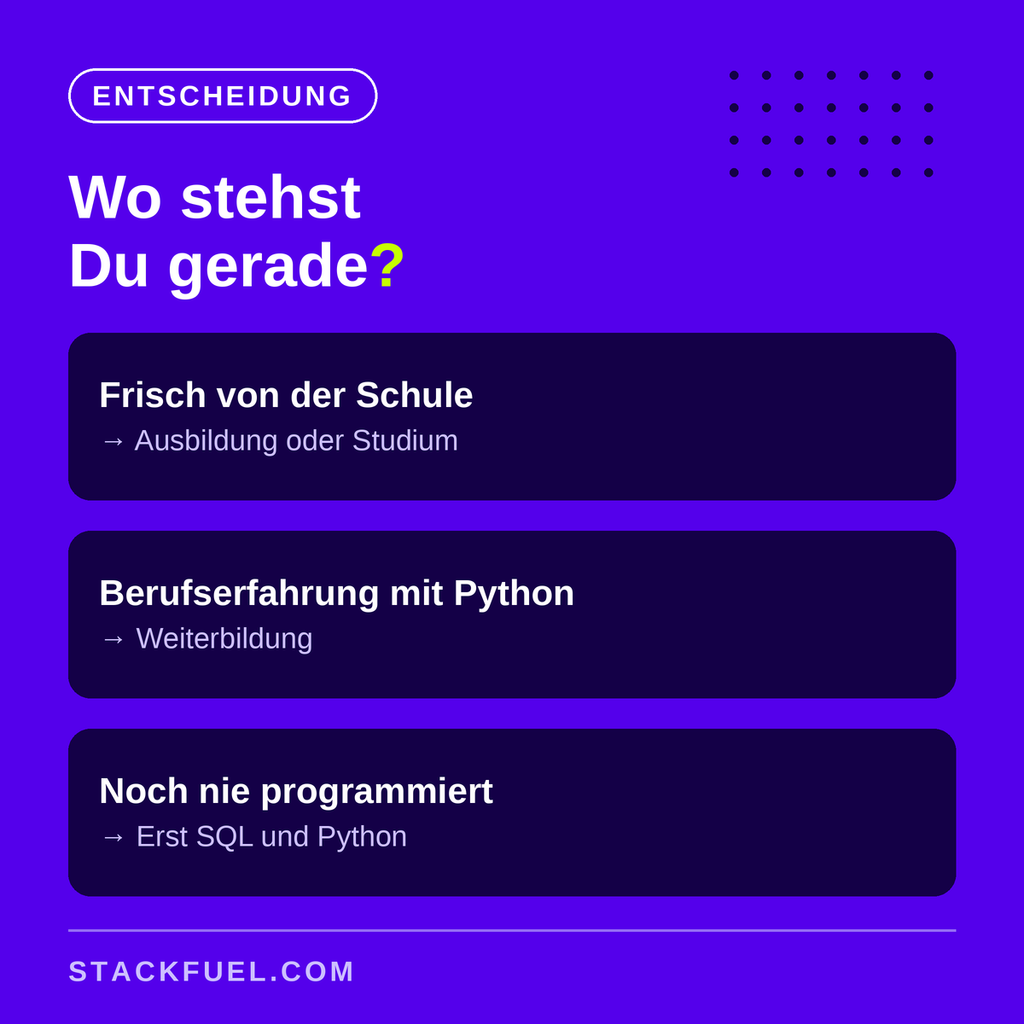
The decision depends less on the profession than on your situation. Ask yourself how much time you have, whether you already have work experience, and whether you need a recognized degree or, above all, the tools of the trade:
- You've just come home from school: The traditional paths are the dual training program to become an IT specialist in data and process analysis or a degree in computer science.
- You're already in an apprenticeship or working: Continuing education or a part-time degree program saves years compared to an initial degree program.
- You've never programmed before: Start with SQL and Python—either on your own or through a training program to become a data analyst—and later transition into data engineering.
When making this choice, it also helps to keep the goal in mind: According to our data, data engineers in Germany earn Analysis of Salary Portals an average of about 68,500 euros gross per year. Anyone who prefers building models to working on data links should know how to Distinguishing Between Data Engineers and Data Scientists in Terms of Tools and Getting Started.
Conclusion
There is no formal training program for data engineers, but there is a path to entering the profession:
- Next on the list is the three-year dual training program to become an IT specialist for data and process analysis.
- A degree in computer science is the most common academic path and is also available through distance learning.
- With professional experience, continuing education is the fastest way to acquire the skills needed for the job.
- Continuing education and retraining may be funded through an education voucher if the agency confirms that the requirements are met.
- Today, every course should also teach students how to evaluate AI results and use AI tools.
Not sure which path is right for your situation? StackFuel has been AZAV-certified since 2020, Over 8,000 graduates have completed continuing education programs in data and AI with us, with a completion rate of 93 percent. Together, we’ll assess your prior knowledge, your goals, and your eligibility for financial aid. Simply schedule your free consultation.
Frequently Asked Questions About Data Engineer Training
Is there a training program for data engineers?
No, according to our interpretation of the BIBB career search, there is no officially recognized apprenticeship program with that name. The closest option is the three-year apprenticeship program to become an IT specialist for data and process analysis. In addition, college programs and continuing education can lead to a career in this field.
How long does the training program for an IT specialist in data and process analysis take?
Three years. The training program is a dual program that alternates between on-the-job training and vocational school and concludes with a two-part final exam.
Can I become a data engineer without going to college?
Yes. Many data engineers have a college degree, but it's not required. With vocational training or professional experience in IT, a solid grasp of Python and SQL, and the right continuing education, it's possible to get started.
Is continuing education just as good as vocational training?
It’s a little different. An apprenticeship leads to a professional certification from a professional association, while continuing education leads to a certificate from the provider. For adults with work experience, continuing education is significantly shorter and more practice-oriented; however, it does not replace the state-issued professional certification.
Is a career path toward becoming a data engineer supported?
The Employment Agency may provide financial support for continuing education and retraining through an education voucher, provided the requirements are met. Dual training is paid for by the employer.