
 ChatGPT
 Perplexity
 Claude
 Grok

Monday morning, shortly after eight: A pipeline is lit up in red on the monitoring screen. Until it turns green again, no analyst will get fresh numbers, no dashboard will be accurate, and no data scientist will be able to train her model. This is exactly where the answer to the question of what a data engineer does begins: they build and maintain the pipelines through which data flows within the company. Here, you’ll learn about the six key responsibilities of the role, how AI is changing it, and how to tell if the job is right for you.
A data engineer builds and maintains data pipelines that collect raw data from many sources, clean it, and prepare it so that data analysts, data scientists, and business units can work with it. In day-to-day work, this means developing pipelines, modeling data, troubleshooting outages, and keeping an eye on costs and system performance.
What does a data engineer do all day?
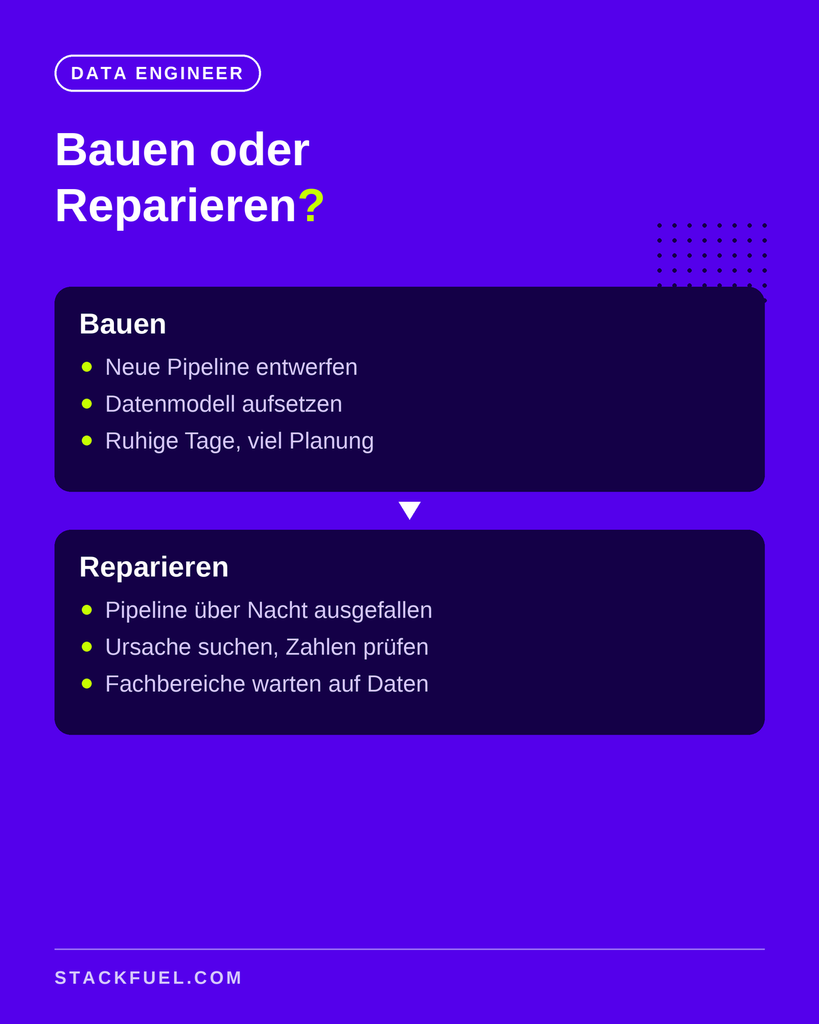
The pipeline usually sets the tone for the day. Data engineer Baraa Khatib-Salkini, who shares his 17 years of professional experience on his channel “Data with Baraa,” distinguishes between two modes. In Build mode, you’re designing something new: a pipeline, a data model, or another layer in the lakehouse. In Fix mode, something is broken, or someone has changed something in the data source without letting anyone know. He estimates that building accounts for only about one-fifth of the work; the rest is data quality, errors, and slow pipelines.
A typical "Fix" case: A Data Analyst reports that the numbers in the dashboard are incorrect. Someone new on the job will then check queries and reports from top to bottom, which takes days. Experienced engineers first check with the source: Was the schema changed yesterday, or was a new release deployed? According to him, unreported changes to the data source are the most common cause of incorrect data.
On top of that, there’s a peculiarity described by Jash Radia, who worked as a data engineer at Google: Good work goes unnoticed until something goes wrong. That’s why some teams have an on-call schedule where you might have to fix a broken pipeline even in the middle of the night.
What are the 6 responsibilities of a data engineer?
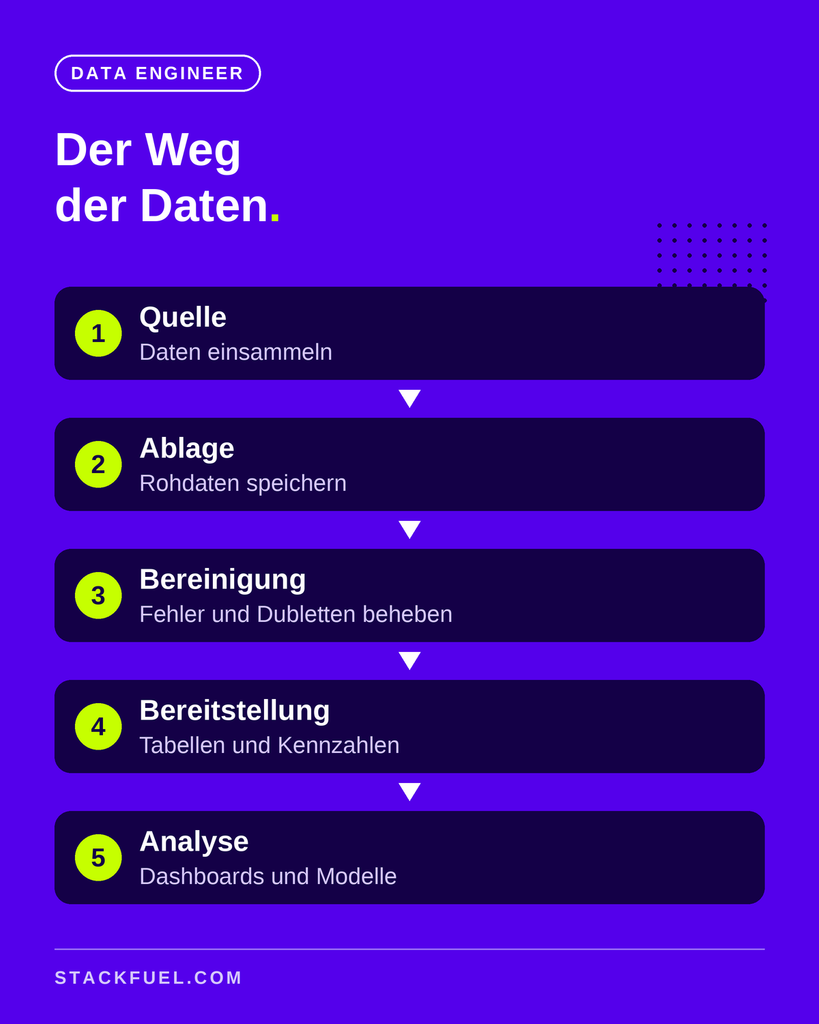
1. Collect data from the sources
Data is scattered across various locations: in the CRM, in the ERP system, in databases, behind interfaces, and in Excel files. A data engineer brings it all into a central system. This happens either in scheduled batches—such as hourly or daily—or as a data stream, where each event arrives immediately. Streaming is worthwhile when minutes count—such as in fraud detection—but it is more complex and expensive to operate.
2. Clean and model data
Raw data is rarely clean. Dates may be listed as day-month or month-day, and duplicates and empty fields are common. The data engineer standardizes the data and organizes it into a format that’s easy to analyze. A common approach is a star schema with a fact table and dimensions such as customers or products. Many teams work in stages: raw, cleaned, and ready for analysis.
3. Provide data
Ultimately, analysts and Data Scientists can find and use the data. Here's an example of what that might look like:, shows Zalando, which serves over 50 million active customers: The company defines metrics as code in YAML files stored in a central repository. Before they are released, automatic checks are run, and a second person reviews them. Afterward, dashboards, SQL queries, and an AI assistant all access the same definition. This ensures that two departments don’t calculate the same revenue differently.
4. Monitor and Repair Pipelines
Pipelines run automatically, but they aren't always error-free. The data engineer sets up alerts, checks the status in the morning, and resolves outages before the business units notice them. This also includes continuously testing data for quality so that errors are detected early—rather than only when they appear in management reports.
5. Keep an eye on speed and costs
Most data platforms run in the cloud today, where billing is based on usage. A query that reloads the entire table every night—even though only a few rows have changed—therefore costs money every night. Data engineers therefore optimize execution times, select appropriate storage and computing power, and ensure that systems scale without the bill getting out of hand.
6. Clarify requirements with the academic departments
Before any code is written, there’s a discussion. If the data scientist wants two years’ worth of click data for a recommendation model, the data engineer asks about the sources, the volume of data, the desired level of recency, and how the data should be made available later on. The result is often a brief design document, so that everyone involved is on the same page before development begins.
How is AI changing the work of a data engineer?
Connecting a database to an AI assistant is no longer a job for specialists. Through the Model Context Protocol, an open standard, Claude, ChatGPT, and other assistants access databases, files, and tools directly. If you have a question about revenue, you ask it in the chat, and the assistant writes the query itself. At first glance, it looks as though anyone can now build data pipelines.
That's only half true, because the assistant is only as reliable as the data it sees. According to a a representative Bitkom survey conducted in September 2026 57 percent of companies in Germany use AI. Users cite data preparation (50 percent) and integration into existing systems (41 percent) as the main cost drivers, while only 21 percent cite software licenses. Both of these are core responsibilities of data engineers.
The AI often provides the initial draft for a query or transformation; the data engineer reviews, tests, and decides what goes into production. A new consideration is what an assistant is actually allowed to access and which definition it uses. The MCP Server from dbt For example, AI assistants provide controlled access to data models, metrics, and data sources. At Zalando, the dashboard and AI assistant access the same verified metric for precisely this reason.
No reliable study has yet measured how much time is spent on testing versus how much on development. Nevertheless, the trend is clear: less manual coding, more responsibility for quality, access rights, and the importance of data. That is why Is AI shifting the role of the data engineer rather than replacing it?.
How does a data engineer differ from a data analyst and a data scientist?
All three work with the same data, but at different points in the chain.
| Role | Key Question | Result |
|---|---|---|
| Data Engineer | How does reliable data get to the right place? | Pipelines, data models, and pre-built tables |
| Data Analyst | What happened, and what does this mean for the business? | Reports, Dashboards, Recommendations |
| Data Scientist | What is likely to happen? | Models and Forecasts |
The data engineer is at the beginning of the chain and rarely works in the spotlight: He builds the infrastructure that data scientists use to create value. The main difference between an analyst and a scientist is their perspective, looking back at what has happened or looking ahead to forecasts. The differences between engineers and scientists tend to lie in the tools they use, their career paths, and their pay, and when compared across Europe Data engineers earn noticeably more than data scientists.
What tools does a data engineer use?
SQL and Python form the foundation for everyone. Other tools build on this foundation, and these vary from company to company.
| Task | Typical Tools |
|---|---|
| Retrieving and Transforming Data | SQL, dbt |
| Programming and Automation | Python, Git |
| Processing Large Amounts of Data | Apache Spark |
| Planning and Managing Processes | Apache Airflow |
| Processing Data Streams | Apache Kafka |
| Storing and Analyzing Data | Snowflake, Databricks, Google BigQuery, Azure |
You don't have to know everything. What's more important is understanding the concepts behind it: If you can build a pipeline from individual components, you'll quickly find your way around a finished platform. In addition, there are increasingly more AI Assistants in the Editor and on the Data Platform, who suggest code, explain it, and narrow down errors.
Is data engineering difficult, and what skills do you need?
Technically, you’ll need SQL, Python, Git, and a basic understanding of a cloud platform. These skills can be learned, but they require practice—just watching isn’t enough. Jash Radia considers the technical side to be the easier part. What really sets data engineers apart, he says, are soft skills: managing stakeholder expectations, translating vague requests into clear technical requirements, and being able to shift priorities.
How do you become a data engineer?
There is no single, predetermined path. A degree in computer science, applied mathematics, physics, or engineering is helpful, but just one of several ways: Online courses and project-based learning also lead to careers in this field. Many people enter the field through a career change, for example from data analysis or software development. Which which of the three typical career paths is right for you, depends mainly on whether you already know how to program.
If you're already programming or analyzing large datasets, our Data Engineering Training. It is classified as an advanced program and consists of eight modules that take 9 to 10 months to complete on a full-time basis and 18 to 19 months on a part-time basis. You’ll work in Azure, build data warehouse and lakehouse solutions, and complete three mini-projects as well as an end-to-end capstone project. In addition, there is subsidized courses offered by other providers, ranging from four-week intensive courses to continuing education programs lasting several months. If you are registered as unemployed or a job seeker, the Employment Agency or Job Center may cover the costs with an education voucher.
Conclusion
A data engineer ensures that data reliably reaches the people who work with it. Here’s the most important information at a glance:
- The job consists of six tasks: collecting, cleaning and modeling, preparing, monitoring, optimizing, and coordinating with business units.
- The workday alternates between construction and repairs. If you stay calm when problems arise and appreciate behind-the-scenes work, this is the right place for you.
- AI is increasingly writing the first draft. The data engineer remains responsible for ensuring data reliability, access rights, and testing.
- SQL and Python are the common foundation, and a clean project is more important than a long list of tools.
Are you wondering if a career as a data engineer is right for you? StackFuel has been AZAV-certified since 2020, Over 8,000 graduates have completed our continuing education programs in data and AI, with a completion rate of 93 percent. Together, we’ll assess your prior knowledge, find the right entry point for you, and discuss funding options. Simply schedule your free consultation.
Frequently Asked Questions About the Data Engineer Role
What does a data engineer do?
A data engineer builds and maintains data pipelines that collect and clean data from various sources and prepare it for analysis, reporting, and AI. This also includes monitoring, troubleshooting, and managing system performance and costs.
How much does a data engineer earn?
According to our analysis of salary websites, the average gross annual salary in Germany is around 68,500 euros, with an entry-level salary of around 61,000 euros. Experience, region, and industry significantly affect these figures; they are higher in Bavaria and Munich.
What is the difference between a data engineer and a data scientist?
The data engineer ensures that reliable data is available, and the data scientist uses that data to develop models and forecasts. The data analyst analyzes the data and explains what it means for the business.
Is data engineering hard to learn?
The technical skills can be learned: SQL, Python, Git, and a cloud platform are the core. Collaboration with business units and responsibility for live systems often carry more weight. Working on your own project helps you realistically assess both.
Will AI Replace the Data Engineer?
No. AI assistants are increasingly writing the first drafts of queries and pipelines and accessing data sources directly through interfaces. To do this, they need reliable data, clear access rights, and testing. This is precisely the responsibility of the data engineer, whose work is shifting from writing to testing and monitoring.
Can I become a data engineer without any prior experience?
A college degree isn't required, but programming skills are. Many start out as data analysts or with Python and then transition into data engineering. Our data engineering training program requires professional experience with advanced Python or with analyzing large datasets.