
 ChatGPT
 Perplexity
 Claude
 Grok

An AI agent builds a pipeline in just a few minutes; it runs without errors on the first try, and on the second run that same day, the numbers appear twice in the target table. That’s how data engineer Volker Janz, who works at Airflow provider Astronomer, describes it in a Commentary in *Computerwoche*. The agent had done exactly what he was asked to do—just not what nobody had thought of. This little mishap illustrates where the profession is headed, and it answers the question of whether AI will replace data engineers.
No, AI will not replace the data engineer. It is taking on an increasing share of the code-writing, but the responsibility for data quality, the meaning of the data, and the verification of results remains with humans. The role is shifting from simply building pipelines to focusing on specification, context, and oversight.
How exactly is AI changing the work of data engineers?
You can see this change in the work itself. Coding agents read a repository, write files, execute commands, and run tests. Through the Model Context Protocol, an open standard, assistants like Claude or ChatGPT can be connected directly to databases, files, and tools. This means that a first draft of an SQL script, a transformation model, or a test case can often be created in minutes rather than hours.
A survey shows just how far AI has already penetrated German companies: A representative Bitkom survey conducted in September 2026: 57 percent use AI, 11 percent already use AI agents, and another 29 percent plan to do so. Among data professionals, the rate of use is even higher. In a survey conducted by author Joe Reis among 1,101 people in the data field, 82 percent use AI daily or more often. However, the responses come from his newsletter community and are therefore not representative.
You are currently viewing a placeholder content from YouTube. To access the actual content, click the button below. Please note that doing so will share data with third-party providers.
Data analysts are also feeling this shift; for them, Above all, AI is changing the way data is analyzed and reported. For engineers, it's all about pipelines that need to run reliably at night.
What remains with humans: specification, context, and verification?
The pipeline in the example wasn't wrong because the model was flawed. It was wrong because the instruction was „implement a daily aggregation,“ not „make sure that running the same process again on the same day doesn't produce duplicates.“ An agent fills such gaps with the most obvious solution. This results in three tasks that, according to Janz, are becoming increasingly important.
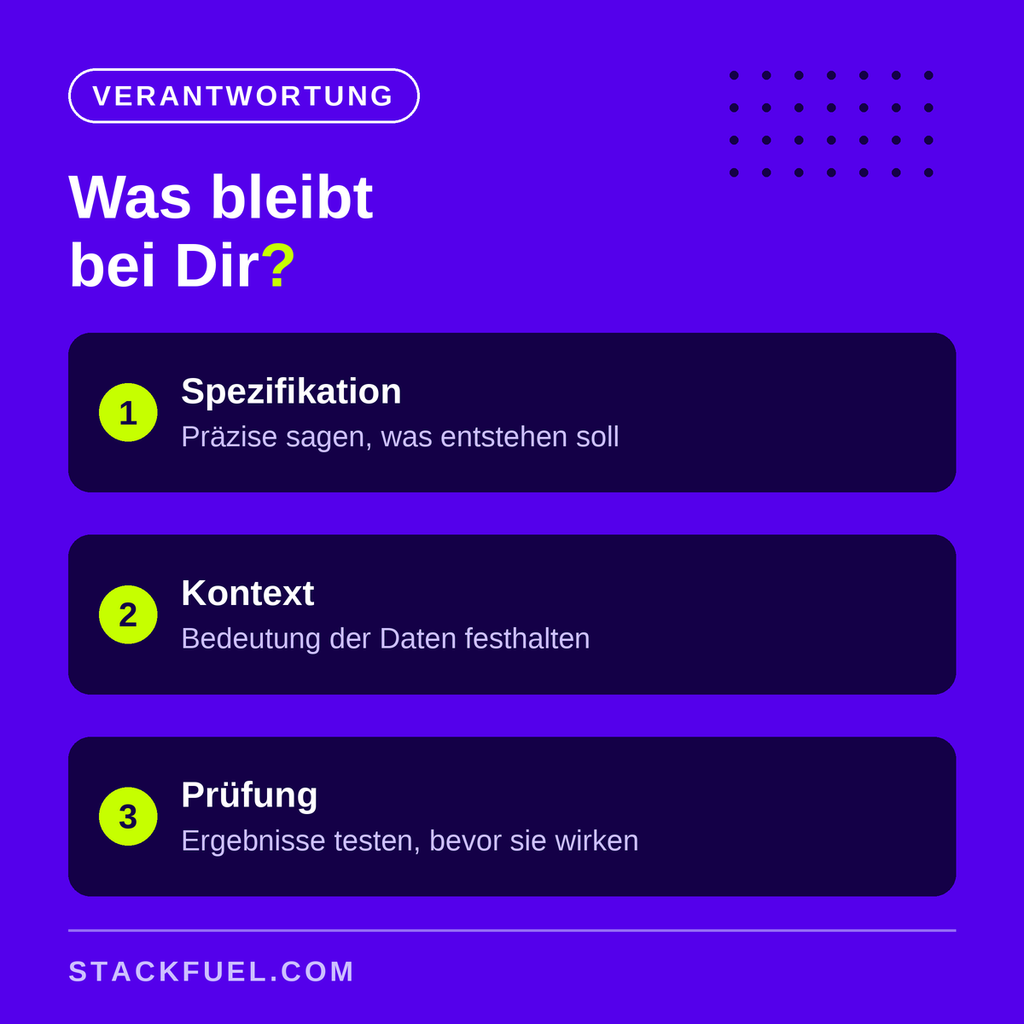
The Specification. If you specify source tables, primary keys, how the query behaves on a subsequent run, and how to handle missing values, you’ll get a robust result. If you write „aggregate revenue by product,“ you’ll get a prototype. This is the classic craft of a data engineer—except that the recipient is now an agent.
The context. An agent knows only what is in its context: conventions, schemas, and naming rules. Janz sees the most valuable context in the meaning of the data. What exactly is an „active user,“ and how are the entities related? Data modeling thus becomes a matter of making sense of meaning. At the same time, context must be curated, not exhaustive. Instructions that are too long are easily overlooked by the model.
The exam. Agents are faster than a human can read their results, and they provide an answer even when they aren’t certain of it. That’s why evaluation is necessary: regression tests that show whether a rewritten SQL script produces the same data results as before. As a cautionary example, Janz cites Air Canada’s chatbot, which provided incorrect information in 2024 and cost the airline damages because the bot accessed outdated and contradictory sources.
This is a practitioner’s commentary, not a study. However, the Bitkom figures support this trend: AI users cite data processing (50 percent) and integration into existing systems (41 percent) as major cost drivers, while software licenses account for only 21 percent. Janz’s classification is therefore a useful conceptual model: Anyone who can detect errors in data before they end up in a dashboard or model remains indispensable. Tools such as Apache Airflow for orchestration and dbt Transformations remain the tools of the trade for this purpose, even if an agent provides the initial draft.
What do the numbers say about the future of this role?
It’s worth distinguishing between sources here. The Joe Reis survey asks about expectations: 42 percent of respondents expect their data teams to grow, while 7 percent expect them to shrink. This reflects the sentiment within a self-selected group and is not a forecast. As a snapshot of the The Future of Data Engineering It's still worth it: Respondents expect more work rather than less.
The salary situation is more challenging. The analysis of TalentUp from October 2026 compares roles with the salaries of software developers. On average across seven countries, data engineers earn 9.8 percent more, while data scientists earn 5.8 percent less. As a country-wide average, this figure does not apply to Germany. For Germany, the same analysis reports that AI engineers earn 78,600 euros, compared to 59,300 euros for software developers—a 32.5 percent increase. This is a distinct role, not simply a rebranding of the data engineer position. In Germany, the According to our analysis, the average salary for data engineers is around 68,500 euros.
What the numbers don't reveal is how many entry-level positions will be available in two or three years. Anyone who claims to have an accurate forecast on this simply doesn't know.
What should you be learning right now as an aspiring data engineer?
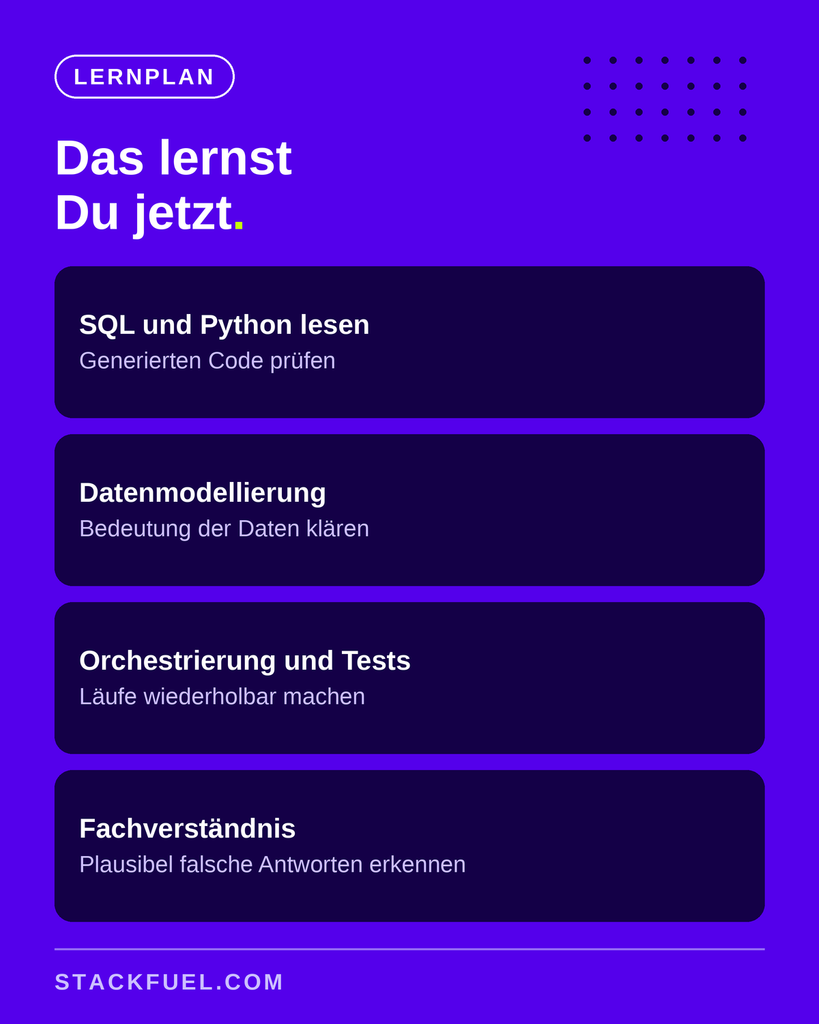
The fundamentals remain the same. Anyone who wants to review an AI-generated pipeline must be able to read SQL and Python and understand what the results mean. On top of that, there are a few skills that were previously considered a bonus:
| Ability | Why It's Becoming More Important |
|---|---|
| Reading and Verifying SQL and Python | You need to recognize when generated code is doing the wrong thing |
| Data modeling | The meaning of the data lies in the context, which an agent cannot determine on its own |
| Orchestration and Testing | Make runs repeatable; automatically verify results |
| Write Specifications | Precise requirements are the new interface to the agent |
| Technical Understanding | Only someone who knows the business can spot a plausibly incorrect answer |
The order is the same as before: first the basics, then the platform. It’s helpful to a milestone for each of the six learning steps. In everyday life, Coding agents in the repository and assistants in Databricks or Snowflake in addition, the results of which you must be able to verify.
What does this mean for you as you get started?
The entry barrier isn’t getting lower—it’s shifting upward. Simply typing out syntax makes an AI faster, but understanding data flows, quality, and operations does not. Anyone new to the field should therefore build their own project early on—one that runs from the source to the evaluation—and validate it with tests. In everyday life The job involves both building pipelines and repairing outages, and Depending on your prior experience, there are three ways to get started.
The Data Engineering Training The StackFuel program is classified as advanced and requires professional experience with advanced Python or analyzing large datasets. It lasts 9 to 10 months full-time or 18 to 19 months part-time. Over the course of eight modules, you’ll learn how to reliably collect and process data and prepare it for analytics, BI, and AI using Azure, Snowflake, Synapse, and Spark in Databricks, and you’ll build your own cloud project. If you lack programming experience, starting with Python or the Data Analyst track is often the better first step.
Regarding financial assistance: If you are registered as unemployed or a job seeker, the Employment Agency or Job Center may cover the costs with an education voucher. Before doing so, the agency will determine during a counseling session whether You meet the requirements and whether the course and the provider are accredited.
Conclusion
AI is changing the role of the data engineer, but it isn't replacing it. Here's the bottom line:
- What's changing: Agents write drafts of code, tests, and transformations in minutes.
- What remains: Specification, context, and verification continue to be the responsibility of humans, and they are becoming more important.
- The facts are as follows: 57 percent of companies in Germany use AI and invest primarily in data and integration, and data engineers in Germany earn the highest salaries compared to other countries. There is no forecast for the number of jobs.
- What you can do: Learn the basics thoroughly, expand your knowledge of data modeling and testing, and build your own project.
Want to know which entry-level position is right for your situation? StackFuel has been AZAV-certified since 2020, Over 8,000 graduates have completed continuing education programs in data and AI with us, with a completion rate of 93 percent. Together, we’ll review your prior experience, find the right continuing education program for you, and discuss funding options. Simply schedule your free consultation.
Frequently Asked Questions About Data Engineers and AI
Will AI Replace the Data Engineer?
No. AI takes over parts of the coding process, but humans remain responsible for defining specifications, providing context, and verifying the data. The role is shifting toward responsibility for data quality and the meaning of the data.
Can AI write data pipelines?
Yes, as a draft. An agent can build a pipeline in minutes. Whether it responds correctly when run again, when values are missing, or when sources have changed must be specified and verified by a human.
Is data engineering still worth it?
The numbers don't contradict this: According to TalentUp's country-by-country comparison, data engineers earn 9.8 percent more than software developers. That's no guarantee of a job in two to three years, but it is an indication that the role is in demand.
Do I need to know how to use AI tools to become a data engineer?
A solid foundation in SQL, Python, and data modeling will take you further than any single tool. You should be familiar with AI tools and know how to use them critically, but they are no substitute for understanding what they produce.
What is the difference between a data engineer and an AI engineer?
Data engineers provide reliable data, while AI engineers build applications using AI models. According to the TalentUp analysis, AI engineers in Germany earn 78,600 euros, while software developers earn 59,300 euros.
What's it like to be a data analyst?
There, too, AI is changing the nature of the work without replacing the job. For him, the focus is shifting primarily to analysis and reporting; for the data engineer, it’s the building and testing of pipelines.