

-
Data Quality in Practice - Focus Excel

-
AI specialist Variant
-
Microsoft Copilot - Deepening Variant
-
Business analysis and process modeling
-
Change management and digital transformation Variant
-
Strategic AI management Variant
-
AI - Workflow & Automation
-
SQL & Relational Databases
-
Analytics & Reporting - Focus Power BI
-
Data Analytics
-
Data Science
-
Object-Oriented Programming
-
Portfolio project
-
Data Quality in Practice - Focus Excel
-
AI specialist or Microsoft Copilot - Deepening
-
Business analysis and process modeling
-
Change management and digital transformation or Strategic AI management
-
AI - Workflow & Automation
-
SQL & Relational Databases
-
Analytics & Reporting - Focus Power BI
-
Data Analytics
-
Data Science
-
Object-Oriented Programming
-
Portfolio project

Training


 Data quality
 Excel
 PowerQuery
- What? You'll create data in structured tables, analyze it using functions such as VLOOKUP, pivot tables, and charts, learn about the dimensions of data quality, and clean up data using the PowerQuery Editor.
- What for? So that analyses and decisions are based on clean, verified data, and so that you can assess where Excel reaches its limits.
- Practice: In the final project, you will clean, verify, and analyze an unprocessed corporate dataset.
 2 weeks (full-time)
 German
1 of 2 · Depending on your version
Your version
 Generative AI & Large Language Models
 Prompting & automation
 Use cases in the corporate context
Learn how to use AI models such as ChatGPT and co. safely, efficiently and purposefully in your day-to-day work...
1 month (full-time)
German
Training
Generative AI & Large Language Models
Prompting & automation
Use cases in the corporate context
- Understanding the basics of artificial intelligence, machine learning and generative models
- Know how Large Language Models (LLMs) work and their limitations
- Learn effective prompting to achieve precise and repeatable results
- Use AI for research, text generation, summaries and ideation
- Design workflows with AI support to automate recurring tasks
- Assessing the risks, bias and data protection aspects of AI use
- Apply best practices for the introduction of AI in the team and in the company
1 month (full-time)
German
Your version
 Microsoft Copilot
 Prompting
 M365 Workflows
You use Microsoft Copilot strategically in Word, Outlook, PowerPoint, Teams, and Excel, and achieve reliable results with clear prompts....
1 week (full-time)
German
Training
Microsoft Copilot
Prompting
M365 Workflows
- What? You classify the Copilot variants in Microsoft 365, clarify data access and privacy, formulate prompts according to a fixed four-element structure, and systematically check AI outputs for errors and hallucinations.
- What for? So you can work on texts, emails, presentations, meetings, and Excel reports faster and more reliably.
- Practice: In the final project, you'll implement your own Copilot project across multiple apps and build your own personal prompt library.
1 week (full-time)
German
Training
 Process modeling
 Requirements Engineering
 Stakeholder Management
- What? You analyze business contexts using methods such as SWOT and PESTLE, model processes using flowcharts, swimlanes, UML, and BPMN, gather and prioritize requirements, conduct gap analyses, and assess the business impact.
- What for? So that you can prepare for change initiatives in a structured way, involve stakeholders in a targeted manner, and enable decisions to be made on a solid foundation.
- Practice: For your final project, you will develop your own project proposal and present it to stakeholders.
3 weeks (full-time)
German
1 of 2 · Depending on your version
Your version
 Change Frameworks
 Resistance & Stakeholders
 Change KPIs
You analyze digital changes, manage them using appropriate change frameworks, and embed them sustainably within the organization through data and communication....
2 weeks (full-time)
German
Training
Change Frameworks
Resistance & Stakeholders
Change KPIs
- What? You classify drivers of change and maturity levels, apply frameworks such as Lewin, Kotter, ADKAR, and Cynefin, define KPIs for acceptance and impact, and manage culture, resistance, and communication.
- What for? So that you can manage change in organizations in a planned and controlled manner, make success measurable, and actively involve those affected.
- Practice: You'll work with scenario-based exercises and, in your final project, integrate stakeholder analysis, frameworks, a set of KPIs, and a communication roadmap into a comprehensive change project.
2 weeks (full-time)
German
Your version
 AI Strategy
 AI Use Cases
 AI Governance
You'll learn how to strategically plan, thoroughly evaluate, and responsibly implement AI initiatives....
4 weeks (full-time)
German
Training
AI Strategy
AI Use Cases
AI Governance
- What? You will identify and evaluate AI use cases, assess data quality and governance, take the GDPR and the EU AI Act into account, and learn how to implement AI strategies using change management, KPIs, and ROI analysis.
- What for? So you can make informed preparations for AI decisions, keep an eye on risks, and make the business value of AI measurable.
- Practice: In the final project, you will develop your own AI roadmap, including a business case and governance framework, and present it to the entire class.
4 weeks (full-time)
German
Training
n8n
 AI Agents
 AI - Workflow & Automation
- What? You'll learn n8n from the basics all the way to robust workflows, integrate APIs and data pipelines, use LLM nodes with advanced prompt engineering, and build AI agents with memory, knowledge integration (RAG), and tools.
- What for? So you can automate recurring tasks without programming and operate AI solutions in a reliable, privacy-compliant, and quality-assured manner.
- Practice: In this hands-on project, you will design, implement, and present your own automation solution over the course of four sprints and earn certification in AI – Workflow & Automation.
1 month (full-time)
German
Training
 SQL
 Database design
 CTEs & Window Functions
- What? You'll write queries using filters, groupings, joins, and subqueries; learn about normalization and database design; and use CTEs and analytical functions to generate metrics and rankings.
- What for? So that you can independently retrieve data from databases, aggregate it, and make it available throughout the company.
- Practice: You will work on four practical projects and, as part of your final project, independently analyze an unknown database.
4 weeks (full-time)
German
Training
 Power BI
 DAX
 Data Storytelling
- What? You'll learn about the interface and basic functions of Power BI, prepare data using the Power Query Editor, design visualizations and dashboards, and calculate metrics using DAX and statistical methods.
- What for? So you can support data-driven decision-making in your company with clear reports and interactive analyses.
- Practice: You'll reinforce what you learn in each chapter through practical projects—four in total.
4 weeks (full-time)
German
Training
 Python
 pandas
 Data visualization
- What? You'll learn the basics of Python and work with pandas and matplotlib, use SQL and APIs in Python, and apply statistical methods as well as linear and logistic regression.
- What for? So that you can analyze company data on your own and visualize the results in a way that is tailored to your target audience.
- Practice: You'll analyze New York City taxi data and, as your final exam, work on a case study involving customer churn at a telecommunications company, which you'll discuss with our coaching team.
9 weeks (full-time)
German
Training
Machine Learning
 scikit-learn
 PySpark
- What? You'll brush up on the fundamentals of Python and math for data science, apply techniques such as regression, random forests, SVM, and k-means using scikit-learn, learn about NLP and neural networks with Keras, and work with large datasets using PySpark.
- What for? So that you can derive reliable predictive models from data and evaluate their quality.
- Practice: During the final exam, you will analyze large datasets, build predictive models, and discuss your results with our coaching team.
9 weeks (full-time)
German
Training
 Object-Oriented Programming
 Python Classes
 Clean Code
- What? You work with classes, inheritance, and composition; use decorators and comprehensions; and adapt your code to industry standards such as PEP8.
- What for? So that you write code that your team can understand, maintain, and expand upon.
- Practice: In two final projects, you'll build your own interface to a data science library and program your own blockchain.
6 weeks (full-time)
German
Training
 Portfolio project
Git & GitHub
 Agile Teamwork
- What? You'll select a data analytics or data science project, set up your work environment using Git and GitHub, organize your project with Notion, work using agile methods, and carry out a complete data project from analysis to presentation.
- What for? So you can show potential employers a real sample of your work instead of just a resume.
- Practice: You'll work on the project on your own or in a small group, receiving feedback from our coaches, and present it online to participants and StackFuel employees.
3 weeks (full-time)
German
Your Program Data Scientist – Change ManagementData Scientist – Change Management with CopilotData Scientist – Strategic AI Management
Book consultation- 11 Trainings
- 11–12 months10–11 months full-time
- Part-time work is also possible



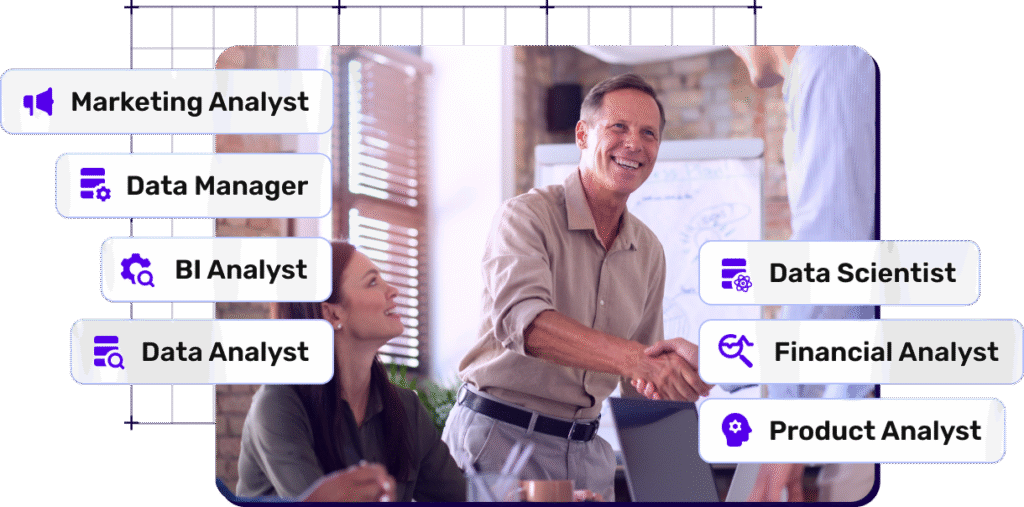


Marketing Analyst

Data Manager

BI Analyst

Data Analyst

Data Scientist

Financial Analyst

Product Analyst
The next
start dates.
start dates.
The start dates apply to all options. The program name and duration are listed under your option.
| Training program | Duration | ||
|---|---|---|---|
| 02.11.2026 |
11–12 months10–11 months
Full-time
|
Apply | |
| 02.11.2026 |
23–24 months21–22 months22–23 months
Part-time
|
Apply | |
| 16.11.2026 |
11–12 months10–11 months
Full-time
|
Apply | |
| 16.11.2026 |
23–24 months21–22 months22–23 months
Part-time
|
Apply | |
| 30.11.2026 |
11–12 months10–11 months
Full-time
|
Apply | |
| 30.11.2026 |
23–24 months21–22 months22–23 months
Part-time
|
Apply | |
| 14.12.2026 |
11–12 months10–11 months
Full-time
|
Apply | |
| 14.12.2026 |
23–24 months21–22 months22–23 months
Part-time
|
Apply | |
| 11.01.2027 |
11–12 months10–11 months
Full-time
|
Apply | |
| 11.01.2027 |
23–24 months21–22 months22–23 months
Part-time
|
Apply |
The next
start dates.
start dates.
The start dates apply to all options. The program name and duration are listed under your option.
Training
Start dates
 Data Scientist – Change ManagementData Scientist – Change Management with CopilotData Scientist – Strategic AI Management
-
02.11.2026
- Full-time - 11–12 months10–11 months
- Part-time - 23–24 months21–22 months22–23 months
-
16.11.2026
- Full-time - 11–12 months10–11 months
- Part-time - 23–24 months21–22 months22–23 months
-
30.11.2026
- Full-time - 11–12 months10–11 months
- Part-time - 23–24 months21–22 months22–23 months
-
14.12.2026
- Full-time - 11–12 months10–11 months
- Part-time - 23–24 months21–22 months22–23 months
-
11.01.2027
- Full-time - 11–12 months10–11 months
- Part-time - 23–24 months21–22 months22–23 months