
 ChatGPT
 Perplexity
 Claude
 Grok

A model is designed to predict which customers will cancel their subscriptions in the next quarter. The data for this is stored in three systems that no one has ever properly consolidated. Before the data scientist can train the first model, a data engineer must reliably prepare the data. So when you compare data engineers and data scientists, you’re comparing two links in the same chain. Five differences show where the roles diverge, who earns what, and which one is right for you.
A data engineer builds and maintains the data pipelines that provide reliable data. A data scientist uses this data to develop models and forecasts. So the engineer works on the data before it becomes a model, while the scientist works with the data that results from it. Both need SQL and Python, but they have different priorities when it comes to day-to-day work, tools, and getting started.
What is the difference between a data engineer and a data scientist in terms of their jobs?
The first three differences relate to the work itself: the goal, the day-to-day routine, and the tools.
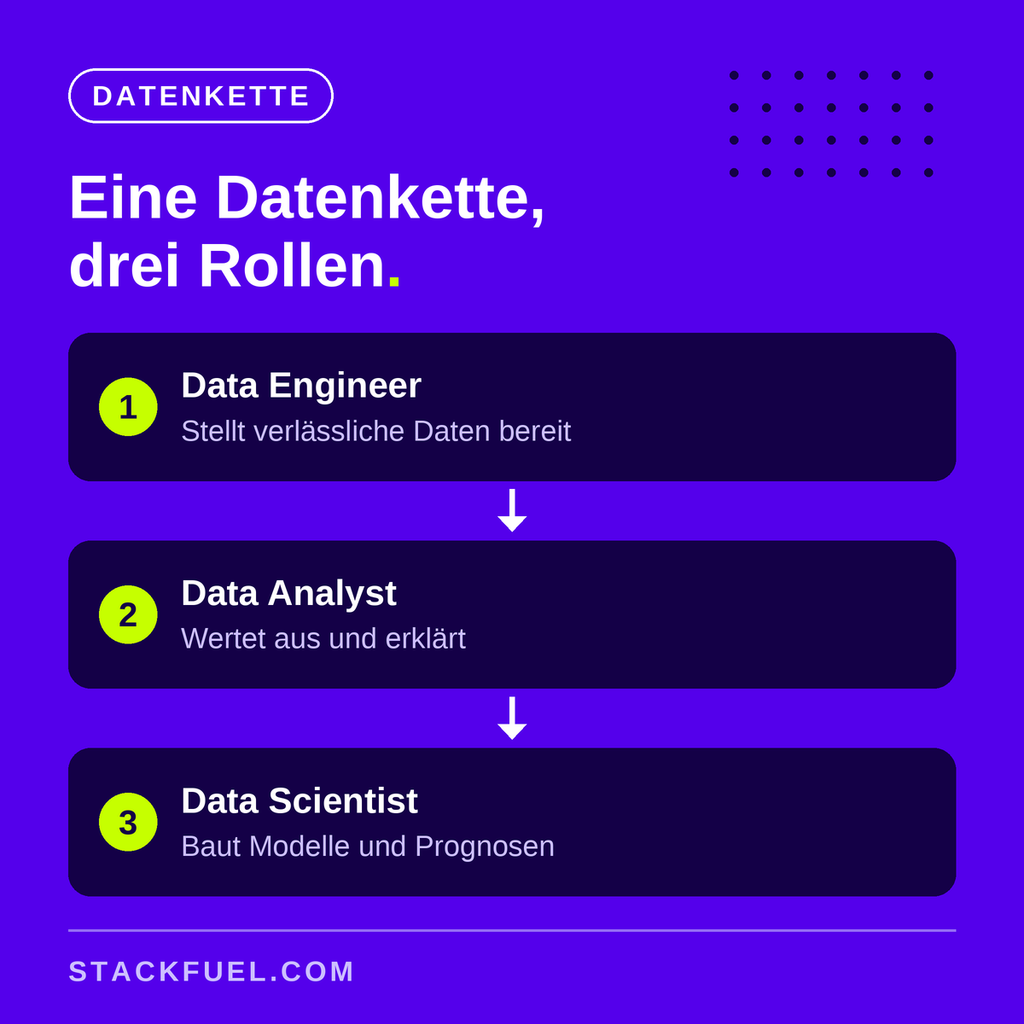
1. The Goal: Reliable Data or Actionable Insights
A data engineer is responsible for ensuring that data is complete, up-to-date, and delivered to the right place. The results of their work are pipelines, data models, and prepared tables. A data scientist aims to draw conclusions from this data: who is likely to quit, what price boosts sales, which machine will soon break down. The scientist’s output consists of models, forecasts, and an assessment of how reliable they are. If you compare the roles side by side, the engineer asks, „Is the right data coming in?“ while the scientist asks, „What does it tell us about tomorrow?“ For the engineer, this breaks down in day-to-day work into Six recurring tasks, from collecting to providing the data.
2. Everyday Life: Operation and Troubleshooting, or Experimentation and Explanation
A data engineer’s workday revolves around pipelines. In the morning, they check whether the overnight runs completed successfully, build new data pipelines, and look for errors if a data source has changed its format. In some teams, being on call is part of the job. A data scientist spends their time exploring data, building features, testing models, and explaining results in a way that enables a business unit to make decisions based on them. The pressure comes from different sources: for the engineer, it’s noticeable when something fails; for the scientist, it’s when a model doesn’t deliver in real-world use what it promised during testing. The division of labor is clear: Data Engineers build the infrastructure that data scientists use to create value.
3. The Tools: Cloud and Pipelines, or Statistics and Models
SQL and Python are both fundamental to both. After that, their toolkits diverge:
| Data Engineer | Data Scientist | |
|---|---|---|
| Core | SQL, Python, Git, Linux | SQL, Python, Statistics |
| Transferring and Storing Data | Cloud platform (e.g., Azure), data warehouse, lakehouse | tables that are usually provided ready-made |
| Process | Spark, Databricks, orchestration (e.g.,. Airflow), dbt | pandas, notebooks |
| Learning from Data | rare | scikit-learn, machine learning frameworks, model evaluation |
The line isn't clear-cut. In small companies, one person does both; in large ones, there are additional roles such as analytics engineer or ML engineer. A look at the job posting reveals more than the job title does.
How do you get into the role?
The fourth difference concerns the path to becoming a data scientist. The path to becoming a data scientist usually involves analysis and statistics: Those who can first evaluate and visualize data go on to learn how to build models. For many, this is a Career change from a field unrelated to this profession. The path to becoming a data engineer rarely involves no programming experience. Many come from software development or IT; others start as data analysts or with Python and then delve deeper into data pipelines and the cloud. Which of these Paths to a Career in Data Engineering What's right for you depends mainly on your programming experience.
A college degree isn't required for either role. What matters when you're starting out is what you can demonstrate: for scientists, analyses and models; for engineers, a pipeline that runs from the source to the evaluation.
Who earns more, a data engineer or a data scientist?
The fifth difference is the question that many people ask first. A solid answer consists of two parts.
First, let's take a look at Germany: According to our survey, the average gross annual salary for data engineers is Analysis of German Salary Portals around 68,500 euros, with an entry-level salary of around 61,000 euros. Other websites cite higher and lower figures, so it’s worth checking the source for each number. For data scientists, German sources provide very different ranges, and job titles are assigned for different tasks depending on the company. A single average figure for Germany would be less reliably supported here than it is for engineers, so we do not provide one.
Second, a comparison across several countries: The analysis of TalentUp from October 2026 compares these roles to the salaries of software developers. On average across seven countries, data engineers earn 9.8 percent more, while data scientists earn 5.8 percent less. That’s a difference of just over 15 percentage points—though this is a country-wide average and not a figure specific to Germany. The same analysis shows where the money is in the AI field: AI engineers in Germany earn 78,600 euros, compared to 59,300 euros for software developers—a 32.5 percent increase. This is a distinct role, not synonymous with that of a data scientist.
Ultimately, your salary is determined more by your experience, region, industry, and level of responsibility than by your job title. Those who combine engineering and modeling expertise are in the best position on data teams.
How is AI changing these two roles?
AI plays a role at different points in the chain for both roles. For data scientists, AI knowledge is already standard in many places: According to the TalentUp analysis mentioned earlier, 72 percent of job postings for data scientists in the U.S. already require AI skills, though these no longer command a salary premium there. For data engineers, on the other hand, the amount of work that relies on AI is growing. According to a a representative Bitkom survey conducted in September 2026 57 percent of companies in Germany use AI and cite data processing (50 percent) and integration into existing systems (41 percent) as major cost drivers, while only 21 percent cite software licenses.
In everyday work, AI assistants often write the first draft for both roles—whether it’s a query, a transformation, or model code. The verification remains the responsibility of humans: the engineer ensures that an assistant accesses verified data and clear definitions, while the scientist evaluates whether a result is technically sound. No reliable study has yet measured how much time both now spend on verification rather than development. For your consideration, this means: Anyone responsible for ensuring the reliability of systems that rely on AI has a role that is likely to grow—and that is precisely why Is AI shifting the role of the data engineer rather than replacing it?.
Which role is right for you?
A few questions can help you make a decision faster than any salary chart.
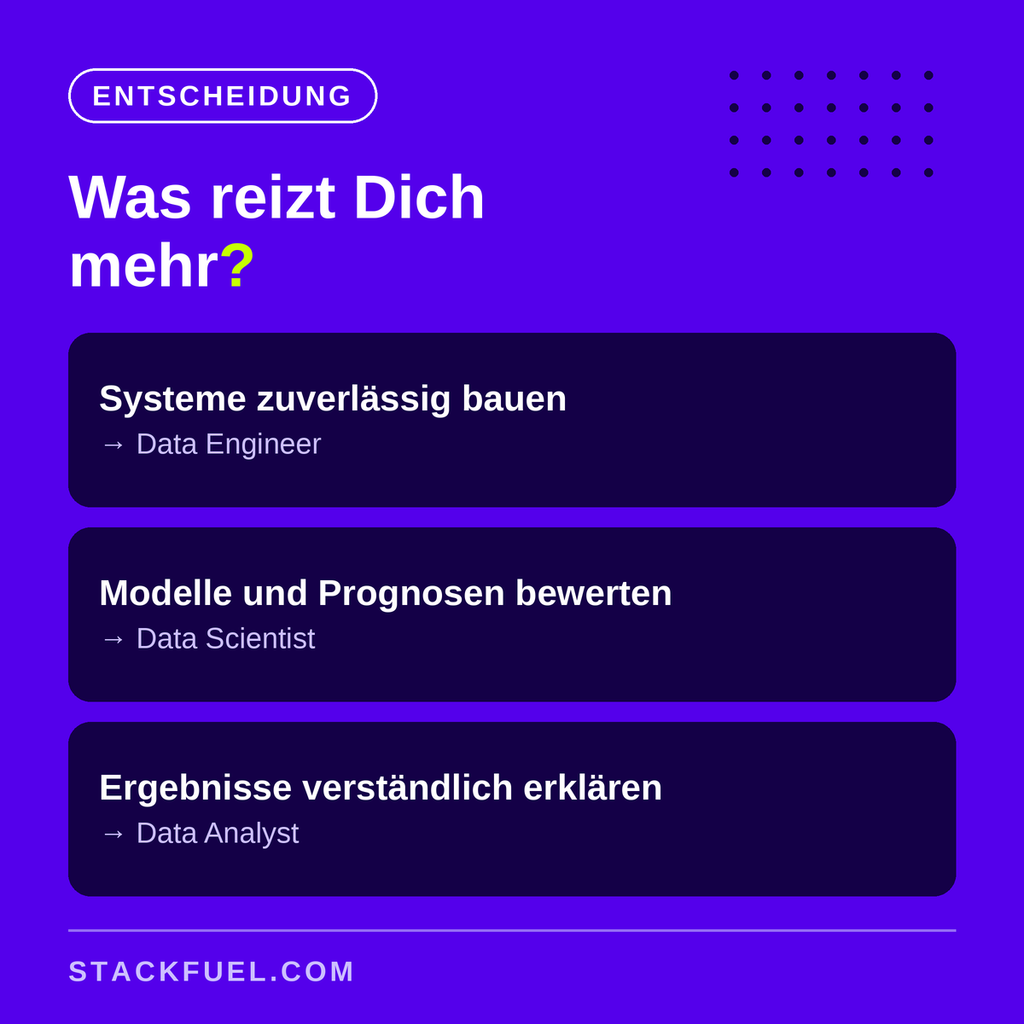
You should take a closer look at the Data Engineer role if you enjoy building systems, getting to the root of problems, and take pride in a process that runs reliably overnight. The Data Scientist role is a good fit if you’re drawn to statistics, hypotheses, and the question of how reliable a statement is. If you prefer to explain results in an understandable way, the Data Analyst role might be the better first step. The main difference between an Analyst and a Scientist is their perspective: One explains what has happened; the other predicts what is to come.
When it comes to continuing education, there is a simple rule: Prior experience should match the goal. The Data Science Training The StackFuel program takes 9 months full-time and 18 months part-time, covering topics ranging from statistics and Python to machine learning. The Data Engineering Training is classified as advanced, requires professional experience with advanced Python or analyzing large datasets, and lasts 9 to 10 months full-time or 18 to 19 months part-time. Over the course of eight modules, you’ll learn Azure, Snowflake, Synapse, and Spark in Databricks and build your own cloud project. If you lack programming experience, a data analyst or Python training program would be a better place to start.
The following applies to funding: With a education voucher The Employment Agency or Job Center may cover the costs if you are registered as unemployed or a job seeker and the course and provider are approved. Employees can involve their employer through the Qualification Opportunities Act. For data engineering, there are Subsidized courses ranging from four weeks to ten months, which differ primarily in their prerequisites.
Conclusion
Data engineers and data scientists work on the same data pipeline, but at different stages. Here’s the most important information in a nutshell:
- Goal: The engineer provides reliable data, and the scientist derives predictions and insights.
- Everyday Work and Tools: Pipelines, the cloud, and operations on one side; statistics and models on the other. SQL and Python are used for both.
- Introduction: The path to becoming a data scientist involves analysis and statistics, while the path to becoming a data engineer involves hands-on programming experience.
- Salary: In a cross-country comparison, engineers come out on top; experience, region, and level of responsibility remain key factors.
- AI: For scientists, AI knowledge is already standard; for engineers, the amount of work that relies on AI is growing.
Not sure which role is right for you yet? StackFuel has been AZAV-certified since 2020, Over 8,000 graduates have completed our continuing education programs in data and AI, with a completion rate of 93 percent. Together, we’ll assess your prior knowledge, find the right entry point for you, and discuss funding options. Simply schedule your free consultation.
You are currently viewing a placeholder content from YouTube. To access the actual content, click the button below. Please note that doing so will share data with third-party providers.
Frequently Asked Questions About Data Engineers and Data Scientists
How much does a data engineer earn compared to a data scientist?
According to the TalentUp analysis’s country-wide average, data engineers earn 9.8 percent more than software developers, while data scientists earn 5.8 percent less. For Germany, our analysis of salary portals puts the gross annual salary for data engineers at around 68,500 euros. Experience, region, and industry significantly affect both figures.
Who needs more programming skills?
Both roles require knowledge of SQL and Python. The data engineer delves deeper into software development, the cloud, and pipeline operations, while the data scientist focuses more on statistics and modeling. For those starting out as data engineers, practical programming experience is the biggest hurdle.
Can I switch from being a data scientist to a data engineer, or vice versa?
Yes, both career paths are common. Those who build models learn about data requirements and pick up skills in the cloud and data pipelines. Those who build data pipelines expand their knowledge to include statistics and machine learning. The common foundation of SQL and Python makes this easier.
Which role is being transformed the most by AI?
Both roles use AI assistants for initial drafts. For data scientists, AI skills are already standard in many job postings and rarely offer a competitive edge. For data engineers, the amount of work that relies on AI is growing: preparing data, connecting systems, and defining what an assistant is allowed to access.
What about the data analyst?
The data analyst analyzes data and explains what it means for the business. For many, this role is the first step before moving on to data science or data engineering. The data analyst’s questions focus on what has happened, while the data scientist’s questions focus on predictions.
Are continuing education programs in both areas funded?
With an education voucher, the Employment Agency or Job Center can cover the costs. To qualify, you must attend a counseling session at the Employment Agency and enroll in an approved course offered by an accredited provider. Our counseling team will guide you through the process until your application is approved.