
 ChatGPT
 Perplexity
 Claude
 Grok

In everyday language, “retraining” is a general term, but in official terminology it refers to a specific path: You learn a new, recognized trade—typically in two years for a three-year apprenticeship. Data scientist is not a recognized trade. Those who want to transition into the field of data therefore usually opt for continuing professional education, which can differ significantly from retraining in terms of duration, certification, and financial support.
There is no formal retraining program to become a data scientist, because retraining programs lead to recognized vocational professions, and data scientist is considered a profession requiring a college degree. The transition can be achieved through continuing professional education. Under certain conditions, this may be funded by the Federal Employment Agency or the Job Center.
What is the difference between retraining and continuing education?
Both approaches are eligible for funding, but they pursue different goals. The Federal Employment Agency explains that a Retraining for a three-year vocational program typically takes two years takes longer if you study part-time or through distance learning. A continuing education program lasts as long as the selected course specifies.
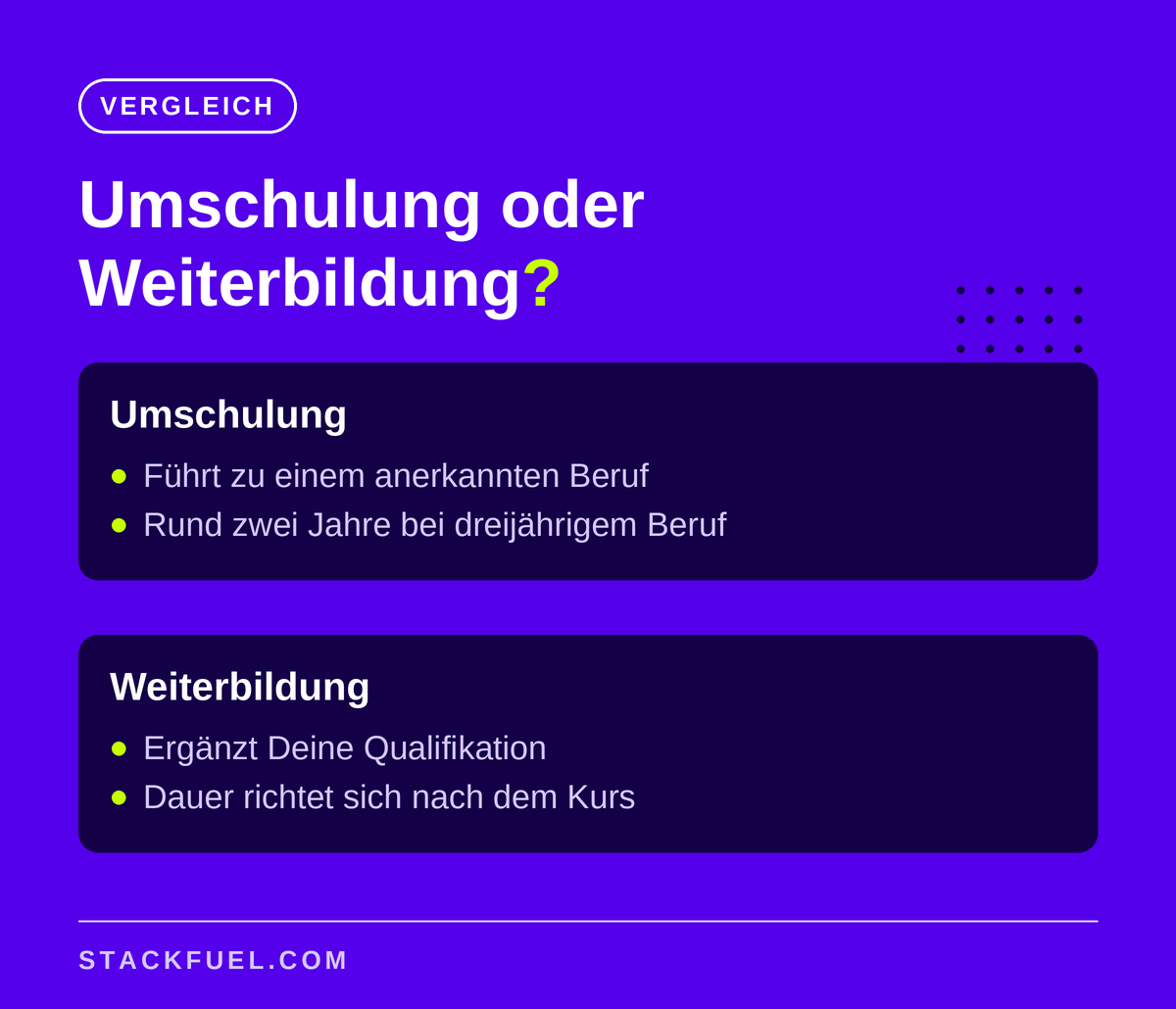
| Retraining | Continuing Professional Development | |
|---|---|---|
| Goal | new recognized apprenticeship program | new or advanced qualification |
| Duration | usually two years for a three-year career | depending on the course, often significantly shorter |
| Conclusion | Degree in a recognized vocational field | Course Certificate from the Provider |
| Financing | Expenses and unemployment benefits may be covered; in the case of company-sponsored retraining, compensation may be provided | Education voucher available |
For data scientists, this means that anyone looking to change careers is actually looking for a path into data work. You almost always take that path through continuing education, because there is no specific retraining program for this profession. The same distinction applies to the Retraining as a Data Analyst.
Which retraining program is most closely related to this field?
The next recognized apprenticeship program is the IT Specialist for Data and Process Analysis. The training program is designed to last three years; according to the Federal Employment Agency, retraining for this position therefore typically takes two years. During the program, you will learn to process large amounts of data, analyze them statistically, and present the results, according to IHK as well as improving business processes with data.
This career path provides a solid foundation, but it doesn’t make you a data scientist yet: Machine learning isn’t mentioned in the descriptions from BIBB and IHK, so you’d need to add it later. This is especially worthwhile if a recognized degree is important to you—for example, because you want to work in an industry where employers value it. If your main goal is to understand data and models, continuing education will get you there faster.
When is continuing education the better option?
A continuing education program is a good fit if you’ve already completed vocational training in a trade and want to learn data work in addition to that, rather than pursuing a second vocational degree. It focuses on specific skills: data preparation using SQL, Python, statistics, and machine learning, as well as a project to demonstrate your work. How realistic it is to get started depends on the Requirements and Opportunities for Career Changers depends, especially on the prior knowledge you've gained from your previous job. Like a The Path to Becoming a Data Scientist What the overall picture might look like depends on the time and the starting point.
StackFuel offers the Continuing education in data science AZAV-certified since 2020. It lasts 9 months full-time or 18 months part-time and covers SQL, Power BI, Python, machine learning, and a portfolio project. The course page classifies it as an advanced-level program. This is explicitly a continuing education program and not a retraining program: Upon completion, you won’t receive certification for a recognized vocational trade, but rather proof of what you’ve learned and a project you can show to employers. Data Scientist Training Programs with Education Vouchers can be compared in terms of duration, content, and supervision.
Which approach is best for which situation?
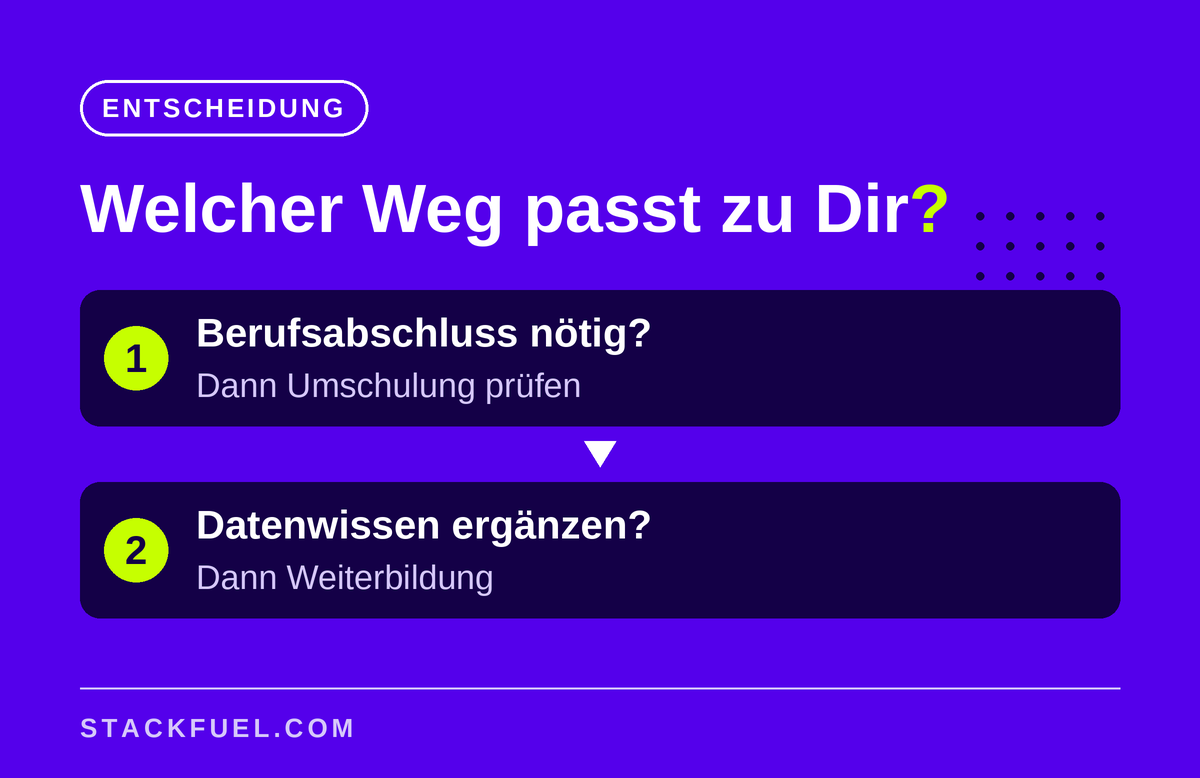
Two questions can help you make a decision.
First: Do you need a recognized vocational degree because you don’t have one yet? If so, retraining is the right approach, and becoming an IT specialist for data and process analysis is a logical goal. Expect it to take two years, and plan to add machine learning as an additional step afterward.
Second: Do you already have a career and want to add data skills to your skill set? Then you don’t need to learn a second profession. The StackFuel training program lasts 9 months full-time or 18 months part-time and combines your subject matter expertise with SQL, Python, and machine learning. People with backgrounds in financial control, logistics, or sales often already understand the business questions behind the data, and that’s exactly what can be combined with these methods.
If you’re still unsure after considering both questions, a consultation at the Employment Agency or the Job Center can help clarify things before you commit to a course. Bring your resume, your career goal, and the question of which program is right for you. Before you go, write down three things: what you’ve done professionally so far, what data-related tasks you’ve already encountered, and what kind of job you’d like to have in two years. This will help the counselor assess your situation and help you evaluate your own decision.
What does the funding entail?
Under certain conditions, retraining and continuing education may be funded by the Federal Employment Agency or the Job Center. The Federal Employment Agency explains that funding is available in the The consultation will be reviewed: The continuing education program must improve your prospects in the job market, and both the provider and the course must be accredited. As of January 1, 2025, clients of the Job Center can also receive this financial assistance through the Employment Agency.
Specifically, this means the following for you:
- You schedule a consultation with the Employment Agency or the Job Center.
- Continuing education must improve your prospects in the job market—for example, to end or prevent unemployment.
- You're looking for an approved course from the "mein NOW" course database.
- The Employment Agency or the Job Center decides whether to issue an education voucher.
Whether the Eligibility Requirements for the Education Voucher Once these requirements are met, the agency will verify during the interview whether the Employment Agency or Job Center Which agency is responsible depends on your situation. Even for retraining, a education voucher are eligible.
How is AI changing career transitions?
AI is changing the nature of tasks, not the question of whether a shift toward the digital world makes sense. According to Bitkom, by 2026 57 percent of companies with at least 20 employees use AI, compared with 36 percent the previous year. Assistants handle some of the routine tasks involved in programming and simple data analysis. There are no reliable figures on how much work time will be spent on development versus monitoring in the future.
Humans are still needed for what machines struggle to assess: whether the data is relevant to the question, whether a result is plausible, and what it means for a decision. This requires a foundation in SQL, statistics, and machine learning—regardless of whether you learn these skills through a career change program or continuing education. For your career transition, this means: Choose your path based on what degree you need and how quickly you want to start working, and learn the AI tools right along with the course.
Conclusion
- A retraining program leads to a recognized vocational qualification and typically takes two years for a three-year vocational program.
- Data scientist is not a trade that requires formal training; a career change can be achieved through continuing education.
- The next recognized profession is IT specialist for data and process analysis; machine learning is not part of that job description.
- Financial assistance may be available for retraining and continuing education; this will be reviewed during the consultation.
Are you wondering whether a career change or continuing education is right for you? StackFuel has been AZAV-certified since 2020, Over 8,000 graduates have completed our continuing education programs in data and AI, with a completion rate of 93 percent. Together, we’ll assess your prior knowledge, find the right entry point for you, and discuss funding options. Simply schedule your free consultation.
Frequently Asked Questions About Data Scientist Retraining
Is there a retraining program to become a data scientist?
Strictly speaking, no. Retraining leads to a recognized vocational qualification, and the Federal Employment Agency classifies “data scientist” as a profession requiring a college degree. The transition is achieved through continuing professional education.
What is the difference between retraining and continuing education?
Retraining leads to a new, recognized vocational qualification and typically takes two years for a three-year program. Continuing education supplements or expands your qualifications; its duration depends on the course.
Can the Employment Agency provide funding for data science training?
This may be the case if the continuing education improves your prospects in the job market and the course and provider are accredited. You can find out if this applies to you during a consultation at the Employment Agency or the Job Center.
How long does retraining take?
For a three-year vocational training program, it typically takes two years; it takes longer if done part-time or through distance learning. StackFuel's data science training program lasts 9 months full-time or 18 months part-time.
As someone changing careers, can I get started in data science?
Yes, through professional development. How well you get started depends on your prior knowledge. If you already analyze data in Excel or SQL, you’ll have a head start; a consultation can help you assess your specific path.