
 ChatGPT
 Perplexity
 Claude
 Grok

You’re looking for a data analyst retraining program because you want to change careers, and someone told you that the employment agency might help cover the costs. That’s true. However, many people use the term „retraining“ differently than it’s defined in legal terms. And that’s exactly what determines how long you’ll study, what will ultimately be listed on your certificate, and which application you’ll need to submit.
You are currently viewing a placeholder content from YouTube. To access the actual content, click the button below. Please note that doing so will share data with third-party providers.
This article explains what retraining to become a data analyst really entails, how it differs from continuing education, how long each option takes, and how financial assistance works. By the end, you’ll know which path is right for your situation.
What is a retraining program to become a data analyst?
Retraining leads you to a new, recognized professional certification, which culminates in an exam administered by the relevant professional association. „Data Analyst“ is not a protected professional title in and of itself, so the retraining program usually follows the related profession of IT Specialist for Data and Process Analysis. Alternatively, a continuing education program can qualify you in just a few months, though it does not lead to a professional association certification.
Career Change or Continuing Education: What's the Difference?
In everyday life, many people confuse the two terms, even on the websites of many providers. The difference, however, is clear: Retraining leads you into a different profession and concludes with a final exam administered by the relevant professional association, as described by the Employment agency. Continuing education, on the other hand, builds on what you already know and usually lasts just a few months.
The table shows the key differences in the path to becoming a data analyst.
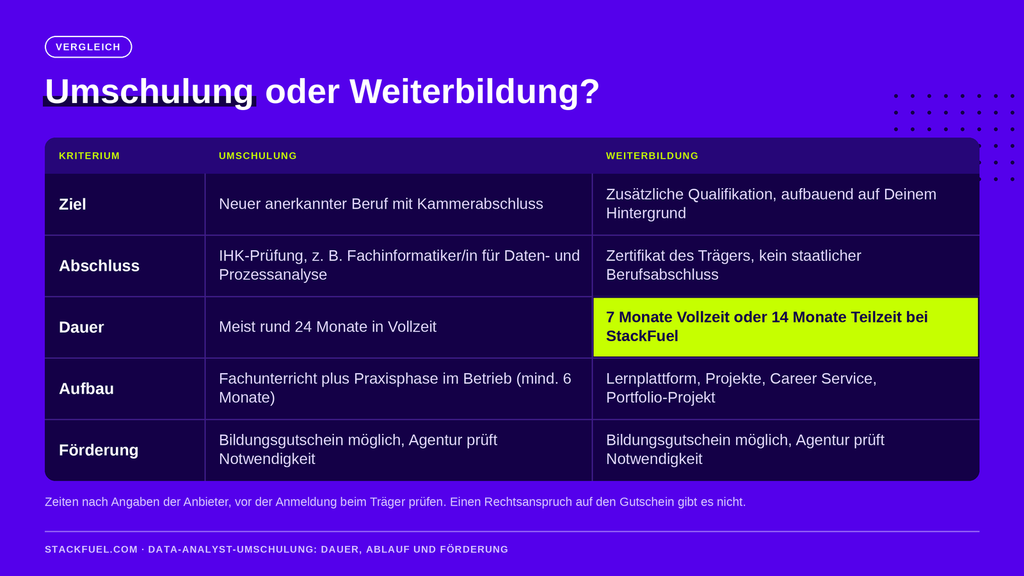
When it comes to funding, the difference is less significant than many people think. Both options can be covered by an education voucher. In both cases, the Employment Agency will assess whether the program is necessary and appropriate for you. For more information, see the section on funding.
How long does the retraining program last?
For retraining as an IT specialist for data and process analysis, training providers typically estimate 24 months of full-time study. The program begins with intensive courses covering the technical fundamentals, followed by a sequence of practical phases at a company that alternate with specialized instruction, project work, and exam preparation. The on-the-job training phase lasts at least six months with one provider and concludes with the IHK exam. Some providers also offer the retraining program on a part-time basis, in which case the duration is extended accordingly. One provider in Düsseldorf lists 32 months for the part-time option, including an eight-month internship.
Training to become a data analyst takes significantly less time. StackFuel’s Data Analyst course lasts seven months full-time or 14 months part-time. It covers Excel, SQL, Power BI, and object-oriented Python and concludes with a portfolio project. This is a certificate issued by the training provider, not a professional certification from a professional association. That’s exactly what you should consider when making your decision.
All dates are provided by the program providers. Start dates, internship requirements, and part-time options vary by provider, so be sure to ask for specific details before registering.
Which option is best for whom?
Retraining is a good fit if you need or want a formal degree. This applies, for example, if you haven’t yet completed vocational training, if you want to enter an industry where credentials carry a lot of weight, or if a two-year structured program with on-the-job training suits you better than a short, intensive course. The cost is time: You’re committed for two years before you can start working as an IT specialist.
Continuing education is a good fit if you already have a career and want to leverage your experience as an asset. That’s precisely where the strength of a career change lies. Someone who has worked in logistics for ten years understands how logistics data is generated and why it’s important. Employers looking for an analyst in operations, marketing, or finance want exactly this combination of data skills and subject matter expertise. At the Career change as a data analyst That's why your previous job isn't a disadvantage—it's actually your strongest selling point.
There isn't a clear-cut answer for every situation. If you're considering both options, you should ask this exact question during your consultation with the agency or the job center: Is continuing education enough to help me reach my goal, or do I need a degree?
Three Obstacles to Overcome Before You Make Up Your Mind
The first pitfall is the term itself. Many providers use the term „retraining“ to describe a course that is legally classified as continuing education. That’s why you should always ask about the certification: a professional association exam or a provider certificate? Both can be valuable, but the outcome shouldn’t come as a surprise to you.
The second pitfall is the timeline. Retraining commits you for two years, and the practical training phase at a company requires that you find a placement or that the training provider arranges one for you. Clarify this early on, because without a practical training placement, the program will come to a standstill. With continuing education, the risk is lower, but the responsibility for landing your first job falls more heavily on you.
The third pitfall is what you expect at the start. After retraining or continuing education, you’ll start as a Junior Data Analyst, with an entry-level salary and a period during which, realistically, you’ll need to submit a lot of applications. If you know this going in, you can better plan your finances and your patience.
How does the funding program work?
Both methods can be accessed via the Education Voucher from the Employment Agency funding. It’s important to be realistic: There is no legal entitlement to the education voucher. Ultimately, your case worker will make the decision on a case-by-case basis and will assess, before granting funding, whether the program is necessary and appropriate.
The process is straightforward and consists of five steps.
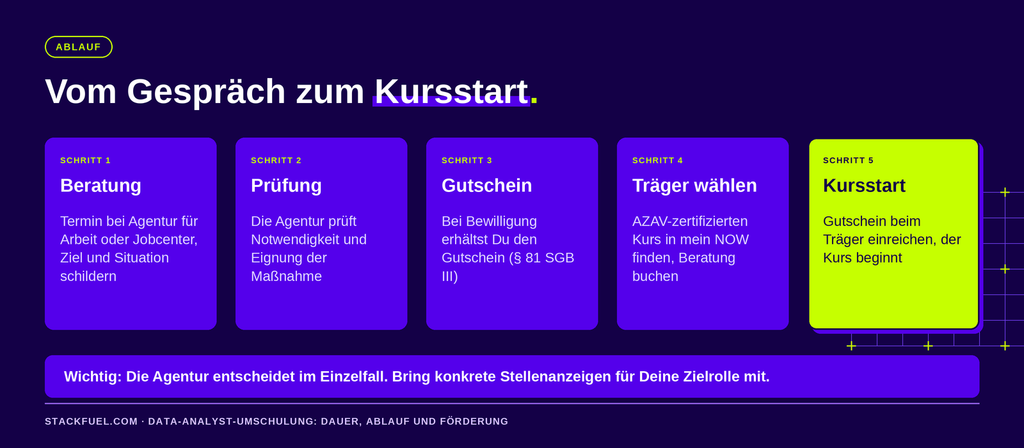
The first step is to schedule an appointment at the Employment Agency or the Job Center and explain your situation and your goal. If you want to prepare, bring specific job postings for the role you’re aiming for. They show that the continuing education aligns with an actual job market. If your application is approved, you’ll receive a voucher and can then look for a certified provider. You can search for courses through the portal my NOW, as recommended by the agency. Look for the note „Funding with an education voucher“ there.
How You you'll receive the education voucher We've put together a step-by-step guide to help you prepare for the consultation.
How much does it cost, and is there any additional financial assistance available?
With the education voucher, the agency covers the cost of the program if it approves it. Some providers advertise the funding as „up to 100 percent.“ However, funding is always determined on a case-by-case basis and depends on your situation.
For retraining programs that lead to a recognized vocational certification, there is also the Continuing education bonus. It has been available on an indefinite basis since 2025 and amounts to 1,000 euros for passing the intermediate exam and 1,500 euros for passing the final exam, for a total of 2,500 euros. Check before you begin whether the selected program is eligible for this.
The bonus applies to programs leading to a recognized professional certification. If you’re considering continuing education that doesn’t lead to a professional certification, you should check with the agency in advance. This should be on your list of things to consider when choosing between the two options.
How do you find a good carrier?
The same basic rules apply to retraining and continuing education. The provider must be AZAV-certified; otherwise, the voucher cannot be redeemed. In addition, these questions will help you:
- How much hands-on practice is included in the course, and do you work with real data?
- Will there be a final project that you can show employers?
- What kind of support is available for job seekers?
- How transparent is the provider in reporting completion rates?
StackFuel has been AZAV-certified since 2020 and has over 8,000 graduates. The completion rate is 93 percent. The learning platform is called DataLab, and the Career Service helps you with your job applications. Important to note: StackFuel’s Data Analyst course is a continuing education program, not a retraining program leading to a professional certification from a trade association.
What matters after the course is proving that you can do the job. You don't need a dozen certificates for that—you need a Data Analyst Portfolio with a project that answers a real question.
What comes after retraining?
After completing your retraining as an IT specialist for data and process analysis, you’ll apply for entry-level positions in the data field. A realistic starting point is as a junior, with the opportunity to specialize later in a specific industry or in BI. As you gain experience and specialize, your Data Analyst Salary Noticeable.
At first, you'll earn an entry-level salary, not a top salary. The higher pay comes with experience, specialization, and a proven track record. This applies equally to career changes and continuing education.
Frequently Asked Questions About Data Analyst Career Transition Training
How long does it take to retrain as a data analyst? According to the providers, retraining to become an IT specialist in data and process analysis typically takes 24 months full-time; part-time programs take longer. In contrast, continuing education to become a data analyst takes just a few months—at StackFuel, seven months full-time or 14 months part-time.
Is it possible to retrain as a data analyst using an education voucher? Yes, in principle, that's correct. There is no legal entitlement. The Employment Agency or the Job Center decides on a case-by-case basis whether the measure is necessary and appropriate.
What is the difference between retraining and continuing education? Retraining leads to a new, recognized vocational qualification that requires a professional certification exam. Continuing education expands existing knowledge and concludes with a certificate from the program provider.
Do I need any prior knowledge for the retraining program? In most cases, a high school diploma, adequate German language skills, and a placement test administered by the program provider are sufficient. You do not need an IT background to pursue further training as a data analyst.
Can I apply for a job after completing the training program even if I don't have a degree? Yes. For many data analyst positions, experience with tools and projects counts for more than a formal degree. What matters is having a compelling project and the courage to apply before you feel you’re „ready.“.
Your Next Step
If you're not sure whether retraining or continuing education is right for your situation, having a conversation is the best first step. Simply schedule your free Consultation at StackFuel. Together, we'll review your background, your target role, and whether and how the program can be financed through the education voucher.