
 ChatGPT
 Perplexity
 Claude
 Grok

If you search for a data scientist’s salary, you’ll find figures ranging from 57,000 to 80,000 euros per year—often on the same results page. Both are correct; they just measure different things. In this article, we’ll break down six current sources, show you the salary based on degree, experience, company size, region, and country, and calculate what you’ll take home. What a What a Data Scientist Does in Their Day-to-Day Work, we'll explain that separately; here, we're just talking about money.
In Germany, a data scientist earns an average of about 68,000 to 70,000 euros gross per year, or about 5,700 euros per month. Starting salaries typically range from 54,000 to 62,000 euros; after ten years, salaries of 85,000 to 92,000 euros are common. Large corporations and the southern regions pay the most, while startups and the northeastern regions pay the least.
How much does a data scientist earn in Germany?
The answer depends on who you ask. Salary websites analyze voluntary data provided by users, whereas the Federal Employment Agency analyzes actual social security reports. In addition, each source measures a different group: only entry-level employees, all experience levels, or an entire occupational group.
| Source (as of November 2026) | Key figure | Gross per year | What's Behind It |
|---|---|---|---|
| Stepstone | Median | 57.200 € | A broad range with many entry points, ranging from €49,200 to €68,100 |
| kununu | Average | 68.200 € | 2,744 user entries, most of which range from €59,200 to €69,400 |
| GEHALT.de | Median | 70.333 € | Converted to 40 hours per week, the mid-range is €62,130 to €79,619 |
| Federal Employment Agency Wage Atlas | Median | €80,424 (€6,702 × 12) | Official data for 2025, but for the entire „Computer Science, Expert“ group, including machine learning engineers and AI engineers |
The middle of this table is most useful for your own assessment: about 68,000 to 70,000 euros for a full-time position at all experience levels. Stepstone serves as a conservative lower limit because it includes many entry-level and mid-level positions. The Salary Atlas is the only official source, but its figures are higher because the statistics do not distinguish data scientists separately and include well-paid AI and machine learning roles. If someone mentions 80,000 euros as the average during a salary negotiation, you now know where that number comes from. For related roles, the same portals list slightly lower figures; we’ll show you how those figures are calculated in the Salary as a Data Analyst and at the Salary as a Data Engineer.
What is the starting salary for a data scientist?
For those entering the workforce directly, it lists get in IT an average of 57,700 euros; Stepstone reports around 54,000 euros. Portals that include all individuals with less than three years of experience show higher figures: kununu at 61,300 euros, GEHALT.de at 63,673 euros. These figures already reflect the first salary increases after one to two years.
How much you earn to start depends heavily on your degree when you join directly out of school. The figures from "get in IT" refer to the middle half of full-time salaries:
| Access | Gross per year |
|---|---|
| Bachelor's Degree Holder Trainee | approx. 46,600 € |
| Direct Admission with a Bachelor's Degree | €48,700 to €56,000 |
| Trainee with a Master's degree | approx. 51,100 € |
| Direct Admission to a Master's Program | 53,600 to 61,700 € |
| Direct Entry with a Ph.D. | €60,000 to €70,000 |
Without the right degree, the path usually leads through a Career change as a Data Scientist; you can find your realistic earnings below.
Many older articles on salaries—including our own earlier version of this text—cited starting salaries of 80,000 to 93,000 euros for PhD holders. That’s too high for the broader job market. Such offers do exist, but they’re mostly found at international tech companies, in pharmaceutical research, or in quantitative finance.
Data Scientist Salary by Level of Experience: Junior, Senior, Lead
Your degree determines where you start; experience determines the rest. Data from kununu shows a clear tiered pattern, broken down by jobs with and without hiring responsibilities:
| Experience | Typical stage | Without a guide | With a tour guide |
|---|---|---|---|
| under 3 years old | Junior Data Scientist | 61.000 € | 68.200 € |
| 3 to 6 years | Data Scientist (Professional) | 73.700 € | 79.700 € |
| 6 to 10 years | Senior Data Scientist | 83.900 € | 88.600 € |
| over 10 years | Lead, Principal, Head of Data | 86.600 € | 91.600 € |
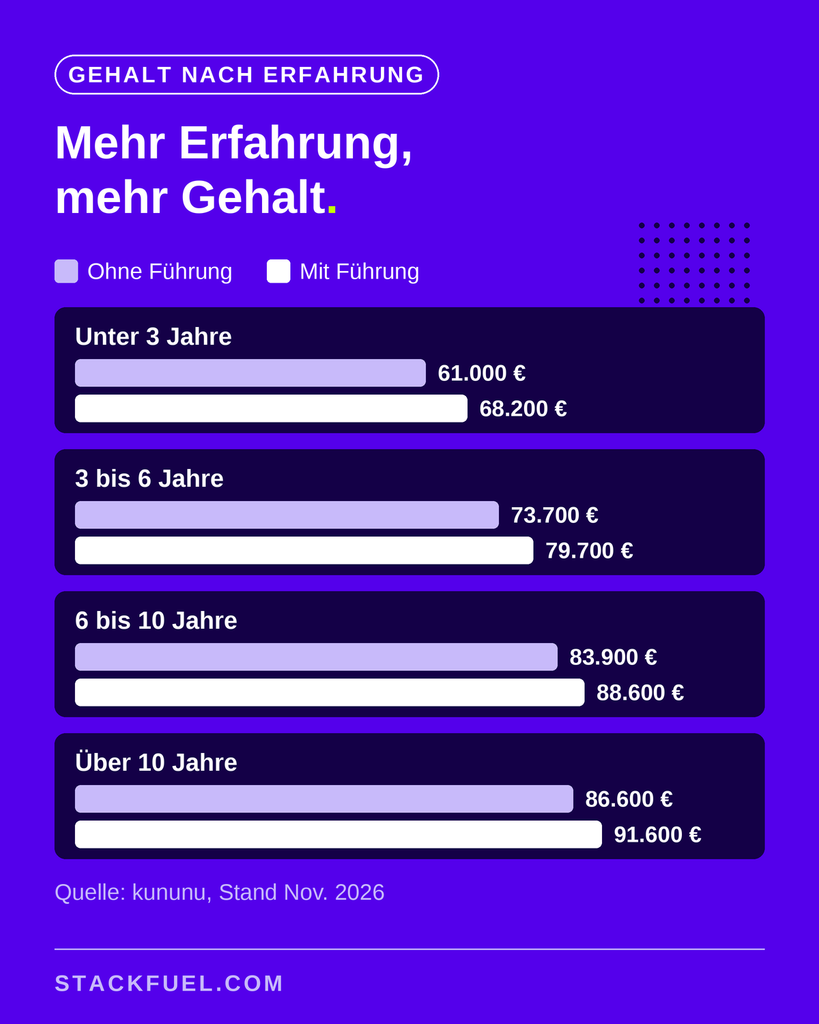
This means there is a difference of about 25,000 to 30,000 euros between the first job and the tenth year of one’s career. According to kununu, supervisory responsibilities result in an average pay increase of about 8 percent. Stepstone puts the average at 88,000 euros with experience, while GEHALT.de reports 80,249 euros for more than nine years of experience.
What sets these roles apart in day-to-day work: As a junior, you prepare data, build initial models, and work under supervision. As a senior, you make architectural decisions, oversee models through to production, and pass on your knowledge to junior colleagues. Lead and Principal roles are responsible for a division’s data strategy, either as part of a team or as a subject matter expert without direct supervisory authority. Those who not only develop models but also reliably deploy them into production and monitor them tend to advance more quickly. Suitable Data Science Certifications can demonstrate such skills on their resume.
Data Scientist Salaries by Company Size and Industry
In addition to experience, the employer is the biggest factor. According to GEHALT.de, the median salary rises almost linearly with company size:
| Company size | Median gross annual income |
|---|---|
| Fewer than 100 employees | 62.235 € |
| 101 to 1,000 employees | 71.263 € |
| 1,001 to 20,000 employees | 77.998 € |
| more than 20,000 employees | 89.561 € |
So there’s a difference of about 27,000 euros a year between a small business and a large corporation. The gap is smaller but still noticeable when you’re just starting out: According to get in IT, startups pay an average of 51,800 euros, while large corporations pay 62,100 euros. In return, you’ll usually have a broader range of responsibilities at a startup—from the data pipeline to the finished model—and you’ll learn quickly as a result.
When it comes to industries, the Automotive industry: 62,700 euros Top. Most sectors range between 56,000 and 64,000 euros, with retail (51,200 euros) and logistics (50,600 euros) paying the least. According to get in IT, healthcare, the energy sector, and manufacturing are also among the well-paying fields.
Data Scientist Salaries by State and City
Within Germany, the same job pays more or less than 13,000 euros a year, depending on the region. According to GEHALT.de, Baden-Württemberg (73,647 euros), Hesse (73,145 euros), Hamburg (72,473 euros), and Bavaria (71,869 euros) lead the way. Berlin ranks in the middle with 67,817 euros, while the eastern German states bring up the rear with salaries ranging from about 60,500 to 62,000 euros; Mecklenburg-Western Pomerania comes in last with 60,470 euros.
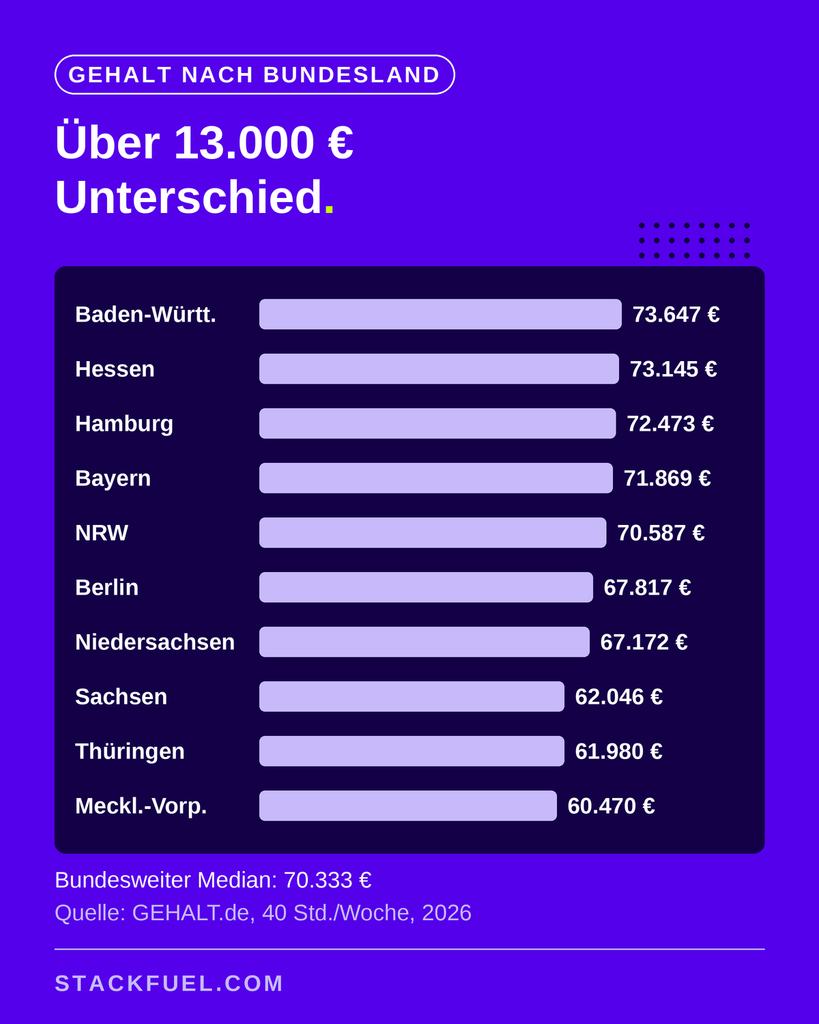
According to kununu, this is what it looks like in the major cities:
| City | Average gross annual income | Range |
|---|---|---|
| Munich | 71.500 € | 52,600 to 101,800 € |
| Cologne | 70.000 € | 51,300 to 101,500 € |
| Hamburg | 69.400 € | 53,400 to 97,200 € |
| Stuttgart | 69.300 € | €47,600 to €100,400 |
| Frankfurt am Main | 69.000 € | 51,300 to 104,400 € |
| Berlin | 67.000 € | €47,100 to €100,700 |
| Düsseldorf | 66.400 € | €42,000 to €104,900 |
Munich also ranks at the top of the salary atlas, with a median monthly salary of 7,970 euros for the entire occupational group. The range in Berlin, Frankfurt, and Düsseldorf is striking: young startups are dragging down the lower figures, while banks and international tech companies pay six-figure salaries. Also keep the cost of living in mind. A higher gross salary in Munich doesn’t automatically mean more money at the end of the month, given the city’s rent levels. For remote positions, it’s worth asking during the interview which location the salary range is based on.
What is the take-home pay for a data scientist?
For a single person in tax bracket I with no children, about 35 to 40 percent of their gross income goes toward taxes and social security contributions. For the kununu average of 5,683 euros gross per month, that leaves about 3,400 to 3,700 euros net. Stepstone estimates that its slightly lower median gross salary of 56,100 euros per year translates to about 3,040 euros net per month.
Your actual take-home pay depends on your tax bracket, church tax, health insurance, and the state you live in. That’s why you should always double-check your specific offer using a gross-to-net calculator before accepting it. And ask about the total package: vacation pay, Christmas bonus, performance bonuses, training budget, and the percentage of work done from home can often make a difference of several thousand euros between two offers with the same base salary.
Data Scientist Salaries in Austria and Switzerland
Austria: According to kununu Austria On average, data scientists earn 60,400 euros gross per year, distributed over 14 pay periods, or about 4,300 euros per month. The starting salary for those with less than three years of experience is 54,800 euros, rising to 80,200 euros after ten years. This level is thus slightly below that in Germany.
Switzerland: Salaries are significantly higher here. According to kununu, the average salary in Switzerland is 109,800 francs, Robert Half For 2027, the range is 108,250 to 153,000 francs, with a median of 130,500 francs. According to kununu, the starting salary is around 93,100 Swiss francs. However, this is offset by significantly higher costs for rent, health insurance, and childcare. A move is financially worthwhile, especially if you carefully calculate the local costs.
United States: For the sake of completeness: The U.S. Bureau of Labor Statistics reports a median annual salary of $120,230 for May 2025. Here, too, health insurance, housing costs in tech hubs, and fewer vacation days noticeably narrow the gap.
How much do career changers earn as data scientists?
There are no official statistics specifically for career changers. Realistically, you’ll start in an entry-level position, meaning at the starting salary range mentioned above: typically between 50,000 and 60,000 euros. You can earn more if you bring specialized knowledge from your previous career—such as in controlling, engineering, or the natural sciences—and combine it with Python and machine learning projects. However, you shouldn’t expect an offer of more than 70,000 euros immediately after completing continuing education without relevant prior experience.
For many, a career change is a two-step process: first as a data analyst, then—as experience grows—in data science. The pay gap between the roles is smaller than many people think. GEHALT.de reports a median salary of 63,300 euros for data analysts, while kununu reports 66,300 euros for data engineers. We’ve compared the roles to show exactly where their responsibilities diverge. Data Scientist vs. Data Analyst broken down.
What matters most in a job interview isn't so much a certificate on paper as it is a portfolio that shows you can solve a real-world business problem using clean code, SQL, and a clear, understandable result. That's exactly what the Further training to become a Data Scientist Offered by StackFuel: 9 months full-time or 18 months part-time, working with Python, statistics, and machine learning on real-world projects in our DataLab learning platform, with support from the Career Service. If you are unemployed or at risk of becoming unemployed, the Employment Agency or Job Center may cover the costs through a education voucher cover. There is no legal entitlement to this; it is decided on a case-by-case basis. You can find an overview of other providers in our comparison of Top Data Science Continuing Education Programs with an Education Voucher.
How Can You Increase Your Salary as a Data Scientist?
The figures above show four factors that you can influence yourself:
- Choose an employer. The transition from a small business to a large corporation results in a median pay increase of over 40 percent. The automotive, energy, pharmaceutical, and large tech sectors consistently offer the highest pay.
- Go beyond analysis. Those who put models into production, operate and monitor them, and work with cloud platforms or large language models are rated higher than those who only build models on a laptop.
- Take responsibility. Whether as a team lead or a senior expert, salaries for those with six or more years of experience are well over 80,000 euros.
- Negotiating with data. Base your claim on multiple sources—such as the salary atlas for your region and a website for your city—rather than on a single figure.
Conclusion
- The typical salary for a data scientist in Germany is around 68,000 to 70,000 euros gross per year.
- Starting salaries typically range from 54,000 to 62,000 euros, with PhD holders earning between 60,000 and 70,000 euros.
- After six to ten years, a salary of 84,000 to 89,000 euros is typical, with managers earning over 90,000 euros.
- Company size and region each account for a difference of more than 13,000 euros, and in the case of employers, the difference can be as high as 27,000 euros.
- In Switzerland, salaries are significantly higher, while in Austria they are slightly lower than in Germany.
If you're wondering whether and how you can realistically get started in data science, talk to us. In a free consultation Let's take a look together at your prior knowledge, your goals, and your opportunities for support.
StackFuel has been AZAV-certified since 2020, Over 8,000 graduates have completed continuing education programs in data and AI with us, with a completion rate of 93 percent.
▸ Schedule a Free Consultation
Frequently Asked Questions About Data Scientist Salaries
How much does a data scientist earn per month?
On average, about 5,700 euros gross per month based on twelve monthly paychecks, which amounts to approximately 68,200 euros per year, according to kununu. After taxes, in tax bracket I, that leaves about 3,400 to 3,700 euros.
What is the starting salary for a data scientist?
For those entering the workforce directly, the salary is usually between 54,000 and 58,000 euros gross per year. With a master’s degree, the typical range is 53,600 to 61,700 euros; with a bachelor’s degree, 48,700 to 56,000 euros; and with a doctorate, 60,000 to 70,000 euros.
How much does a senior data scientist earn?
According to kununu, data scientists with six to ten years of experience earn an average of 83,900 euros without managerial responsibilities and 88,600 euros with them. Six-figure salaries are possible at large corporations and tech companies.
Where do data scientists earn the most in Germany?
In Baden-Württemberg, Hesse, Hamburg, and Bavaria, the median figure is over 71,800 euros in each case. Among cities, Munich leads with an average of 71,500 euros, followed by Cologne and Hamburg.
Does a data scientist earn more than a data analyst?
Yes, but less than is often assumed. GEHALT.de reports a median salary of 63,300 euros for data analysts and 70,333 euros for data scientists. The gap widens with experience and machine learning expertise.
How much does a data scientist earn in Switzerland?
According to Robert Half, the median salary for 2027 is 130,500 Swiss francs, with a typical range of 108,250 to 153,000 Swiss francs. However, the cost of living is significantly higher than in Germany.