 ChatGPT
 Perplexity
 Claude
 Grok

Some data science courses consist of a few hours of video content, while others involve a year of full-time study with guidance and a final project. Both are called “data science courses,” and anyone looking simply for the “best” one will end up with rankings where this very distinction gets lost. A more important question is what a course needs to offer to help you achieve your goal: getting a taste of the field, expanding your expertise to include data, or becoming a data scientist professionally. Five criteria depend on this, which are listed here in order.
The right data science course depends on your goal. If you want to become a data scientist, you’ll need a course that includes a hands-on project, Python, and machine learning, as well as personalized guidance, a flexible schedule, and a certificate that employers can recognize. A short online course is enough to get a taste of the field.
What types of data science courses are available?
This term encompasses four formats that differ significantly in terms of their objectives, effort required, and funding:
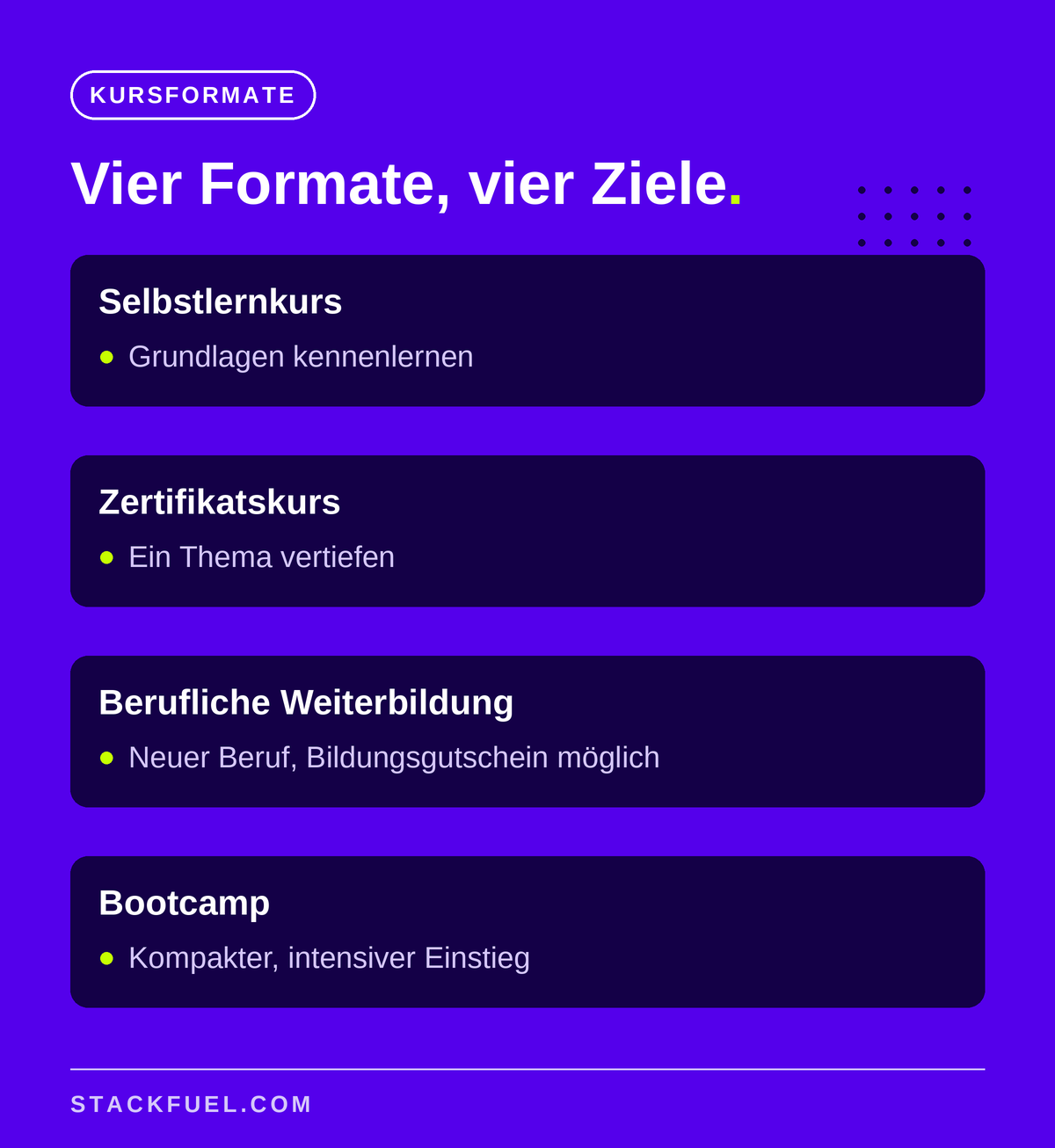
| Format | Typical destination | Typical effort | Financing |
|---|---|---|---|
| Self-paced course (video, platform) | Learn the Basics | Hours to weeks, without consistent care | usually paid for out of pocket |
| Certificate Program (University, Professional Association, Academy) | Explore a topic in depth; add to your resume | Weeks to months, often while working | paid out of pocket or through the employer |
| Professional Continuing Education with Certification | New Career or Career Change | Several months to about a year, full-time or part-time | Education voucher available |
| Boot Camp | A concise, in-depth introduction | a few months | depending on the provider |
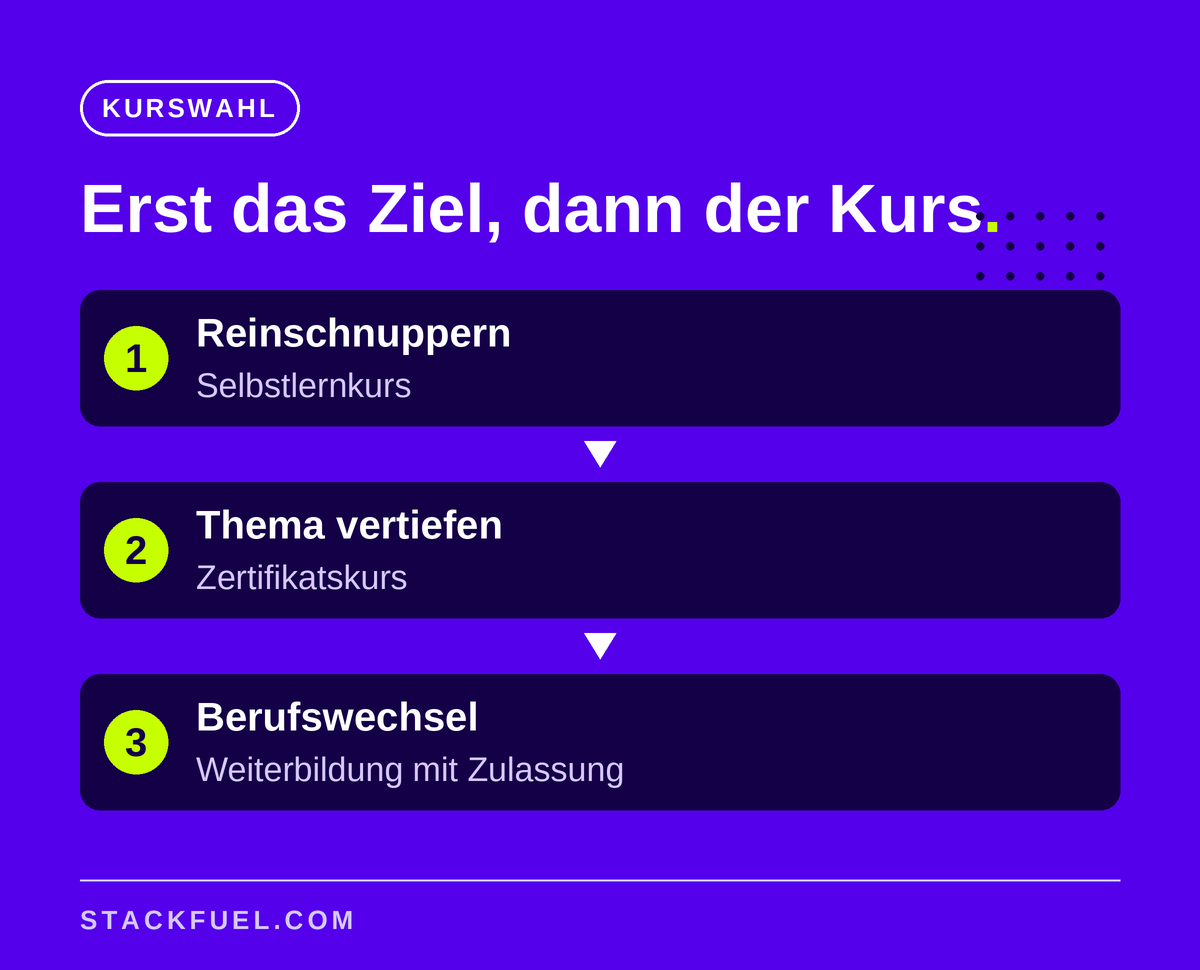
Which format is right for you depends on one question: Do you want to change careers or expand your knowledge? If you’re changing careers, a single self-study course is rarely enough, because it doesn’t include a project of your own or feedback on your code. However, if you just want to see if the subject is right for you, it’s a good and affordable way to get started.
What can a data science course do—and what can't it do?
The Federal Employment Agency lists "data scientist" in its occupational database as Employment After Graduation. So a course is no substitute for a college degree—nor does it need to be: People coming from other professions usually make their way to machine learning via SQL and data analysis, because a model is only as good as the data it was trained on. What this path might look like in detail, depends on prior knowledge and time.
A good course provides you with methods, hands-on experience, and a certificate. The professional experience comes later. If you're unsure whether analysis or modeling is a better fit for you, you should understand the difference between Data Scientist and Data Analyst Understand: Data analysts prepare and analyze data, while data scientists also build predictive models. Both roles share a foundation in SQL and Python, so a course can begin with an introduction to analytics and build on that foundation.
What are the 5 criteria that determine which course to choose?
Compare courses based on these five points, in this order.
1. Experience and Portfolio
A course should end with a project of your own that you can showcase in job applications: collecting data, cleaning it, analyzing it, training a model, and explaining the results. Videos alone don’t show whether you can do this on your own. Ask about the final project, the datasets used, and who will review your code.
2. Python, SQL, and Machine Learning at the Right Level of Depth
Check the curriculum to make sure the sequence is logical: start with SQL and data preparation, then move on to Python and its data libraries, followed by statistics and machine learning. Courses that jump right into neural networks skip over data preparation—without which no model can produce useful results. A course on Power BI or another reporting tool also demonstrates that results should be accessible to people who don’t read code.
3. Support
If you're left on your own when you encounter an error message, you can quickly lose days. Make sure to check whether there are designated contact people to answer your questions, whether code feedback is included in the course, and whether there's support available for job applications. A video-only course usually doesn't offer these things.
4. Time Model
Full-time study gets you to your goal faster, while part-time study is easier to balance with a job or family. More important than the stated course duration is the number of hours you actually have free each week. A course you drop after six weeks is more expensive than a longer one that you stick with.
5. Completion and Eligibility
A certificate of participation confirms that you attended. More meaningful, however, is a degree that employers can recognize, such as a state-recognized profession like the three-year dual training program to become a IT Specialist for Data and Process Analysis or a college certificate. The significance Data Science Certifications varies greatly depending on the provider. Whether a course is eligible for funding also depends on its accreditation, which is the subject of the next section.
It’s best to ask these questions in writing before you pay or request a voucher: How many hours per week is realistic? Who will review my code, and how quickly will I receive feedback? What project will I have to show for it at the end? What happens if I miss a phase? Reputable providers will give you specific answers. If they dodge the question, that’s one less reason for you to trust the course.
How does financial support influence voting choices?
Depending on the situation, the Employment Agency or the Job Center may cover course fees. This applies only to approved courses and providers, and eligibility for funding is determined during a consultation. The Federal Employment Agency specifies as a condition that the continuing education You need to improve your chances in the job market, for example, to end or prevent unemployment. Only after this conversation should you choose a suitable course from the mein NOW course database. Whether the Eligibility Requirements for an Education Voucher The agency will determine whether you meet these requirements during the consultation.
StackFuel also offers this type of accredited continuing education. The Continuing education in data science The program lasts 9 months full-time or 18 months part-time. The program covers data quality, business analysis, SQL, Power BI, data analytics, data science, object-oriented programming, AI automation, and a portfolio project. The course page classifies the program as advanced. Please evaluate it based on the five criteria above, just as you would any other course. Also Subsidized training programs for data scientists can be compared using the same five criteria.
How is AI changing learning and the workplace?
Today, AI assistants write code scaffolding, explain error messages, and summarize documentation. According to Bitkom, by 2026 57 percent of companies with at least 20 employees use AI, up from 36 percent last year. For data scientists, this means routine programming tasks will be completed faster, but the final judgment is still up to you. Is the dataset clean? Does the model fit the question? What do the results mean for the business? Without a basic understanding of SQL, statistics, and machine learning, you won’t be able to tell when AI-generated code is producing incorrect results.
In terms of course selection, this means that good courses teach students how to use AI tools, but do not replace the fundamentals. In an earlier survey, Bitkom also cited a shortage of skilled workers as an obstacle to digitalization, 70 percent of companies indicate this. There are no reliable figures on how much of the work time will be spent writing code and how much on reviewing it in the future. In addition to data scientists, there are Other AI careers, ranging from AI manager to AI engineer, which require similar prerequisites.
Conclusion
- The goal determines the format: You can get a taste of it with a self-study course, but a career change requires more.
- Review the practicum project, curriculum, supervision, schedule, and final requirements in that order.
- Financial assistance may cover costs, but it requires enrollment in approved courses and a counseling session.
- AI tools are a valuable part of a good course, but they do not replace the fundamentals of SQL, statistics, and machine learning.
Are you trying to figure out which data science course is right for you? StackFuel has been AZAV-certified since 2020, Over 8,000 graduates have completed continuing education programs in data and AI with us, with a completion rate of 93 percent. Together, we’ll review your prior knowledge, find the right schedule, and discuss funding options. Simply schedule your free consultation.
Frequently Asked Questions About the Data Science Course
How much does a data science course cost?
The range is wide, from affordable self-study courses to continuing education programs lasting several months with guidance. Specific prices vary depending on the provider. For approved continuing education programs, the Employment Agency or the Job Center may cover the costs under certain conditions; this can be clarified during a consultation.
Can I take a data science course using an education voucher?
Yes, if the course and the provider are approved and the Employment Agency or Job Center determines that the training is appropriate for you. This will be reviewed during the counseling session before you select a course.
How long does a data science course last?
This ranges from a few hours for self-paced courses to about a year for full-time professional development programs. StackFuel's data science program lasts 9 months full-time or 18 months part-time.
Do I need any prior knowledge of Python or math?
Not required for beginner courses. StackFuel’s data science training program is classified as advanced on the course page. During the consultation, we’ll determine whether your prior knowledge is sufficient and which option is right for you.
Is an online course enough to become a data scientist?
A single self-study course is rarely enough, because it lacks a project, guidance, and a clear-cut conclusion. It’s a good starting point to see if the subject is right for you.