 ChatGPT
 Perplexity
 Claude
 Grok

There is no formal training program in Germany to become a data scientist that includes an apprenticeship contract and vocational school. That might sound like bad news, but it isn’t: There are three paths to this career, and two of them don’t require a college degree. Which one is right for you depends on your high school diploma, your availability, and how quickly you want to start working.
There is no recognized training program for data scientists; the Federal Employment Agency classifies the profession as a career requiring a college degree. Those who want to enter the field without a college degree can either choose the dual training program to become an IT specialist for data and process analysis and continue their education, or enter the field as a career changer through continuing education.
Is there a training program to become a data scientist?
The Federal Employment Agency does not list "data scientist" in its occupational database as an apprenticeship occupation, but rather as Academic Career. That’s why there are no training regulations, no vocational school, and no apprenticeship contract with that name. This leaves you with more options than it might seem at first, because no one dictates where your knowledge must come from. Like a Roadmap to Becoming a Data Scientist How it looks depends mainly on your starting point.
The same applies to data analysts: There are not a traditional dual training program, continuing professional development is the established path. Understanding the difference between the two is important for your planning:
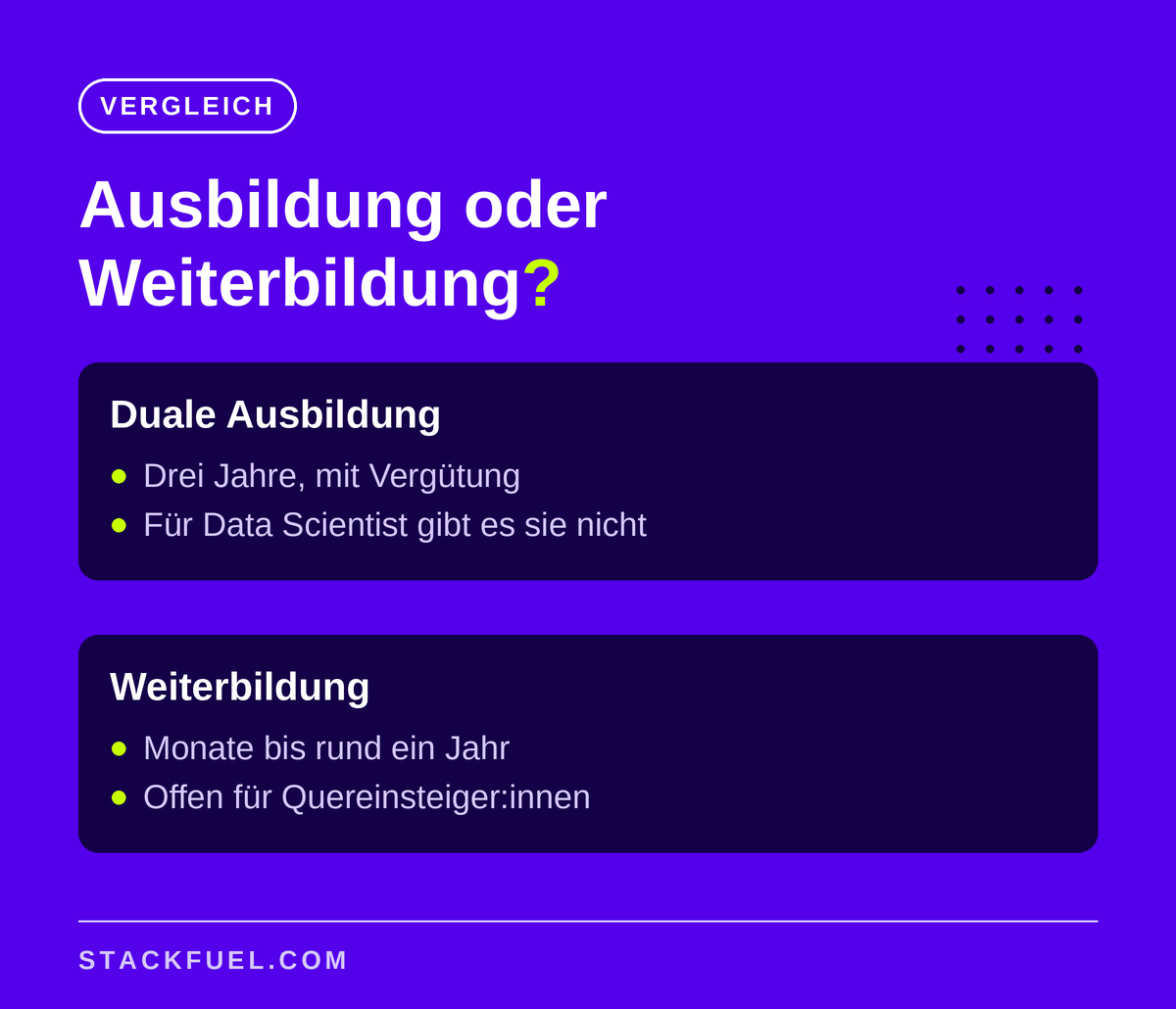
| Dual Training Program | Training | |
|---|---|---|
| Duration | usually three years | several months to about a year |
| Requirement | usually a high school diploma and an apprenticeship contract | Open to all, including those changing careers |
| For Data Scientists | Doesn't exist; see below for the next job | A well-established path for career changers |
| Financing | Apprenticeship stipend | Education voucher available |
What type of training is most relevant to this profession?
The one that comes closest is the Three-year training program to become an IT specialist in data and process analysis. According to the Chamber of Industry and Commerce (IHK), in this role you will analyze large amounts of data, look for patterns and trends, develop IT solutions for business processes, and ensure data security and data quality. The Federal Institute for Vocational Education and Training It describes automated data processing, statistical analyses, and reports with visualizations.
This provides a solid foundation for working with data, but it doesn’t make you a data scientist yet: Machine learning isn’t mentioned in the descriptions provided by the IHK and BIBB. Those who choose this path will need to supplement it with further training afterward. This appeals primarily to people who want to learn a paid trade right after high school and have the time to do so. For those already in the workforce, continuing education offers a faster path to entry.
What are the 3 paths to becoming a data scientist?
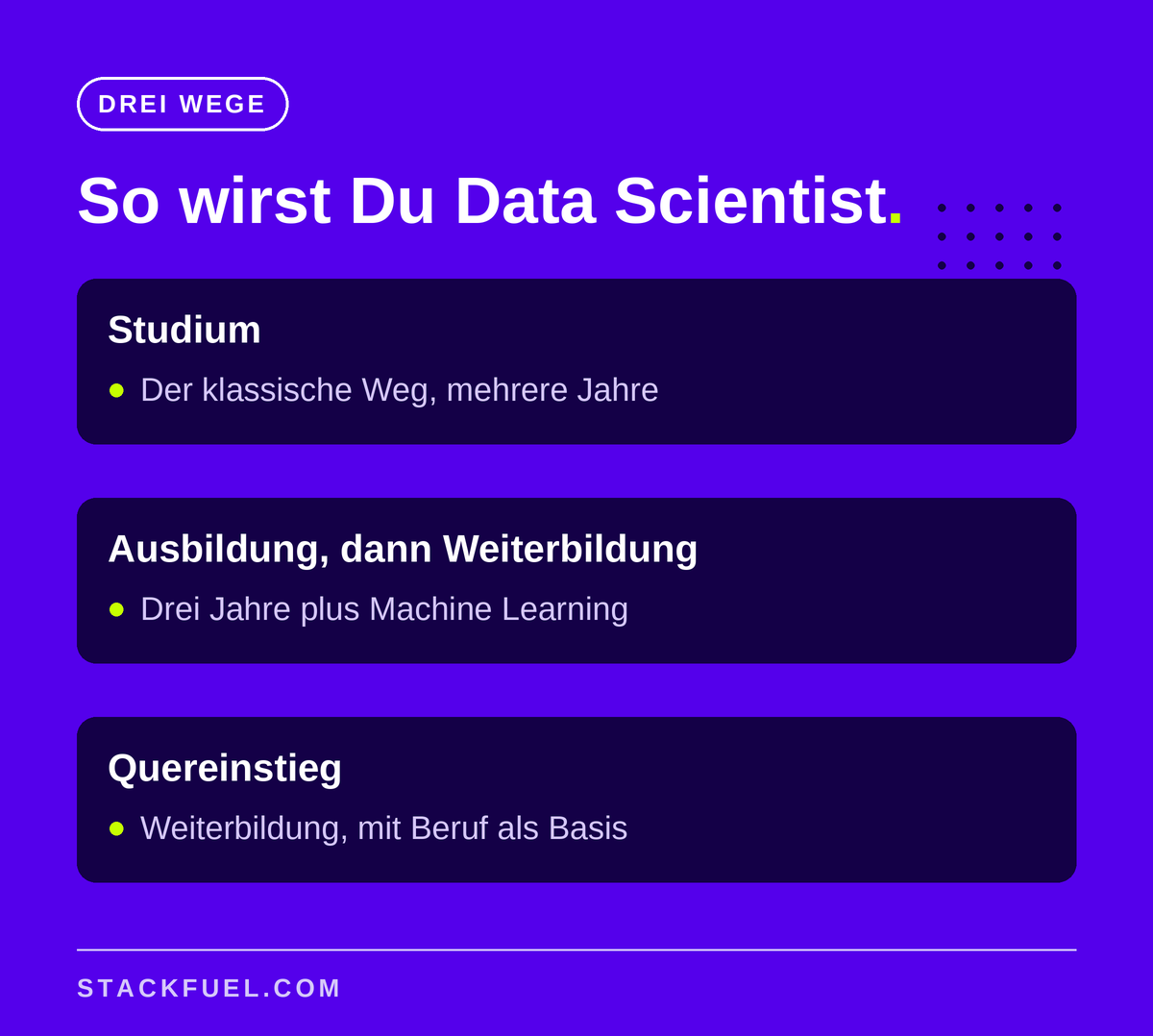
| Path | Requirement | Duration | This works if |
|---|---|---|---|
| Degree (in computer science, statistics, mathematics, or a related field) | Admission to Higher Education | several years | You're starting right after high school and want to take the traditional path |
| Dual-track apprenticeship as an IT specialist in data and process analysis, followed by continuing education | Apprenticeship Contract | three years of training plus continuing education | You want to pursue a recognized vocational training program and add machine learning later |
| Changing Careers Through Continuing Education | No specific educational background required | several months to about a year | You already have a job and want to change careers |
A college degree is the requirement set by the Federal Employment Agency for this profession. Different conditions apply to career changers. Requirements and Realistic Prospects for a Career Change This depends mainly on the prior knowledge you bring from your previous career: If you already analyze data in Excel, you have a head start; if you come from the healthcare or skilled trades fields, you’ll need more time to learn SQL and Python.
What is the process for enrolling in a subsidized continuing education program?
A professional development program will equip you with the skills required for the job in a matter of months rather than years: data preparation using SQL, Python, statistics, and machine learning, plus a project to showcase your work. It prepares you for the A Day in the Life of a Data Scientist Next: Collect and clean data, build models, explain results.
With StackFuel, this is done through the Continuing education in data science. It is AZAV-certified, lasts 9 months full-time or 18 months part-time, and covers SQL, Power BI, Python programming, machine learning, and a portfolio project. The course page classifies it as advanced; you can determine whether your prior knowledge is sufficient during a consultation.
Under certain circumstances, the costs may be covered by the Federal Employment Agency or the Job Center. The Federal Employment Agency states that it How to Provide Different Levels of Support for Continuing Education for the Unemployed and the Employed and that only the local authority has the authority to provide binding information. Whether the Eligibility Requirements for the Education Voucher The agency will determine whether you meet these requirements during the consultation.
Before you make up your mind, try this quick self-assessment: Can you filter and analyze a spreadsheet with several thousand rows in Excel? Have you ever written a database query or a small script? The more “yes” answers you have, the easier it will be to get started with SQL and Python. If you answer “no” to two of these questions, your journey will likely start with the basics of data analysis rather than diving straight into machine learning—and that’s not a disadvantage, but rather the usual sequence.
Which approach is best for which situation?
Three initial situations occur particularly frequently.
If you’re just finishing school and don’t have a job yet, a dual training program is the way to go—it offers pay and leads to a vocational degree. You’ll need patience, because you’ll only learn machine learning afterward—either through continuing education or on the job. Before applying, check which companies in your area offer this training program and ask them what data-related tasks trainees are responsible for.
If you already have a career, for example in financial control, logistics, or sales, a second three-year training program is rarely necessary. Your specialized knowledge will help you with data work, and you’ll supplement it with SQL, Python, and statistics.
If you’ve completed a degree in a field unrelated to data, your path lies somewhere in between. What you’re missing most are the methods—not a new degree—and continuing education can fill exactly that gap. To determine this, assess which topics you’ve already covered in your degree—such as statistics—and which ones you still need to learn.
How is AI changing the landscape of vocational training?
AI is changing, above all, what needs to be done at the start of a career in data. Today, assistants can handle code scaffolding, simple queries, and initial analyses in seconds. According to Bitkom, by 2026 57 percent of companies with 20 or more employees use AI, In 2025, the figure was still 36 percent. These figures do not reveal how this affects entry-level positions, and there are no reliable statistics available on this topic.
One thing is certain: what remains a human task is this—you decide whether a question can even be answered with the available data, check whether a model produces plausible results, and explain the outcome in a meeting. To do this, you need a foundation in statistics and machine learning—and you’ll learn that through any of the three paths. When it comes to choosing a path, this means: Opt for the track that gives you a solid foundation combined with hands-on experience, and learn how to use AI tools at the same time. AI Careers: From AI Manager to AI Engineer are based on similar principles.
Conclusion
- There is no recognized training program for data scientists; the profession is generally considered a career path pursued after completing a college degree.
- The dual apprenticeship program to become an IT specialist in data and process analysis lasts three years and is the next vocational training program.
- For career changers, continuing education is the fastest route—with financial support available under certain conditions.
- AI takes care of the routine tasks, while you retain your judgment and core skills.
Are you wondering if a career as a data scientist is right for you? StackFuel has been AZAV-certified since 2020, Over 8,000 graduates have completed our continuing education programs in data and AI, with a completion rate of 93 percent. Together, we’ll assess your prior knowledge, find the right entry point for you, and discuss funding options. Simply schedule your free consultation.
Frequently Asked Questions About Data Scientist Training
Is there a dual training program for data scientists?
No. The Federal Employment Agency classifies “data scientist” as a university-level profession. The closest equivalent dual training program is that for “IT Specialist for Data and Process Analysis,” which typically lasts three years.
Can I become a data scientist without a college degree?
Yes, as a career changer—whether through professional development or after completing a dual training program followed by further training. You must be proficient in SQL, Python, statistics, and machine learning, and be able to showcase a project.
How long does it take to become a data scientist?
It depends on the path you choose: a degree program takes several years, a dual training program takes three years, and a professional development program takes anywhere from several months to about a year. StackFuel’s data science training program lasts 9 months full-time or 18 months part-time.
Does data science involve a lot of math?
Statistics and probability are part of it; advanced mathematics isn't necessary for most introductory tasks. In a continuing education course, you'll learn the math you need for machine learning, step by step, using practical examples.
Which is better: vocational training or continuing education?
That depends on your situation. If you start right after high school, you can choose a dual training program that pays a stipend. If you’re already working, you can reach your goal faster through continuing education, which may be eligible for financial assistance under certain conditions.