 ChatGPT
 Perplexity
 Claude
 Grok
At the end of June, two days before her first day on the job, Michaela is attending a company event hosted by her new employer. While talking to a coworker, she mentions that she’s just finishing up a Power BI training course. His response: „What, Power BI? Hey, I’ve got a project involving that.“
Half a year earlier, Michaela was unemployed, exhausted, and unsure of what the future held. In the meantime, she completed a training program while unemployed, followed by two months and a education voucher. She received the job offer before her continuing education program had ended. Michaela didn’t learn a new profession. She added two new skills—SQL and Power BI—to her consulting experience and returned to her field. At our online event on November 5, 2026, she spoke with Elisa, who heads the Career Service at StackFuel, about this journey.
The Employment Agency may pay for continuing education while you’re unemployed through an education voucher if it helps you get back to work. Unemployment benefits generally continue to be paid during this time. Michaela used this program to learn SQL and Power BI in two months and received a job offer before her last day of training.
An Overview of Michaela's Journey
| When | What Happened |
|---|---|
| January 2026 | Michaela is unemployed. She has her first appointment at the employment agency at the end of the month. |
| Late February, March | She asks her employment counselor about a training program and gets a quote from StackFuel. |
| April | Start of the full-time SQL and Power BI training program, funded by an education voucher. |
| Late April | First interview with her current employer. |
| June | Completion of her continuing education. She already has a job offer. |
| July | First day on the job at MGM Consulting Partners. |
hhttps://www.youtube.com/watch?v=cIS59099fx8
Where was Michaela when she lost her job?
Michaela studied political science and public administration and then spent about three years advising government agencies on digital transformation. She then moved on to a software startup that also works for the public sector. Both jobs were demanding. When she became unemployed in January 2026, she was, above all, exhausted. Elisa wanted to know if there was a moment when she almost gave up:
„I didn't feel like doing anything at all anymore. I just slept most of the time.“ Michaela, StackFuel graduate
On top of that was the job market: There were few suitable positions in the Berlin area, and she heard from people in her circle who had sent out 150 unsuccessful applications. It wasn’t until she took a few weeks off that she regained her energy. At the startup, she had done a lot of data analysis. She wanted to get better at it.
How does continuing education work while you're unemployed?
Michaela's journey follows a pattern common to many unemployed people. The Employment Agency can pay for continuing education through an education voucher if it is necessary to end her unemployment. This covers course fees and, depending on the situation, also Travel expenses or child care. Anyone who begins a subsidized continuing education program while receiving unemployment benefits will generally continue to receive those benefits.
One point is often overlooked: The time spent in continuing education counts toward your entitlement, but only at half the rate. For every two days of unemployment benefits received during continuing education, your remaining entitlement is reduced by one day, though a minimum entitlement is maintained. This is stated in the Federal Employment Agency Fact Sheet on Funding for Continuing Education. Anyone receiving a basic income will continue to receive it during continuing education as long as they remain in need of assistance.
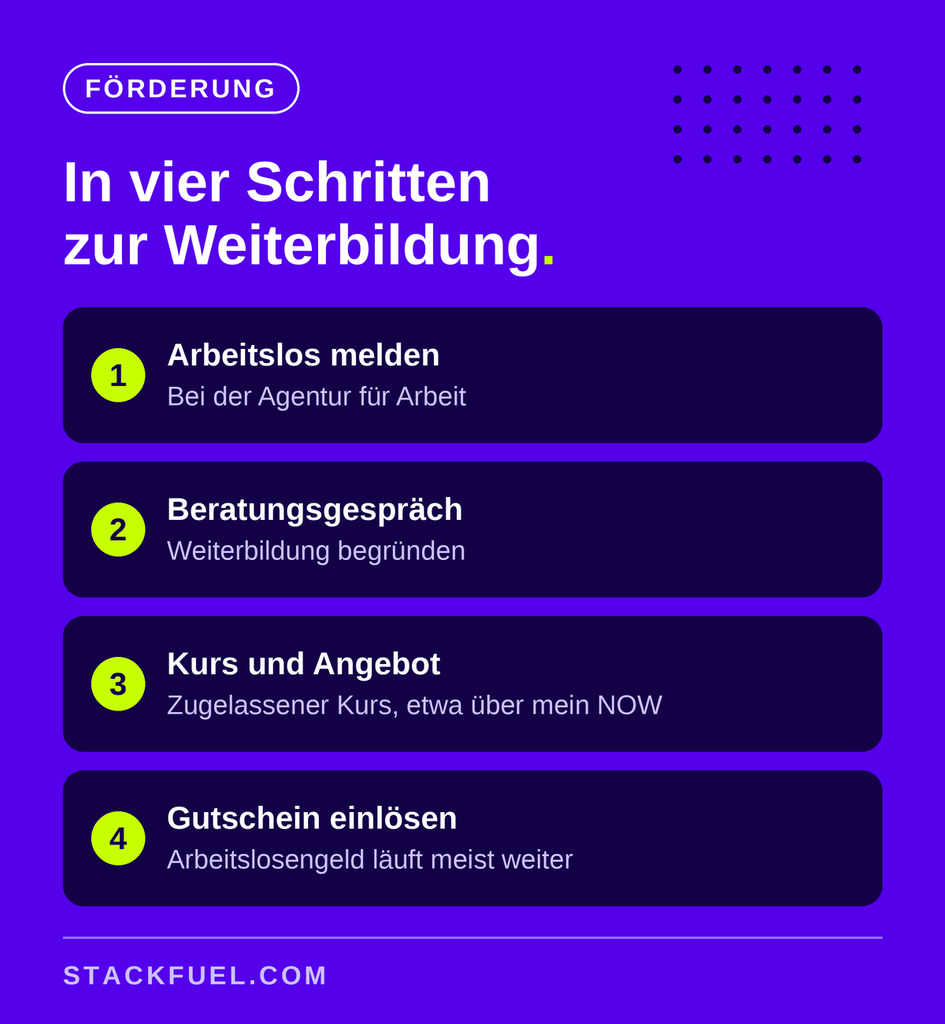
The agency will decide whether to provide funding after discussing the matter with you. The formal requirements, such as be unemployed or at risk of unemployment and choose an approved course, are quickly resolved. As Michaela's case shows, the rest comes down to the reasoning.
How did Michaela get the education voucher?
Through her own initiative. Her employment counselor was open to the idea of continuing education, but expected Michaela to find a provider herself, request a quote, and explain in writing exactly why this particular program would help her return to work.
Michaela searched the continuing education portal my NOW, booked a consultation through our website and had an offer in hand in less than a week. She went into the appointment with the offer and her cover letter, where the recruiter threw up another hurdle: Won’t AI soon take over data analysis entirely?
Her advice for the interview: Show that the continuing education program aligns with your career history. If you can point to past experience and articulate your goals, you’ll come across as convincing. The agency almost always asks about the same points: Why this continuing education program, why you can succeed in it, and what job opportunities are available afterward.
Why learn SQL and Power BI instead of the entire program?
Because two training sessions filled exactly the gap Michaela had. The first offer also included the longer Data Analyst Further Training. Her instructor thought that was too long. She suggested starting with the first two training sessions and seeing how things went from there.
Looking back, that was the right decision for Michaela. She was familiar with Power BI from her job, but not in depth. She took the SQL course first because it explains how relational databases are structured and where the data in a dashboard comes from. After two months of full-time study, she had completed both courses and was able to transition directly into her new job. That’s how our program is designed: The courses are individually certified and can be combined. Sometimes, two skills—built on existing professional experience—are all it takes.
What was a typical day of studying like, and what was difficult?
Study in the morning, reinforce what you’ve learned in the afternoon. Michaela worked through three to four lessons each morning, using videos and doing her own coding exercises. In the afternoons, she attended mentoring sessions, live sessions, or visited the Career Service, and still had plenty of time left for job applications.
The final exam in Power BI was harder than expected: building a dashboard from a very large dataset of flight data. Michaela spent about five days on it, half of that time cleaning the data. In the end, she presented nine dashboard pages to an examiner. His advice: condense the data so that management can see what’s important right on the first page.
How did she apply during her continuing education?
She took a targeted approach right from the start. Every morning before studying, Michaela looked for new job openings—especially on the Employment Agency’s job portal and on LinkedIn—and applied only to the ones that truly interested her. Waiting for the certificate would have taken time: there were a good two months between her first interview at the end of April and her first day on the job.
During career coaching sessions, she worked with Elisa to revise her resume and LinkedIn profile. Elisa’s most important tip: Highlight results. „Experience in public sector consulting“ was transformed into specific projects with details of their outcomes. This applies to every Applying for a Data-Related Job. But what made the biggest difference was a single sentence during the job interview:
„Before, I had to say, “I’m currently looking for a job.’ During my continuing education, I could say, ‘I’m currently in a continuing education program.’ Then the other person asks what field, and you talk about data analysis and Power BI.” Michaela, StackFuel graduate
What started as an explanation of a gap turned into a conversation about what it brings to the table. Elisa, who used to work as a recruiter herself, confirms this: Motivation often carries more weight in an interview than a resume that looks perfect on paper.
What is Michaela doing today?
She is once again consulting at MGM Consulting Partners, this time working more closely with the technical side of things—such as data protection and information security in software development. The project mentioned by her colleague at the company event actually existed: a concept for how change management can be made more data-driven using Power BI dashboards. Michaela was able to jump right in.
SQL helps her indirectly: Anyone who understands how relational databases are structured can more quickly grasp how software stores data. She is now taking an in-house training course to become a modeler.
„Ever since then, I’ve been thinking: I’ve done this, so now I could learn something else, too.“ Michaela, StackFuel graduate
Won't AI soon make data analysis obsolete?
Not according to Michaela’s experience. She’s answered that question twice this year—once at the Employment Agency and once at her new job. She told her recruiter what she knows from her industry: Government agencies want to make decisions based more on data, but they’re still a long way from being ready to use AI. People who know the industry and can work with data are in demand there. That convinced the recruiter.
At her new job, a coworker showed her how to use Power BI via an AI assistant using prompts. In fact, you can Design Copilot in Power BI report pages and answer questions about the data. Michaela's verdict: helpful, but for now, it's no substitute for being able to do it yourself.
This is consistent with the situation across the board. Although, according to Bitkom, 57 percent of companies are using AI, but 9 out of 10 feel they are still in the early stages. Only those who understand how a data model is structured can assess whether the AI's results are correct. That's why AI is part of the learning process: In addition to her two training sessions, Michaela had the option to take additional AI courses.
Who is this path suitable for, and who is it not suitable for?
It's suitable for anyone who can tie their previous experience to their continuing education. Michaela's response to this question from the audience: In a job interview, it's never just about your continuing education—it's also about what you've done before and how the two fit together.
It gets tricky when there’s no apparent connection between your previous job and your target position. If you’ve hardly ever worked on a computer and want to jump straight into data analysis at a large company, it’s hard to justify the career change—neither in a job interview nor to a recruitment agency. Which data jobs match which types of prior experience, but it can be described quite precisely: from a sales analyst in the sales department to a project controller in logistics.
Conclusion: Michaela's Tips for Continuing Your Education While Unemployed
Two training sessions that suited her experience were enough for Michaela. Here's what she has to say:
- Take a break when you need one. Taking a month off is more helpful than sending out applications when you're not feeling up to it.
- Go to the Employment Agency prepared. Three or four strong points, a job offer, and a cover letter can make all the difference.
- Choose the training programs that align with your experience. That way, you'll be able to explain your choices clearly to the agency and later during the job interview.
- Apply while you're still in training. Hiring processes take time, and you'll have something to talk about during the interview.
- Learn the basics, even though AI takes care of a lot of things.
„Back in January, I never would have thought that I’d be sitting here in November telling my story,“ says Michaela. Are you wondering if continuing education while you’re unemployed could help you get back to work, too? StackFuel has been AZAV-certified since 2020, Over 8,000 graduates have completed our continuing education programs in data and AI, with a completion rate of 93 percent. Together, we’ll look at your experience, the right training programs, and the support available. Simply schedule your free consultation.
Frequently Asked Questions About Continuing Education While Unemployed
Can I take a continuing education course while I'm unemployed?
Yes. The Employment Agency may provide funding for continuing education through an education voucher if it is necessary to end unemployment. The requirements are a counseling session before the course begins and enrollment in an approved course offered by an approved provider.
Will I continue to receive unemployment benefits while I'm in training?
Generally speaking, yes. If you begin a subsidized continuing education program while receiving benefits, your unemployment benefits will usually continue to be paid. For every two days you receive benefits during the continuing education program, your remaining entitlement is reduced by one day.
How long does a training course in SQL and Power BI take?
For Michaela, it took two months of full-time study to complete both training programs. The duration depends on which modules you combine. The complete Data Analyst program takes seven months full-time or 14 months part-time.
Can I apply while I'm still in the training program?
Yes, and it's worth it. Hiring processes often take several weeks. Michaela had her first interview during the first month of her continuing education program and received the job offer before the last day of training.
As a recipient of the citizen's income, am I also eligible for an education voucher?
Yes, that is possible. Since January 2025, the Employment Agency has also been responsible for determining eligibility for benefits for Job Center clients. The citizen’s income continues to be paid during continuing education as long as the recipient remains in need of assistance.