
 ChatGPT
 Perplexity
 Claude
 Grok

A lawyer with ten years of customer service experience and three years in sales. A construction manager who works on high-voltage power lines. A marketing specialist who has been planning campaigns for years. In our free Information Session on November 11, 2026 All three wanted to know the same thing: What data analyst jobs can I get as a career changer with my experience?
Maria Schwenke, who heads the StackFuel consulting team, and Nikolai Kopetzki from the consulting team provided answers. Their responses differed for each person, yet they all boiled down to the same point: The A Career Change into Data Analysis This works best in industries where your current field already generates data. Here, you can read about exactly which jobs these are, what job titles they fall under, and how AI is changing them.
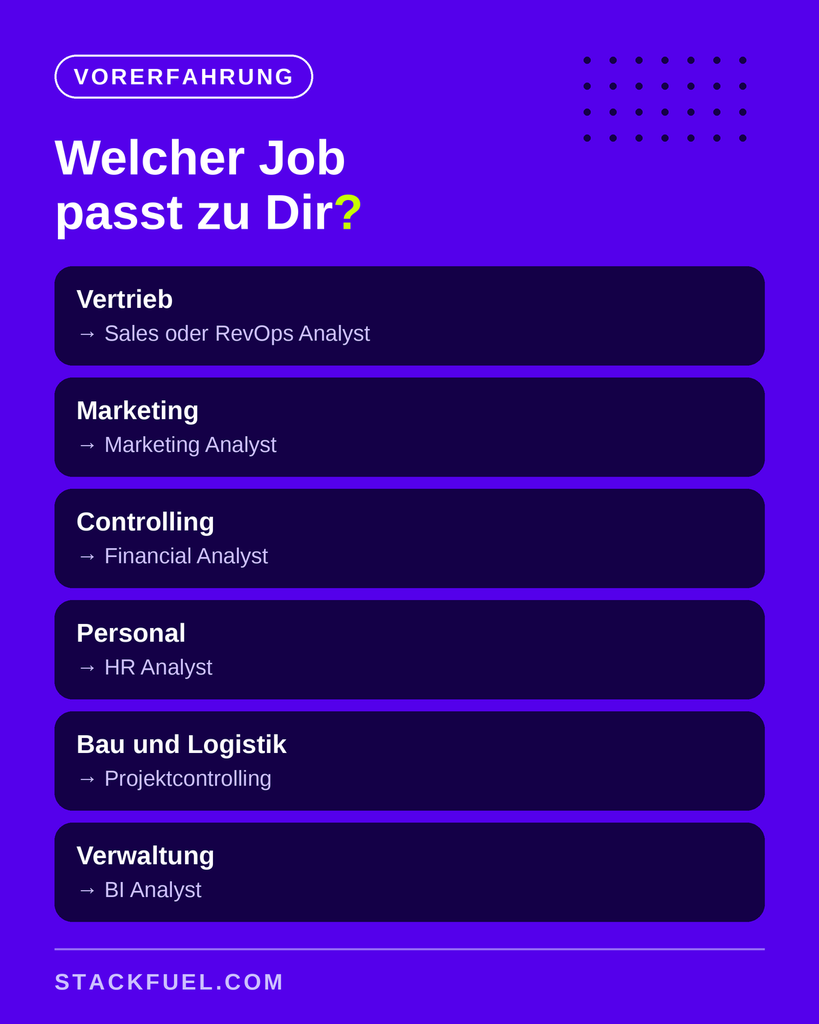
As a career changer, you’ll typically be assigned an analytical role in the field you’re already familiar with: Sales or Revenue Operations Analyst in sales, Marketing Analyst in marketing, Financial Analyst in controlling, or Project Controller in construction and logistics. Your prior experience will determine the direction you take; skills in SQL, Power BI, and some Python will make you a strong candidate for these positions.
Which jobs are a good fit for what kind of prior experience?
There’s no such thing as a “typical” data analyst job, and that’s good news for career changers. With SQL, Power BI, some Python, and the strategic use of AI, you can work in financial control, human resources, marketing, or sales. Your previous experience will determine which area you end up in, because that’s where you’ll understand the questions behind the numbers.
| Your Previous Experience | Realistic Role | Common Questions in the Workplace |
|---|---|---|
| Sales, Customer Service | Sales Analyst, Revenue Operations Analyst, CRM Analyst | Where are we losing customers? Which region is seeing a decline? |
| Marketing | Marketing Analyst, Performance Analyst | Which campaign generates revenue, and which one just generates clicks? |
| Management Accounting, Finance | Financial Analyst, Controller with a Focus on BI | Where are costs exceeding the budget? |
| Personnel | HR Analyst, People Analytics | Why do employees quit during their first year? |
| Construction, Logistics, Project Management | Project Controller, Supply Chain Analyst | Where do delays and bottlenecks occur? |
| Administration, Consulting | BI Analyst, Data Manager | What key metrics does management need each week? |
Comparing your skills to this table doesn't replace looking at actual job postings. However, it does show you where your experience gives you an edge. Three examples from the session illustrate this point.
The Lawyer with Sales Experience: What Jobs Are a Good Fit for Him?
For the first person to ask the question, the advantage lies not in a law degree, but in sales. Anyone who has worked in sales is familiar with a CRM system full of customer data and has planned or automated processes to ensure that customers are reached in a timely manner. It’s similar in customer service. That’s experience with data, even if it was never called that.
Maria sees many opportunities in the field of revenue operations, where sales, marketing, and customer data converge. She was open about his legal background:
„In the field of law, I don't see much interest in data analysis yet. I'm just telling it like it is. But attention to detail does help.“ Maria Schwenke, Head of the StackFuel Consulting Team
So it depends on which part of your resume you associate with data. With three years of sales experience, the answer is obvious: Sales Analyst or Revenue Operations.
The Construction Business Professional: What kinds of data-related jobs are there in the construction industry?
In the construction industry, data analysis makes planning, procurement, and logistics more predictable. The relevant job titles are more likely to be “project controller” or “supply chain analyst” than “data analyst.” For the participant working on high-voltage power lines, Maria and Nikolai had several approaches:
- Identify sources of error. Power BI can be used to analyze where problems tend to occur.
- Manage projects based on data. Displaying planning and logistics data in dashboards helps identify bottlenecks earlier.
- Automate processes. Recurring steps in procurement and project planning always follow the same process.
- Predict outages. Using data science methods, it is possible to estimate when the next error is likely to occur. This is more challenging to learn, but it is possible.
Maria's caveat on this: fewer problems on the construction site, yes. But to promise there won't be any problems at all would be a lie.
The Marketing Professional: Data Analyst or Data Scientist?
"In most cases, a data analyst—or more specifically, a marketing analyst," was Maria's answer to the third questioner. Marketing typically involves evaluating campaigns and presenting results in a clear and understandable way. For that, you need SQL, Power BI, and some Python. Machine learning doesn’t hurt, but it’s rarely necessary to get started. The line is clear: Data scientists build predictive models; data analysts explain what the existing data reveals.
In marketing, automations often run directly within the CRM system—such as HubSpot, Salesforce, or Pipedrive—and don’t require special programming. This is another advantage for career changers: you’re already familiar with the tools and can contribute to the analysis.
Under what job titles can you find these positions?
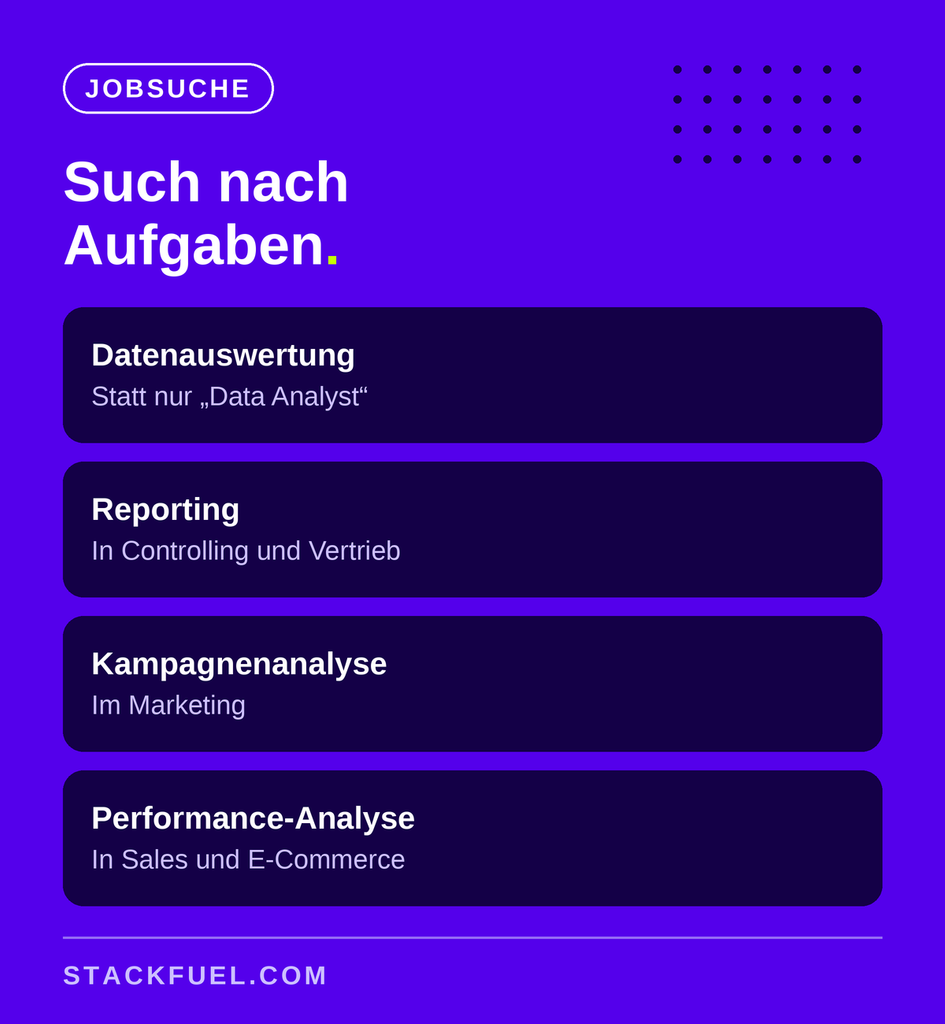
Rarely listed simply as „Data Analyst.“ The term is not a protected designation, and in job postings, the title is often a combination of the department and “analyst”:
- Marketing Analyst, Product Analyst, Financial Analyst, Sales Analyst
- BI Analyst or Data Analyst
- Data Manager or Data Analysis Specialist
Therefore, also look for tasks such as data analysis, reporting, performance analysis, or campaign analysis, in which Job Search on the Federal Employment Agency's Website just like on LinkedIn. Which requirements in such job postings really matter and which are just wish list items, can be seen in typical data analyst job postings.
Also, don't automatically assume you'll start in an entry-level position. If you have professional experience in the industry and strong data skills, you can also start above the Junior Data Analyst Level Get involved. The market remains wide open: According to Bitkom, Germany currently lacks 79,000 IT professionals, and 97 percent of companies with IT job openings are having trouble filling them.
What is a typical workday like in these jobs?
A department has a question; you find the answer in the data. Here’s an example from the session: Why have sales plummeted in the North? You gather the data, prepare it, analyze it, and present the results in a dashboard. Here’s what a typical day like this looks like:
You are currently viewing a placeholder content from YouTube. To access the actual content, click the button below. Please note that doing so will share data with third-party providers.
One participant wanted to know exactly how technical the job is. Nikolai’s assessment: depending on the company, 50 to 60 percent is technical, and the rest is communication. You clarify in advance what problem needs to be solved, and you often give the presentation yourself at the end. On top of that, there’s a task that isn’t mentioned in any job posting:
„All companies have a lot of data. But not all of them actually process it.“ Maria Schwenke, Head of the StackFuel Consulting Team
That's exactly where many people changing careers start. Then everyday life is enough From data cleaning to the presentation to senior management.
How is AI changing these jobs?
AI speeds up the work, but it doesn't replace your judgment. It writes a first draft of an SQL query or Python code, suggests visualizations, and saves you the trouble of typing. In Power BI, you can Copilot can now design entire report pages and answer questions about the data.
In general, this is still in its early stages. In the IT sector, only 9 percent of companies are currently using AI to automate routine data analysis tasks, while another 27 percent are considering it, according to the Bitkom survey on the IT labor market. In the economy as a whole, meanwhile, 57 percent of companies use AI; in controlling and accounting, the percentage rose from 17 to 25 percent.
What you need to remember: ask the right question, verify the result, and explain it to the department. An error that’s passed on without being checked multiplies. In Nikolai’s experience, what’s needed is someone who can do both: understand the fundamentals and use AI strategically. For career changers, this means not skipping over SQL and Power BI—even if an assistant writes the code. Because AI is changing the roles of data analysts, but it is not replacing the profession.
When does switching careers become difficult?
It gets more difficult if you want to leave your industry behind entirely. In that case, you’ll lack the experience that sets you apart from other applicants. This applies at any age, and especially after 50: If you stay in your industry, you can start at a level above the entry level with data skills. Those who switch fields are competing with recent graduates and junior professionals.
Three things make a career change realistic:
- Work experience that can be supported by data. Sales, Marketing, Management Accounting, Human Resources, Logistics, or Project Management.
- A passion for numbers and details. You can learn to program, but you should already have a knack for logical thinking.
- Jobs that require exactly that. Comparing this with job postings in your region shows whether the continuing education is worth it. It also convinces the Employment Agency, which supports continuing education through education voucher can help you if it gets you back to work. During the counseling session, she wants to see exactly how these factors are connected: why you're pursuing this continuing education, why you'll succeed in it, and what job opportunities are available in your region.
You don't always need a whole program for that. Our Data Analyst Further Training It has a modular structure, and each course concludes with its own certificate. If the jobs in your field only require SQL and Power BI, those two are enough. „You don’t have to learn again what you already know,“ says Maria. Michaela, for example, learned exactly that way: Two training sessions—SQL and Power BI—and I got the job offer before the last day of training.
Conclusion
The type of data analyst jobs you can get as a career changer depends primarily on the industry you’ve worked in so far. Here’s what you’ll bring to the table:
- There is no single "dream job." A career in sales can lead to roles in sales or revenue operations; a career in marketing can lead to a role as a marketing analyst; and a career in controlling can lead to a role as a financial analyst.
- Look for roles that involve tasks such as data analysis or campaign analysis, not just the title „Data Analyst.“.
- Stay in your industry. That's where your experience counts, and that's where you can start at a level above the entry level.
- About half of the job is technical; the rest is communication. AI helps you work faster, but you have to check the results yourself.
- Just learn what you're missing for those positions.
Are you wondering which of these jobs is a good fit for your resume? StackFuel has been AZAV-certified since 2020, Over 8,000 graduates have completed continuing education programs in data and AI with us, with a completion rate of 93 percent. Together, we’ll review your experience, the appropriate modules, and funding options. Simply schedule your free consultation.
Frequently Asked Questions About Data Analyst Jobs for Career Changers
What kind of data analyst jobs can I get as a career changer?
Typically, an analytical role in your current field: Sales or Revenue Operations Analyst in Sales, Marketing Analyst in Marketing, Financial Analyst in Controlling, HR Analyst in Human Resources, or Project Controller in Construction and Logistics.
As someone changing careers, do I have to start in an entry-level position?
Not necessarily. Those who stay in their industry and build up their data skills can also enter at a higher level, because industry-specific knowledge matters. Those who switch industries entirely, on the other hand, tend to start as juniors.
How technical is the job of a data analyst?
Depending on the company, about 50 to 60 percent of the work involves technical skills—namely, SQL, Power BI, and some Python. The rest is communication: clarifying questions with the business unit and presenting results in a clear and understandable way.
Do I have to complete the entire data analyst program?
No. The courses at StackFuel are modular, and each one concludes with its own certificate. If the jobs in your field only require SQL and Power BI, those two are enough.
I already had an education voucher. Can I get a second one?
That is possible; the Employment Agency decides on a case-by-case basis. First, clarify what the issue was in the past, explain how the new training program complements your previous experience, and why there are job openings for it, and then openly address the previous funding during the appointment.