ChatGPT
 Perplexity
 Claude
 Grok
Grok

Prompt engineering is the ability to work with AI in a way that consistently yields good results. While this may sound like a niche topic for tech professionals, it’s actually the opposite: a transferable core skill that’s expected in an increasing number of professions. This guide explains what prompt engineering really is, which techniques make the biggest difference, how to build this skill step by step, and which free resources you can use to get started.
What is prompt engineering?
Prompt engineering is the practice of crafting instructions for an AI in such a way that it delivers the desired result. It is not about asking a question, but rather about precisely formulating a task, providing the necessary context, and systematically improving the result. Google Cloud describes prompt engineering in its Overview of the Topic as an iterative process of formulating, testing, and refining—and that is precisely the key: A good prompt rarely comes together on the first try, but rather through deliberate refinement.
It’s important to make this distinction: prompt engineering is not programming. You work with language, not code. What matters is clear thinking, an understanding of what the AI needs, and a willingness to critically evaluate the results.
The Most Important Techniques
Across all models, certain techniques have proven to be particularly effective. They appear in the providers' official guidelines, such as in the Best Practices for Prompt Engineering from Anthropic.
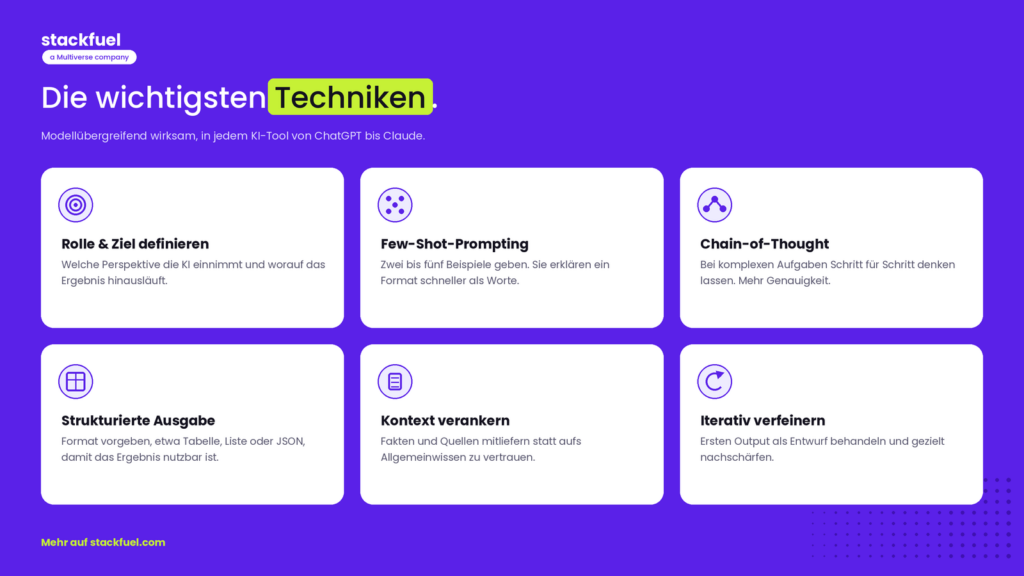
- Define the role and objective. Tell the AI what perspective it should take and what the result should be.
- Few-shot prompting. Give two to five examples of the desired result. Examples explain a format more quickly than any description.
- Chain of Thought. For complex tasks, let the AI work through them step by step. This noticeably improves accuracy.
- Structured output. Specify the format clearly—for example, as a table, list, or JSON—so that the result can be processed further.
- Establish context. Provide relevant facts and sources instead of relying on the AI's general knowledge. This will reduce the number of made-up answers.
- Refine iteratively. Think of the first output as a draft, and refine it as needed.
These techniques are not specific to any particular model. Those who master them are not dependent on any single vendor and can quickly become productive with any new tool.
How to Learn Prompt Engineering
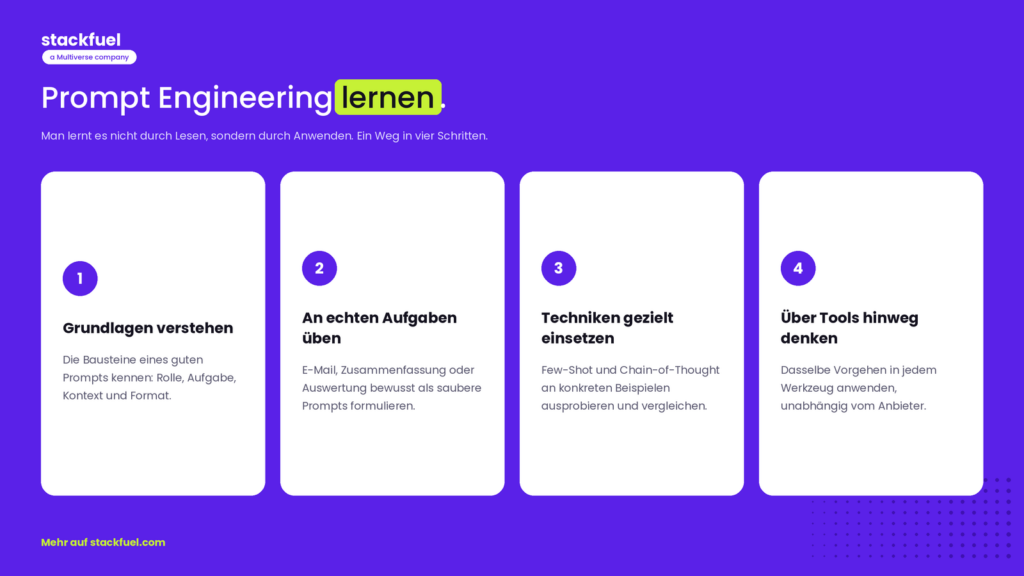
You don't learn prompt engineering just by reading—you learn it by doing. Here's a proven four-step approach:
- Understand the basics. Familiarize yourself with the building blocks of a good prompt: role, task, context, and format. The post How to Prompt ChatGPT Correctly shows you how to do this in practice using templates.
- Practice with real-world problems. Take tasks from your everyday life—an email, a summary, an analysis—and deliberately formulate them as clear prompts. Compare the results of a vague prompt with those of a precise one.
- Use techniques in a targeted manner. Try out "few-shot" and "chain-of-thought" with specific examples and see the difference.
- Think beyond tools. Apply the same approach across different tools so that the capability is independent of any single vendor.
There are some good free resources available to help you get started in a structured way. The Prompting Guide by DAIR.AI systematically covers the techniques, and DeepLearning.AI offers AI Prompting for Everyone A hands-on course that requires no prior programming knowledge.
Is prompt engineering a skill worth developing?
Yes, but with one important caveat. „Prompt Engineer“ as a standalone job title is a moving target and will evolve. The underlying skill, however—working with AI in a precise and critical manner—will become more valuable, not less. It is in demand today in marketing, administration, analytics, human resources, and many other fields.
The reason lies in the numbers. According to the Bitkom Study on AI in Germany Meanwhile, 41 percent of companies are actively using AI—more than twice as many as last year—and 81 percent consider AI to be the most important technology. As AI becomes part of everyday life, the ability to use it effectively is becoming a basic skill. This article highlights the roles related to AI that are currently emerging What careers can you pursue with AI training?.
Prompt Engineering as Part of an AI Training Course
On its own, prompt engineering is a technique. It realizes its full value as part of a broader set of AI competencies, which also includes the secure handling of data, the selection of the right tools, and responsible use in the workplace. This is precisely where a structured AI further training that doesn't teach prompting in isolation, but rather embeds it in real-world use cases. Those who are just starting out will find in AI for Beginners the right way to start.
Frequently asked questions
Can I learn prompt engineering without any prior knowledge? Yes. Prompt Engineering is about language, not code. What’s important is clear expression, curiosity, and a willingness to test and refine results. A technical degree is not required.
How long does it take to become good at prompting? You’ll have mastered the basics after just a few hours of focused practice. The real difference comes from regularly applying what you’ve learned to real-world tasks. If you work with AI every day and actively hone your skills, you’ll develop a reliable intuition in just a few weeks.
Is prompt engineering a profession in its own right? There are job titles with this name, but what’s more important is prompt engineering as a transferable skill that is in demand in many professions. Rather than focusing on the title, it’s worth developing this competency as part of a broader AI qualification.
Using AI Effectively in the Workplace
Prompt engineering is one of the skills that becomes more valuable with every advance in AI. It’s most effective when you learn it in a structured way and in context. That’s exactly what an AI training course teaches, and for job seekers, it’s 100 percent eligible for funding through the education voucher.
If you want to know which path is right for you, just schedule your free consultation. No sales pressure at all.