 ChatGPT
 Perplexity
 Claude
 Grok
Grok

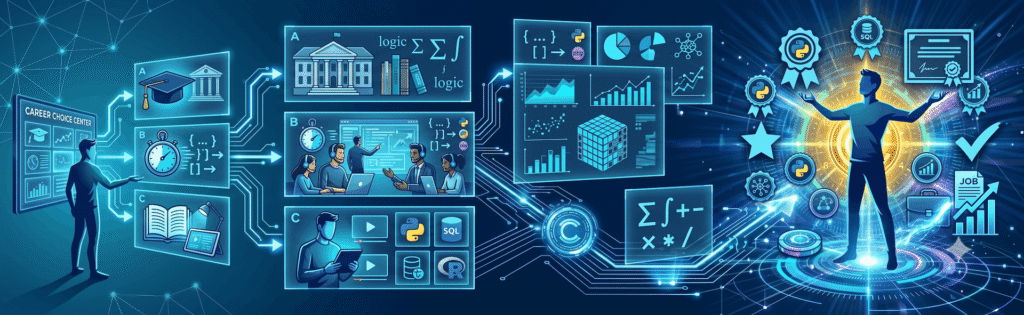
There is no „Best AI Training„. There are four categories. Depending on your starting point and career goals, one of them is right for you: online courses for a quick start.”. Certificate Programs for Advanced Academic Study. Hands-on boot camps for career changers. Distance learning or a master's degree for a formal qualification.
Which one is right for you depends on three questions: What do you want to achieve, how much time do you have, and how will you finance your continuing education? In this article, we’ll compare the StackFuel four-category model and show you how to choose the right program for your situation!
What AI training programs will be available in 2026?
In 2026, AI training programs in Germany fall into four main categories: short online courses (1–40 hours, introductory level), certificate programs offered by the IHK or academic institutions (3–9 months, academically structured), practical boot camps (8–26 weeks, project-based, AZAV-certified), and distance learning programs or master’s programs (1–3 years, leading to a formal academic degree). Which option is right for you depends on your goal: a quick start, Career Change, or Deepening.
The market is vast and confusing. On AI-Campus, you’ll find free modules from the German government. TÜV Rheinland, the Chamber of Industry and Commerce (IHK), and Fraunhofer offer established certification courses. Private providers offer boot camps, most of which are AZAV-certified and therefore Eligible for an education voucher are. Online universities and some traditional universities offer dedicated master’s programs in artificial intelligence or data science. If you’re looking for a program in this field, you can find the right one in just a few steps.
„In our daily consulting work, we see that choosing the right continuing education program is less a matter of content and more a matter of format and eligibility. Those looking to change careers need something different from those who are staying in their current jobs.“
- Maria Schwenke - StackFuel consulting team
| Format | Duration | Costs | Eligible for BGS funding? |
|---|---|---|---|
| Online course | 1–40 hours | Free – €500 | Rare |
| Certificate Program | 3–9 months | $1,500 – $6,000 | Sometimes (if AZAV) |
| Practical Bootcamp | 8–26 weeks | €8,000–€14,000 | Yes (if AZAV-certified) |
| Distance Learning / Master's Degree | 1–3 years | €5,000–€15,000 | Rare |
The table illustrates the range: from free online modules to multi-year master’s programs. The most important column for most working professionals is the last one: eligibility for the Education Voucher. Practical boot camps with AZAV certification are generally 100 percent eligible for funding through the education voucher or the Qualification Opportunities Act. For the other categories, funding is possible but not the norm.
The four categories in detail
Each of the four categories has a clear use case—and clear limitations. We’ll go through them one by one, providing an honest assessment of what each one can do and where its limitations lie.
Online Courses – A Quick Start Guide
What it is: Short, mostly asynchronous learning modules—ranging from one-hour webinars to 40-hour course programs. Providers range from free platforms (KI-Campus, Federal Employment Agency) to LinkedIn Learning and Coursera, as well as specialized commercial providers.
Best for: Basic knowledge, an introduction to key concepts, and a quick way to see if a topic interests you at all. Also ideal as a supplement to another main continuing education program.
- Strength: Quickest way to get started, lowest barrier to entry—many options are free.
- Strength: Flexible – You can study while working, at your own pace.
- Weakness: Certificates often have little market value. They are not sufficient on their own as proof of qualifications for a career change.
- Weakness: Little structured guidance, no practical projects with real feedback.
Cost and duration: Free up to 500 euros. 1–40 hours of study time. AI Campus (funded by the BMBF) is a great free starting point with modular learning units.
Certificate Programs – Academically Structured
What it is: Courses lasting several months that lead to a certificate of completion, typically designed to be taken while working. Providers: TÜV Rheinland Academy, Chamber of Industry and Commerce (IHK) academies, Fraunhofer, private educational institutions, and some universities offering continuing education programs.
Best for: Professional recognition on your resume, structured training in a specific field, and a recognized degree with market value.
- Strength: A well-established format, recognized certifications (TÜV and IHK certifications carry significant market value in Germany).
- Strength: Can be done while working—you keep your job and salary during the training program.
- Weakness: academically structured, often with less hands-on training than a boot camp.
- Weakness: Funding through education vouchers is available only if the program is AZAV-certified. This is not the standard practice for TÜV/IHK programs.
Cost and duration: 1,500 to 6,000 euros. 3 to 9 months, part-time. Patients often have to pay a portion of the cost out of pocket.
Practical Bootcamps – Project-Based Learning
What it is: Intensive programs lasting several weeks with a strong practical component. You’ll work on real-world projects, receive feedback from instructors, and complete the program with a portfolio. Typical providers: specialized training institutions in the data and AI sectors, AZAV-certified.
Best for: Changing Careers and Career Transitions. Anyone looking to transition from a non-data-related career to a data or AI career is best served by a boot camp—the combination of theory, hands-on experience, and career services is tailored specifically to this transition.
- Strength: very hands-on – You'll build projects that you can showcase in job interviews.
- Strength: are generally AZAV-certified and therefore eligible for funding under the 100% program via education vouchers or the Qualification Opportunities Act.
- Strength: Career services as an integral part of the program – application support, resume coaching, and networking.
- Weakness: Intensive. Full-time boot camps require a commitment of 30–40 hours per week. Part-time options are available, but they take correspondingly longer to complete.
Cost and duration: 8,000 to 14,000 euros. 8 to 26 weeks. If the course is AZAV-certified, the costs are usually fully covered by the AfA. If you'd rather focus on specific tools, here's the Tool-focused overview for data analysts in addition.
Distance learning and master's programs – formal academic
What it is: Multi-year degree programs leading to a formal academic degree (Bachelor’s, Master’s, MBA with a focus on AI). These are offered by online universities (IUBH, Deutsche Hochschule, AKAD) and some traditional universities that offer online Master’s programs.
Best for: theoretical specialization, academic research opportunities, career options that require a master’s degree (e.g., corporate positions, academic careers, research institutions).
- Strength: the highest formal standing, widespread recognition, and international validity.
- Strength: In-depth theoretical foundations: mathematics, statistics, machine learning theory.
- Weakness: A long-term commitment (1–3 years full-time, 3–5 years part-time). This is a major life decision.
- Weakness: higher out-of-pocket costs – the education voucher covers these only in exceptional cases, Aufstiegs-BAföG is usually the more realistic approach.
Cost and duration: 5,000 to 15,000 euros. 1 to 3 years full-time; longer if taken while working. Eligible for funding through the Aufstiegs-BAföG program; in some cases, through educational vouchers.
Which AI training program is right for you?
The best AI training depends on your career goals and your current situation. If you’re looking to switch careers into a data-related field, a hands-on bootcamp (e.g., Data Analyst) with AZAV certification and eligibility for education vouchers is a good fit. For professional development in your current job, a certificate program under the Qualification Opportunities Act is a good fit. For theoretical deepening, a master’s degree program is a good fit. There isn’t just one best program—there’s the right one for your situation.
If you're planning a career change
Bootcamp. A hands-on bootcamp is for a career change into a data-related field is the best fit—the combination of theory, hands-on projects, and career services is specifically designed to support this transition. Look for AZAV certification (a requirement for educational vouchers) and career services that go beyond just resume tips. If in doubt, a consultation can help: half an hour is often enough to identify the right category.
If you want to advance in your current job
A certificate program or a part-time boot camp. Both are covered by the Qualification Opportunities Act (Section 82 of SGB III): Your employer applies, and the AfA provides funding. Which format is right for you depends on how specific your new role needs to be. If you’re staying in your current profession and want to add AI skills, a certificate program is often sufficient. If you want to transition into a data role within your company, a part-time bootcamp is the more effective preparation.
If you want a quick start
Online course. If you first want to find out whether AI interests you at all, or if you just need a basic understanding of the terminology for your job, a free online course is the right place to start. AI Campus, the LinkedIn Learning AI tracks, and free Coursera modules are good places to start. Plan: Invest 10–20 hours, then decide if you want to go further.
If you need to delve deeper into academic topics
Distance learning or a master’s degree. This path is worth it if you want a position that formally requires a master’s degree: corporate roles with personnel responsibility in the data sector, research institutions, or consulting firms with minimum academic requirements. Be honest with yourself: a master’s degree takes 1–3 years. This is a major life decision, not just a choice of program.
How much does AI training cost?
In 2026, AI training programs will range in cost from free (AI Campus, some Chamber of Industry and Commerce [IHK] programs) to 15,000 euros (private boot camps, master’s degree programs). Practice-oriented, AZAV-certified boot camps typically cost between 8,000 and 14,000 euros. These are generally 100 percent covered by the education voucher or are eligible for funding under the Qualification Opportunities Act. Out-of-pocket costs usually arise only when funding is not an option.
Important: The amounts listed are gross prices. For AZAV-certified courses eligible for education voucher funding, you, as a participant, won’t pay a cent. AfA pays the course fees directly to the provider. Under the Qualification Opportunities Act, the AfA covers up to 100 percent of the training costs (for small businesses), 50 percent (for medium-sized businesses), or 25 percent (for large businesses), plus a portion of the wage compensation; your employer covers the rest.
How do you pay for your AI training?
There are three funding options available for AI training programs in Germany. Which one is right for you depends on your current employment status.
If you are registered as a job seeker or are at risk of being laid off, you can use the education voucher to enroll in an AZAV-certified continuing education program (§ 81 SGB III) can be fully funded. Most practice-oriented boot camps are eligible for funding. We’ve covered the details and the application process in a separate article on AI Training with an Education Voucher in summary.
If you want to stay active and improve your skills, you can Qualification Opportunity Act (§ 82 of Book III of the Social Code). Your employer applies for the subsidy, and AfA covers up to 100 percent of the course costs plus Percentage of Wage Compensation.
Which of the three options—staying in your job, resigning before being laid off, or pursuing further training after being laid off—is right for you depends on your current employment situation. The A Comparison of Three Approaches We have summarized this in a separate article.
Is it worth pursuing AI training in 2026?
For most professionals, AI training in 2026 is a worthwhile investment—provided it aligns with your career goals. Job postings related to AI or data have increased significantly in Germany in recent years (Source: Indeed Hiring Lab, Germany Report 2026). In addition, the following shows Bitkom Studies on AI Adoption German companies are seeing a steady increase in practical AI applications across all industries. Those in non-data-intensive roles benefit less directly. A free 30-minute consultation will help you determine which approach is realistic for your situation.
By the numbers: a hands-on boot camp typically costs between 8,000 and 14,000 euros—fully covered by AfA if it has AZAV certification. The Starting salary in the data field ranges from 45,000 to 55,000 euros per year in Germany (Source: kununu, 2026). Those who successfully make a career change typically recoup their investment of time and energy well within the first year after graduation. Those who build on their AI skills in their current job see the benefits more slowly but steadily: through salary growth and new areas of responsibility.
If you're not sure whether this is the right choice for your specific situation, we'd be happy to discuss it with you. An honest assessment of the prospects and risks takes just half an hour—and can help you avoid making the wrong decision, whichever way you go.
Frequently asked questions
Five questions that frequently come up in counseling—answered concisely.
Which AI training courses are eligible for education vouchers?
Only AZAV-certified measures that listed on KURSNET, the Federal Employment Agency's website In practice, these are primarily hands-on boot camps (lasting 8–26 weeks, either full-time or part-time). TÜV/IHK certificate courses are less likely to be eligible for BGS funding—in such cases, Aufstiegs-BAföG is often the better option.
How long does an AI training course typically last?
Ranges from 1 hour (free online course on AI Campus) to 3 years (part-time master’s program). Realistic categories: online courses 1–40 hours, certificate programs 3–9 months, hands-on boot camps 8–26 weeks, distance learning 1–3 years. The right duration depends on your goal.
Is an AI master's degree worth it compared to a bootcamp?
For most career changers, no. A master’s degree takes 1–3 years and costs 5,000–15,000 euros in tuition fees. A bootcamp takes 8–26 weeks and is usually eligible for BGS funding. A master’s degree is only worth it if you’re aiming for a position that formally requires one: corporate roles with personnel responsibility, research, or academic consulting firms.
Can I take an AI training course while working?
Yes, many AZAV-certified boot camps offer part-time options (typically 15–20 hours per week over 6–12 months). Certificate programs offered by TÜV/IHK are almost always designed to be taken alongside work. Distance learning programs and master’s degrees can be taken part-time, but they then take 3–5 years to complete.
Are free AI courses (e.g., AI Campus) really useful?
Yes for beginners, but no for a career change. The free modules on KI-Campus (funded by the BMBF) and on LinkedIn Learning provide a solid foundation of knowledge. They are suitable for preparation or for further study alongside your current work. However, a KI-Campus certificate alone is not enough to apply for a job as a data analyst.
Let's find the right training program
Four categories, many programs. And the question of which one is right for you depends on your current situation, your career goals, and your funding status. That’s exactly what the free consultation. Together, we’ll figure out which option is realistic for you, what financial aid is available, and which programs are a good fit.
StackFuel has been AZAV-certified since 2020; all training programs are listed on KURSNET, and cohorts start every nine weeks—both full-time and part-time. Over 8,000 graduates have completed our continuing education programs in data and AI, with a completion rate of 93 percent and 80 percent practical training. Beatrix Bauer worked at Telefónica for 22 years and used the pandemic period to reorient her career. Today, she is a Junior Financial Data Engineer. Here’s what she has to say:
With StackFuel, I was able to learn at a time that suited me, at my own pace, and in a place where I felt comfortable.
- Beatrix Bauer - Junior Financial Data Engineer - Telefónica Germany - Data Scientist Training Program
There’s no single “best” AI training program. But there is one that’s right for your situation. Let’s figure out which one that is together!