 ChatGPT
 Perplexity
 Claude
 Grok

Anyone looking for a path into data analysis quickly finds themselves torn between three options: a bachelor’s degree at a university, a flexible online program, or a condensed continuing education course. All three lead to the same career, but they differ significantly in duration, cost, and what you end up with on paper. The providers’ websites offer little help in making a decision, since each one naturally promotes its own program.
This article takes an objective look at the three options: what they cost, how long they take, who they're intended for, and what employers really want to see in the end.
You are currently viewing a placeholder content from YouTube. To access the actual content, click the button below. Please note that doing so will share data with third-party providers.
Do you need a college degree to become a data analyst?
No. Data Analyst is not a regulated profession, nor is it a degree program requiring a specific degree. A college degree is one of three paths to entering the field, alongside distance learning and subsidized continuing education. The key to getting started is demonstrating proficiency in Excel, SQL, and a BI tool, as well as a A project you can showcase.
That doesn't mean that a college degree is worthless. It just means that the decision depends on your circumstances: your age, budget, time, and whether you already have a degree.
What does a traditional college program offer?
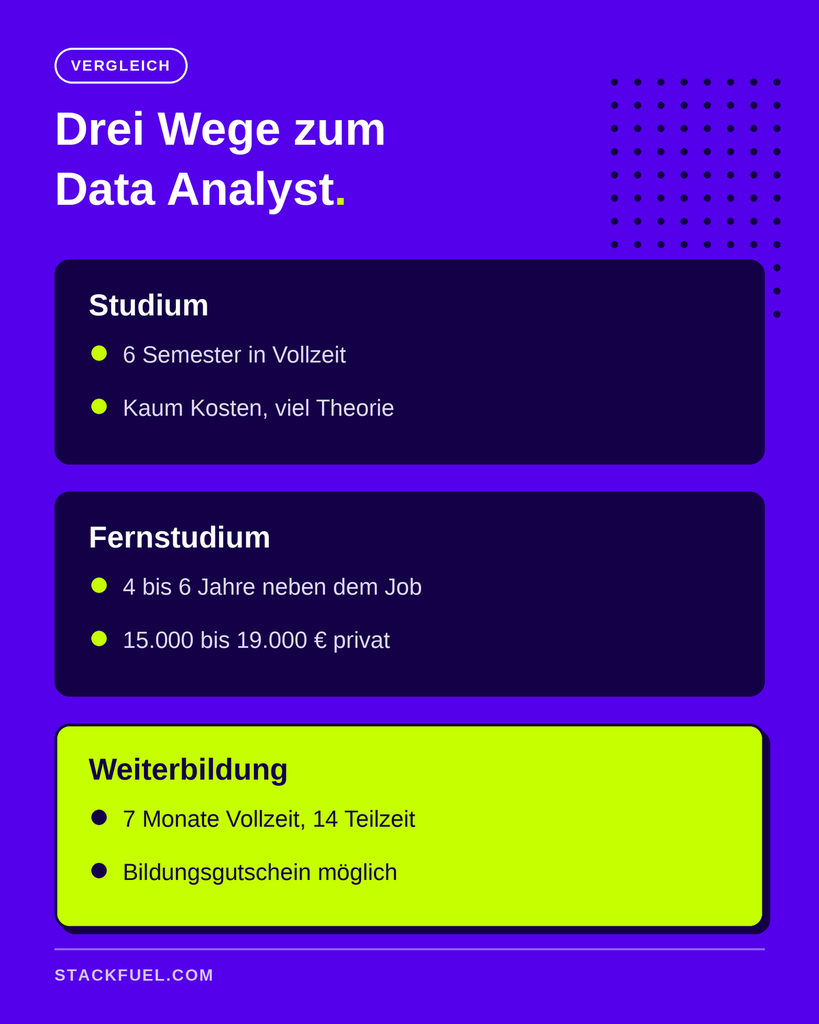
A bachelor's degree in data science or a related field typically takes six semesters to complete at German universities and is worth 180 ECTS credits. Degree programs such as the one with no admission requirements Bachelor's Degree in Data Science at FAU Erlangen-Nuremberg combine computer science, mathematics, and statistics, often with an elective application-oriented subject.
Admission requirements vary by university and state: Some degree programs have no admission requirements, others have a minimum admission score (NC), and, depending on state law, those with professional qualifications may be able to enroll even without a high school diploma. Always check the specific requirements for the program you’re interested in, rather than relying on general statements.
The strengths: The program provides the broadest theoretical foundation, costs practically nothing at public universities aside from the semester tuition, and opens doors to roles that formally require a degree, such as in the public sector or in research. Those who later wish to pursue a career in data science or machine learning will benefit from the in-depth knowledge of mathematics and statistics.
The honest assessment: three to four years of full-time study, hardly any practical experience in the first few semesters, and a curriculum that often doesn’t even touch on tools like Power BI. For someone changing careers at age 35, this is rarely the most efficient route.
What are the benefits of distance learning?
Distance learning adapts the university model to self-directed study. Private distance-learning universities offer bachelor’s programs in data science and business intelligence, typically spanning six to twelve semesters and designed to be pursued while working. The following list shows which universities offer distance learning programs: Higher Education Compass of the German Rectors' Conference including all distance learning programs in Germany. The catch is the price: Private providers typically charge between 15,000 and 19,000 euros for a full bachelor's degree.
College certificates are significantly less expensive. The Hagen Distance Learning University For example, it offers a continuing education program for data analysts consisting of 320 learning hours and 10 ECTS credits for 700 euros, comprising courses in SQL, XML, and Python, with up to four semesters to complete the exams. Such certificates do not replace a degree, but they do complement an existing one.
Distance learning is a good fit if you want a formal college degree but can’t study full-time. The downside is rarely mentioned in the brochures: You’ll need self-discipline for years while working, and dropout rates for distance learning are high. Be honest with yourself about whether you can stick with it for four to six years, studying evenings and weekends.
Also, be sure to factor in the additional costs honestly: Even with distance learning, some providers require in-person sessions—which involve travel and overnight stays—and the standard duration of study can quickly extend by several semesters when you’re working full-time. The promotional claims made by private providers are based on an ideal scenario, not your everyday reality.
When is continuing education sufficient?
In most cases, a structured approach is sufficient to get started as a data analyst in the private sector. Further training as a data analyst, provided it results in something presentable. Employers ask in Job Postings They rarely look for a specific degree program. They ask about Excel, SQL, a BI tool, and whether you can use data to solve a problem.
That’s exactly what continuing education programs are designed for. StackFuel’s Data Analyst training program lasts 7 months full-time or 14 months part-time and covers topics ranging from Excel to SQL and Power BI to object-oriented Python, culminating in a portfolio project. StackFuel has been AZAV-certified since 2020, so the course can be funded through a education voucher The costs will be fully covered if the Employment Agency approves it. There is no legal entitlement; ultimately, your case worker will make a decision on a case-by-case basis.
The difference from a degree program lies in the credential: Continuing education programs conclude with a certificate from the program provider, not a bachelor’s degree. For the vast majority of analyst positions in companies, this doesn’t matter. For careers that formally require a college degree, however, it does.
How do you make up your mind?
The decision depends less on the offer than on your current situation.
You're in your early 20s, have graduated from high school, and have time on your hands: College is worth it. The depth of theoretical knowledge will serve you throughout your entire career, and the cost of attending public universities is unbeatable. Financial assistance is available through BAföG.
You already have a degree and are working: An expensive second bachelor’s degree won’t teach you much that’s new. A college certificate or a part-time continuing education program while working will specifically supplement your existing degree with data literacy skills.
If you're looking for work or at risk of unemployment, subsidized continuing education is almost always the fastest route. With an education voucher, it costs you nothing, takes months instead of years, and culminates in a project you can include in your resume.
If you want to go into research or dive deep into machine learning, there’s no way around getting a degree in the medium term—at least a master’s degree.
Alexander Eckrot, Strategic Operations Manager at StackFuel, has guided thousands of career changers on their way to their first data job. Here’s what he has to say: „Being a data analyst isn’t a talent you either have or don’t have. It’s a path you take.“ Which of the three paths you choose is secondary. What matters is that you can demonstrate results in the end.
What do employers see in the end?
No matter which path you take: What matters in a job interview is what you can do with it. A project you completed as part of your application that answers a real-world question using real data will carry more weight than your degree title in almost any interview for an analyst position. A degree program without projects comes across as abstract, while continuing education with a strong portfolio comes across as concrete.
So evaluate every path using the same criterion: Are you building something along the way that you can showcase in a job application? A curriculum that consists solely of theory and exams will leave you to catch up on that part on your own.
Frequently Asked Questions About College and Distance Learning
Can I become a data analyst without a high school diploma? Yes. You don't need a high school diploma to enroll in a continuing education program, and also Going to college without a high school diploma is possible for those with professional qualifications, depending on the federal state. Only traditional university programs generally require a high school diploma or equivalent.
How much does an online degree program in data analysis cost? A full bachelor’s degree at a private online university typically costs between 15,000 and 19,000 euros. University certificates are significantly less expensive; the data analyst course at the FernUniversität in Hagen costs 700 euros. AZAV-certified continuing education programs can be fully funded with an education voucher.
Does the Employment Agency provide financial assistance for distance learning programs? Undergraduate studies are not funded through the education voucher. The voucher is valid for continuing professional education at AZAV-certified providers. For undergraduate studies, BAföG or scholarships may be available.
Is a certificate worth less than a bachelor's degree? For traditional analyst positions in companies, the overall picture—comprising skills and projects—is more important than the type of degree. Formally, only some of these positions require a college degree, particularly in the public sector and in research.
How long does the entire trip take? Degree program: three to four years full-time. Online bachelor’s degree: four to six years while working. Continuing education: 7 months full-time or 14 months part-time.
Can I switch from distance learning to continuing education? Yes, and vice versa. Starting a degree program isn’t a dead end. Many people changing careers combine an existing degree with a short continuing education program instead of starting over.
Your Next Step
Whether it's a degree program, distance learning, or continuing education: Make your decision based on your individual circumstances, not on the loudest advertising. If you want to know whether a subsidized continuing education program is a good fit for your situation and How to Get the Education Voucher, simply schedule your free consultation with StackFuel. During the appointment, you'll be able to determine which path is realistic for you.