
 ChatGPT
 Perplexity
 Claude
 Grok

Anyone who works with Claude or ChatGPT constantly comes across two terms that often appear in the same sentence: agents and skills. Sometimes you’re told to build an agent; other times, to create a skill. Then there are sub-agents, plugins, and workflows. No wonder so many people get these terms mixed up.
But the difference is simple once you see it. This article explains both terms, shows how they work together, and helps you decide when to build a skill and when to give the agent free rein.
What is the difference between AI agents and skills?
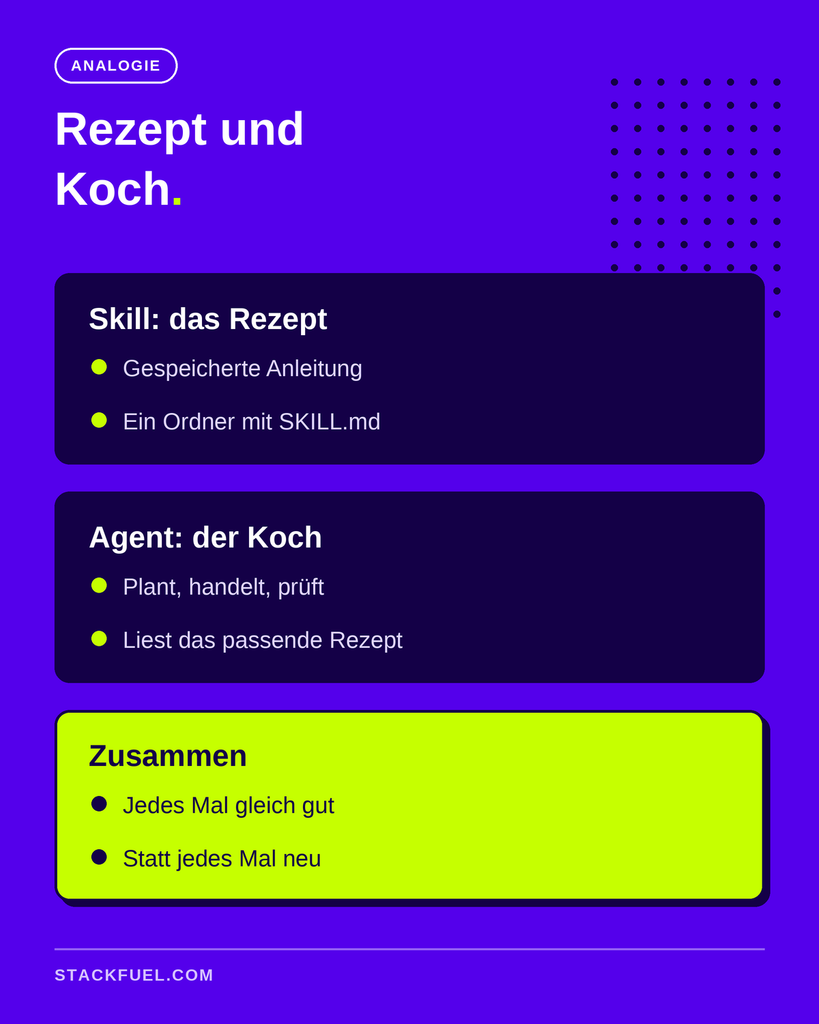
An AI agent is a system that pursues a goal, plans its own steps, and uses tools until the task is completed. A skill is a stored set of instructions for a specific task that the agent refers to as needed. In short: The agent is the cook, and the skill is the recipe. The two do not compete; they work together.
A good cook can still cook without a recipe, but the result will be slightly different each time. Without a cook, a recipe remains just a piece of paper. Only together can they produce a result that’s just as good every time.
What is an AI agent?
An agent differs from a chatbot in that it operates in a loop. A chatbot responds and then stops. An agent plans, acts, evaluates the result, and decides what to do next—repeating this process until the goal is achieved. Anthropic describes agents in its guide to effective agents as language models that use tools in a loop while choosing their own path. This distinguishes them from Anthropic workflows, in which the steps are predetermined.
Google puts it this way in its Explanation of AI Agents Similarly, agents pursue goals on behalf of users, plan, remember, and make their own decisions within certain limits.
In everyday office life, you'll encounter agents today primarily in three forms:
- Claude with its agent-based operating mode, which reads files, creates documents, and performs multi-step tasks
- ChatGPT Work, which works with your folders and connected tools in the desktop app
- Claude Code and Codex, the two agents for software development
What they all have in common is this: You set a goal, not every single step.
What is a skill?
A skill is a reusable set of instructions that teaches an agent to perform a specific task your way—your template, your tone, your steps. You can think of a skill as a saved set of work instructions that sits on the shelf until it’s needed.
Technically speaking, a skill is surprisingly simple: a folder containing a file named SKILL.md. This file includes a name, a brief description, when the skill is needed, and the actual instructions. Optionally, it may also include templates, sample files, or small scripts.
Examples of typical office skills:
- Create a Monthly Report Using the Company's Layout
- Extract incoming documents and enter them into the accounting spreadsheet
- Format the newsletter in the brand's style
- Create presentations based on the company template
A skill alone does nothing. It only becomes active when an agent is assigned a suitable task and activates it.
How do agents and skills work together?
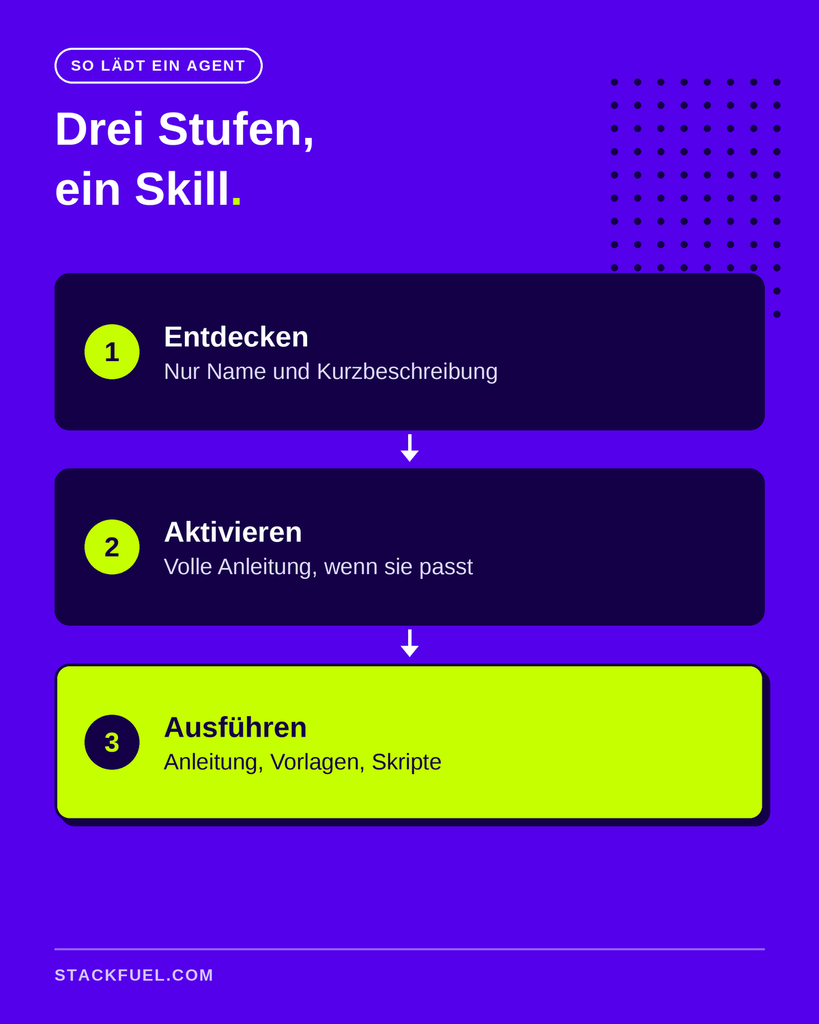
The trick lies in how skills are loaded. An agent does not constantly know the full contents of all skills; that would overload its working memory. Instead, the process takes place in three stages, as defined by the open standard at agentskills.io describes:
- Discover: The agent knows only the name and a brief description of each skill.
- Enable: If a task matches the description, the agent downloads the complete instructions.
- Execute: The agent follows the instructions and uses the included files and scripts as needed.
This incremental loading is why an agent can have dozens of skills installed without slowing down. It also explains why the short description is so important: if it's unclear, the agent won't be able to find the skill when it needs it.
Do Claude and ChatGPT have the same skills?
Yes, and that’s one of the most important developments of the year. Skills were originally developed by Anthropic while working on Claude Code and introduced for Claude in October 2025. In December 2025, Anthropic released the format as an open standard. Since then, according to Anthropic, more than 70 platforms have adopted it, including ChatGPT, GitHub Copilot, Cursor, and VS Code.
In October 2026, Anthropic went one step further and handed over the standard to the Agentic AI Foundation, which operates under the umbrella of the Linux Foundation. As a result, the format is no longer owned by any single company.
For you, this means: Once you've written a skill correctly, it isn't tied to any specific tool. In ChatGPT, skills are part of the plugins that OpenAI offers in its Developer Documentation describes. A plugin bundles apps—that is, the connection to a service like Gmail—and skills—that is, the instructions on how to use them. The app tells the agent where to work. The skill tells the agent how.
And what are sub-agents?
Sub-agents are the third term that causes confusion. They are additional copies of the main agent that the main agent launches to perform subtasks. In the case of market research, for example, the main agent might send out one sub-agent per region. They all work simultaneously and report their results back.
Sub-agents are therefore still agents, just in a subordinate role. And a skill can specify that a sub-agent be used for a particular step. This creates a simple hierarchy:
| Term | What It Is | Analogy |
|---|---|---|
| Agent | A system that plans and acts | the cook |
| Skill | saved instructions for a task | The Recipe |
| Sub-Agent | An assistant to help with part of the work | the kitchen assistant |
| App / Connector | Connection to a Tool | access to the pantry |
When do you build a skill, and when do you let the agent do it?
This distinction has a practical benefit: it tells you where to start looking if a result isn't right.
Build a skill when A task is clearly defined and occurs on a regular basis. Weekly reports, document filing, brand layout: Here, you want things to go the same way every time—you don't want the agent to improvise.
Give the agent free rein when the task is new, disorganized, or open-ended. Initial research into an unfamiliar market requires sound judgment, not rigid guidelines.
If results vary, In most cases, the problem isn't with the agent, but rather with missing or unclear instructions. The better solution in that case is a skill, not a different tool.
It’s best not to write skills on a blank sheet of paper. Another approach has proven effective: Work through the task step by step with the agent, correct it until the result is right, and then have it save the process as a skill. Both Claude and ChatGPT have built-in tools for this. This creates a skill based on an actual run-through rather than on assumptions about what the tool is capable of.
Having a sense of how to clearly describe tasks to an AI helps tremendously. The article on Learn Prompt Engineering. If you're just starting out, it's best to begin with the overview AI for Beginners.
What does that mean for your work?
Agents have only just begun to appear in German companies. How t3n and MIT Technology Review As described as early as 2025, today's agents excel at clearly defined tasks, while they still require supervision when it comes to long, open-ended tasks. Little has changed in this regard: Agents have become faster and more reliable, but they still need clear goals, good guidance, and someone to review the results.
This is precisely the role that is currently emerging in many teams: people who identify recurring processes, document them as skills, and deploy agents in a way that yields reliable results. The overview of AI Training Programs by Occupation.
If you want to learn this systematically, you'll find the Continuing Education in AI Workflow Automation, which focuses on automation in n8n and the use of AI agents. It is part of the AI Continuing Education, which last one to two months full-time or three to four months part-time. StackFuel has been AZAV-certified since 2020; funding through the education voucher is available, though there is no legal entitlement to it.
Frequently Asked Questions About AI Agents and Skills
Is a skill an agent? No. A skill is a set of instructions; an agent is the system that reads and executes them. A skill does nothing unless an agent uses it.
Can an agent work without any skills? Yes. He then has to figure out each process from scratch. That's fine for one-time tasks, but for recurring work, it leads to inconsistent results.
Do Claude skills also work in ChatGPT? Generally speaking, yes, because both support the open Agent Skills standard. A skill that relies on specific connections or tools within a tool may need to be adapted.
Do I need programming skills to build a skill? No. At its core, a skill is a text document containing instructions. The easiest way is to have the agent create it themselves after you've completed the task together once.
What is the difference between a skill and a prompt? A prompt applies to a single conversation. A skill is saved, loaded automatically when appropriate, and can contain templates and scripts. It turns a good prompt into a repeatable workflow.
What are sub-agents? Additional copies of the main agent that process subtasks in parallel and report their results back—for example, one subagent per region in a market research project.
Your Next Step
Find a task that you do the same way every week, and complete it once together with an agent. If the result is correct, save the process as a skill. If you want to learn how to set up such processes professionally and would like to know whether a subsidized training program is right for you, Schedule a free consultation.