
 ChatGPT
 Perplexity
 Claude
 Grok

Applying for your first job as a data analyst feels like a chicken-and-egg problem: You need experience for the job, but you need the job to gain that experience. On top of that, there’s the question of whether anyone even reads cover letters anymore, and what should go in a resume that doesn’t yet include the term „data analyst.“.
This article walks you through the application process step by step: your resume, cover letter, the project that makes up for your lack of work experience, and the job interview—including the rules that experienced recruiters actually follow.
You are currently viewing a placeholder content from YouTube. To access the actual content, click the button below. Please note that doing so will share data with third-party providers.
What should be included in a data analyst job application?
A data analyst application consists of a resume, a brief cover letter (if required), and a project you can showcase. The project is the most important part: for career changers, it makes up for a lack of professional experience and provides a topic for the interview. Transcripts and certificates support your application but are rarely the deciding factor.
How do you structure a resume if you don't work in data?
The most common mistake in a resume for career changers is downplaying their past: They downplay their previous career as if it were a flaw. The opposite is true. Alexander Eckrot, Strategic Operations Manager at StackFuel, who has guided thousands of career changers into their first data jobs, puts it this way: „Your previous background is an asset, not an obstacle.“
Specifically, this means: Describe your career history in terms of data and decisions. Whether you’ve planned order quantities in retail, optimized delivery routes in logistics, or maintained reports in an office setting, you’ve worked with data. Also Volunteer Positions and Projects Count, if you describe them as you would professional experience—with tasks, results, and time frames. „Data literacy plus domain knowledge. You already have half of that,“ says Eckrot about these very profiles.
The structure remains classic: contact information, a profile section with your target role and your three strongest examples, work experience with data-related tasks listed first, followed by continuing education and tools (Excel, SQL, Power BI, Python—honestly rated), and finally the project with a link. One page is almost always enough; two is the maximum.
Do you still need a cover letter?
It depends on the job, and the numbers are more sobering than many advice columns admit. In a StepStone Survey from 2025 Only about half of companies still required a cover letter, and only about a quarter of recruiters considered it essential. Major employers such as Deutsche Bahn have even eliminated the cover letter from parts of their hiring process completely abolished.
The rule of thumb: Whenever a cover letter is required, write a short, to-the-point one. Three paragraphs are enough: why you’re applying for this position, what you can demonstrably bring to the table (using the project as evidence), and why your background is a good fit for this industry. What to leave out: clichés, a rehash of your resume, and any line that could appear in any application. If a cover letter isn’t required, invest your time in the project and in building direct contacts.
Which documents really matter?
The resume is the only document that is practically always required: In the StepStone survey, 96 percent of companies requested one. Sixty-four percent of recruiters cited qualifications and skills as a decisive criterion, while 42 percent cited error-free spelling. By contrast, only a little over one-fifth considered an elaborate layout to be decisive, and references are seen as helpful but rarely as decisive.
For you, this means: Invest your time in content and accuracy, not in design. A clearly structured page where your skills, career history, and project can be grasped in ten seconds beats a visually elaborate portfolio. Include references and certificates where they’re requested, but they won’t carry your application on their own.
Which project should you include in your application?
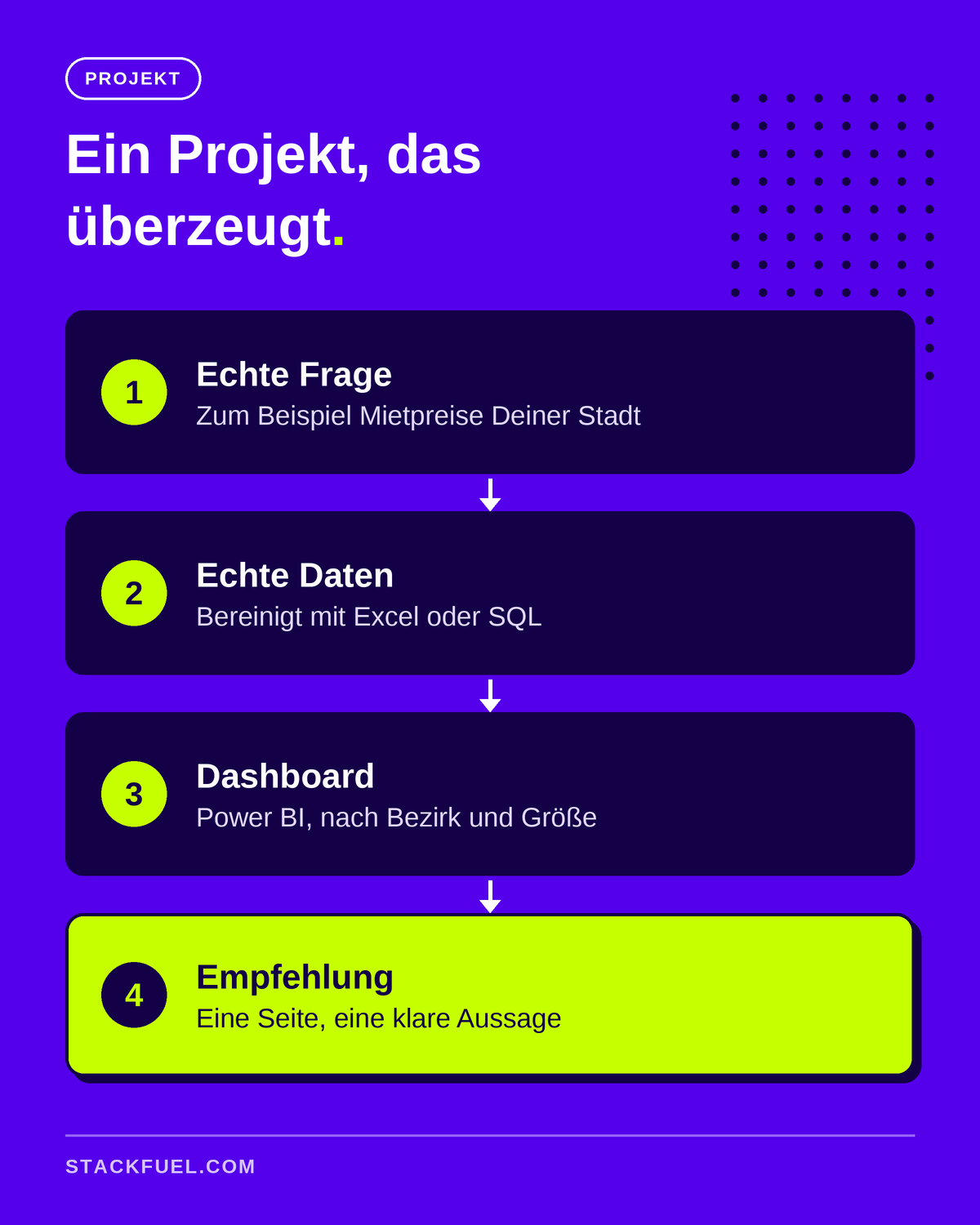
„A project for your application that answers a real-world question is worth more than five academic projects.“ This quote from Eckrot is the most important rule of the entire application process. Course assignments using prepared data sets demonstrate that you can follow a curriculum. A project of your own demonstrates that you can get the job done.
His example of such a project: public rental price data for his own city, cleaned up using Excel or SQL, a Power BI dashboard broken down by district and number of rooms, plus a one-page summary with a recommendation. The question is real, the data is real, and the result can be presented in two minutes. How you can turn this into a complete Data Analyst Portfolio ...is a topic in itself.
It becomes even more meaningful when someone has truly needed the result: an evaluation for a club, an analysis for a small business, or a first freelance assignment. „Anyone who can say, “I did this for someone who really needed the results,’ has much more to show for it than 1,000 certificates.”
You can showcase the project on a small portfolio page, in a Notion document, or in the "Featured" section of your LinkedIn profile—in each case, with screenshots and a brief description of what the project demonstrated.
How do you get past the stack?
The uncomfortable truth about mass outreach: „One conversation is worth ten applications.“ This doesn’t refer to connections, but to direct contacts. Eckrot’s recommendation is clear: „Send a direct message on LinkedIn with a genuine question. Don’t send a generic connection request.“
This works because asking a genuine question of someone on the hiring team sets you apart from the anonymous crowd and, at the same time, provides information that isn't included in any job posting. Send two messages like this each week in addition to your applications—not instead of them.
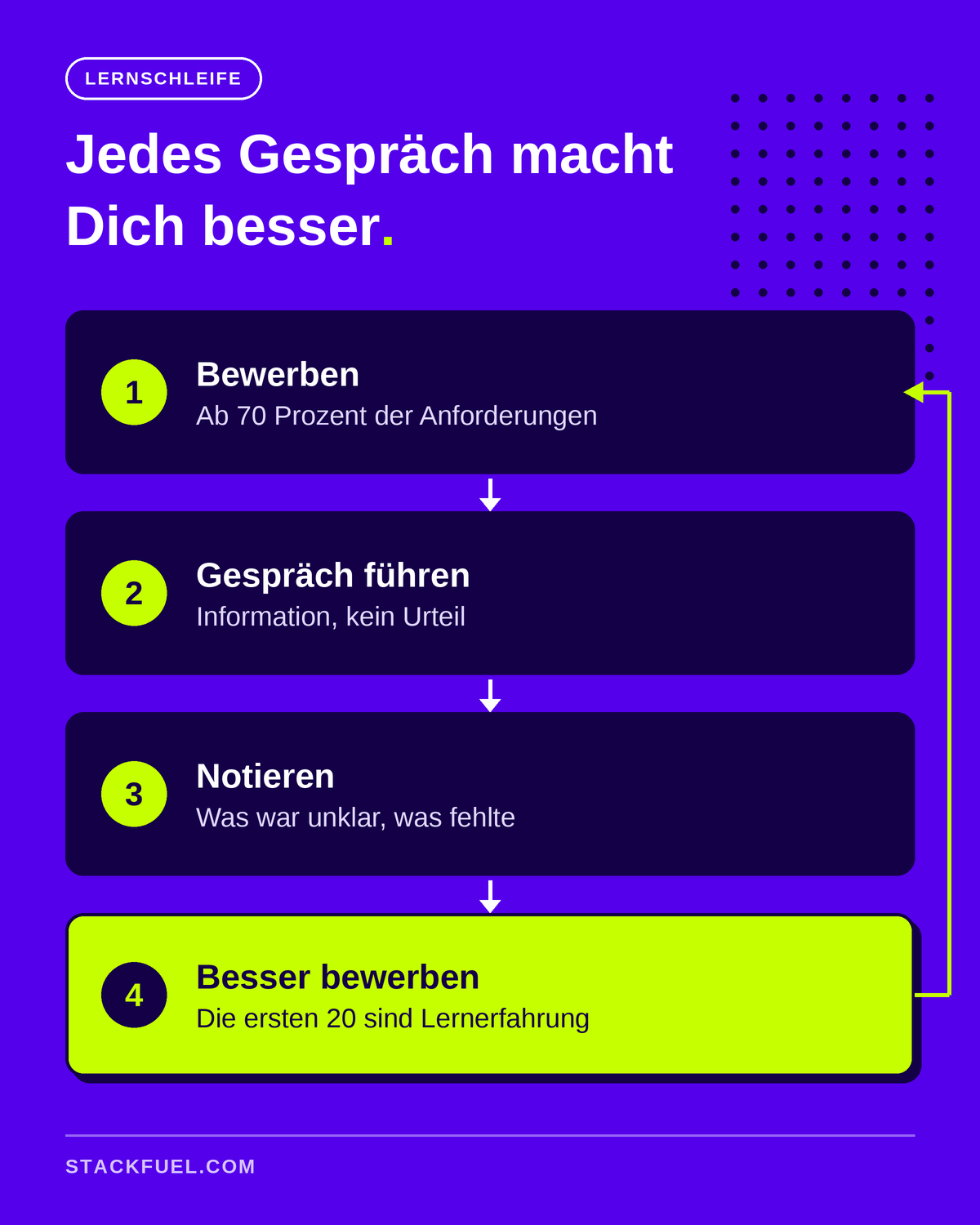
Apply using the 70 Percent Rule, even if you don't meet all the requirements, and learn to, Sort requirements into "Required" and "Wish List", before you filter out an ad.
How do you deal with rejection?
Plan for them. „The first 20 job applications are a learning experience,“ says Eckrot, and this isn’t just a platitude—it’s a practical tip: „View every application process as a source of information, not as a judgment.“
In practice, this means: After every interview, make a note of which questions caught you off guard, where you weren't clear, and what you can do better next time. After five interviews, this has turned into a unique interview training program that no course can replace. The Common Questions for Introductory Interviews are well-documented and almost always revolve around your project, your tools, and your understanding of the role. Rejections without an interview say little about you and a lot about the pile of applications.
Where can you learn the basics if you don't know them yet?
All of the above assumes that you have a solid grasp of Excel, SQL, and a BI tool. If that is precisely where you’re falling short, no job application strategy will solve the problem—only structured learning with a realistic timeline. StackFuel’s Data Analyst training program takes 7 months full-time or 14 months part-time and covers everything from Excel to SQL and Power BI to object-oriented Python, and the final portfolio project is exactly the kind of project for job applications discussed in this article. StackFuel has been AZAV-certified since 2020; with education voucher The Employment Agency may cover the costs in full, but there is no legal entitlement to such coverage.
Frequently Asked Questions About Applying for a Data Analyst Position
Do I need a cover letter for a data analyst job application? Only when requested. According to StepStone, by 2025 only about half of companies were still requiring one, and only a quarter of recruiters considered it essential. If so: keep it short and to the point—three paragraphs.
How do I apply for a data analyst position without any work experience? With a project that answers a real-world question, a resume that translates your past work into data-driven terms, and job applications where you meet about 70 percent of the requirements.
How many applications is it normal to submit before you get hired? Expect a double-digit number. The first 20 or so applications are a learning experience; what matters more than the number is that you take note after each interview of what you can improve.
What questions do employers ask during a job interview? Above all, whether you can explain your project: Why this question, why this data, what was the result, and what would you have done if you’d had more time. Also, a basic understanding of SQL and Excel, as well as why you want to work in this industry.
Does my previous field of work count on my job application? Yes, as an advantage. Industry analyst positions (Operations, Marketing, Sales, Finance) require domain knowledge, and that's exactly what you bring to the table. Data literacy plus domain knowledge is the profile we're looking for.
Your Next Step
Don't start with the cover letter—start with the project: a real question, real data, a dashboard, and a recommendation on a single page. Everything else in your application builds on that. And if you don't have the tools you need, just set up a meeting Your free consultation with StackFuel and determine whether the subsidized continuing education program will fill your skills gap.