ChatGPT
 Perplexity
 Claude
 Grok
Grok

If you are interested in a career in big data and data processing, there is no way around them: the highly sought-after job roles of data analyst and data scientist.
Although the hype surrounding data experts is still huge, it is often not clear what the difference is between a data analyst and a data scientist. Both work with data - but not in the same way.
In this article, we compare the two job profiles and help you to find out whether you are more suited to being a data analyst or a data scientist. Together, we'll take a look at the differences and similarities, career paths, typical tasks and essential skills.
By the way: Thanks to education voucher you can even get further training free of charge under certain conditions.
Why data analysts and data scientists will still be in high demand in 2026
- High demand: Demand for data-driven specialists remains high in Germany Company are increasingly building analytics and data teams, to make data-based business decisions.
- Lateral entry possible: Online courses, bootcamps or certificate programs also enable career changers to start a career in data analytics or data science - without a traditional degree in computer science or statistics.
- Flexible working: Many roles can be performed remotely. A laptop and a good internet connection are often sufficient.
- Career booster: Data expertise is valuable across all industries - be it finance, marketing, healthcare or technology.
- Subsidies: In Germany, there are certain further training courses Funding opportunities, for example via education vouchers (depending on the provider and personal situation).
- Future security: As data is increasingly at the heart of business strategies, these professions are also relevant in the long term.
Data analyst vs. data scientist: direct comparison
| Data Analyst | Data Scientist |
|---|---|
|
|
| Note: The table compares the typical roles, tasks and skills of data analysts and data scientists. Tasks may vary depending on the company and industry. | |
Data Analyst: the analytical consultant in the company
Data analysts play a central role in data-supported decision-making. They process data from SQL databases, Excel spreadsheets or Data Analyst Tools, to identify patterns, analyze past business transactions (e.g. sales figures, user statistics, conversion data) and derive trends. They often use A/B tests to objectively compare different options.
Consulting and communication as a core task
Their work is strongly consulting-oriented: Data analysts prepare the results in such a way that decision-makers can understand them and make informed decisions. This includes:
- Data visualization and storytelling to make complex information understandable
- Contextualization of the results in the business or industry-specific environment
- Unbiased reporting - they only report what the data shows, not what the management wants to hear
Strong communication skills are essential, as decision-makers often do not have the technical skills to analyze data themselves. Data analysts therefore act like investigative consultants who communicate data transparently and comprehensibly.
Cooperation and industry knowledge
Successful data analysts work closely with specialist departments, collect information from various sources and use their knowledge of company processes to make analyses more relevant. Career changers are particularly valuable here, as they already have industry-specific expertise. Networks within the company also facilitate the procurement of information and the impact of consulting.
Data Scientist: The researcher and developer
Researching and developing
In contrast to consulting data analysts, data scientists often work in the unknown and develop new business opportunities. Their work is strongly project-based and long-term: they not only analyze the past, but also develop data-driven products, predictive analytics and AI models to predict future trends.
Technical skills and methods
- Creation of algorithms and machine learning models
- Automation of processes and creation of data pipelines for continuous data processing
- Use of advanced programming skills (e.g. Python, R)
- Application of statistics, Machine Learning and data infrastructure
Interdisciplinary knowledge
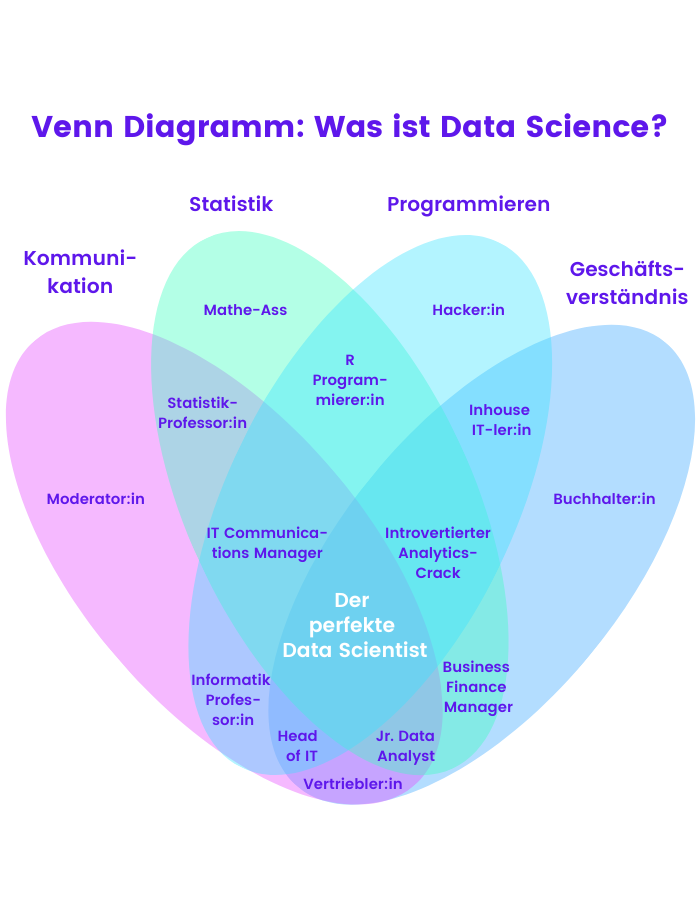
Data scientists combine several disciplines that go beyond pure analysis:
- Mathematics & statistics - deeper knowledge than typical software engineers
- Computer science & programming - programming better than classic statisticians
- Communication & domain knowledge - important to convey results in an understandable and business-relevant way
A background in research or STEM professions (mathematics, computer science, natural sciences, technology) and relevant previous experience are therefore advantageous.
Advantages and disadvantages of both roles
Similarities (advantages of both professions)
- Good entry opportunities without a traditional university degree if further training or bootcamps are used.
- Flexible working models (especially remote) are well established.
- High demand: Data expertise is a competitive advantage in many companies.
- Career potential: You can later switch to related roles as a Data Analyst or Scientist, e.g. Data Engineer, ML Engineer, Analytics Lead.
Challenges
- As a Data Analyst: You need to be strong in communication, make analyses understandable and often coordinate with specialist departments.
- As a data scientist: You need in-depth technical and mathematical skills, a lot of initiative in research topics and often patience for long-term projects.
- Both roles require continuous learning: technologies, tools and methods are developing rapidly.
Which job is right for whom?
| Data Analyst | Data Scientist |
|---|---|
|
|
| Note: This table shows which role is more suited to which interests and skills. Areas of responsibility may vary depending on the company and industry. | |
Conclusion
Data analyst and data scientist are both excellent career paths - with high demand, good salary opportunities and versatile development opportunities.
If your focus is more on analysis, consulting and business decisions, the Data Analyst path is very attractive.
If you are more interested in modeling, machine learning and automated data processes, the Data Scientist path is probably the better choice.
Ultimately, it depends very much on your strengths, interests and career goals. And: It is possible to start a career without studying - with the right further training, you can easily get into both roles today.
Difference Data Analyst - Data Scientist - Part 2
In Part 2 of the Data Scientist vs. Data Analyst article series, you'll learn more about the average annual salary for Data Analysts and Data Scientists, career stages, requirements for the two jobs, skills needed, and how to master the job entry process. Click here for Part 2 of the series.




 English
  German