 ChatGPT
 Perplexity
 Claude
 Grok

A boot camp promises to get you ready to enter the world of data in just a few weeks. That sounds like the fastest shortcut—and for some people, it is. For others, it’s an expensive disappointment because the pace, price, and support don’t fit their situation.
This article compares well-known data boot camps in Germany, outlines what you need to consider in terms of duration, cost, and financial aid, and helps you decide between a boot camp, continuing education, and self-study. A disclosure up front: StackFuel itself offers a data analyst training program. It is included in the comparison but clearly distinguished, and the information about competitors comes from their websites and comparison sites.
What is a data analyst boot camp?
A data analyst boot camp is an intensive course. In just a few weeks or months—whether full-time or part-time—you’ll learn the core tools of data analysis: typically SQL, Excel, or Python, along with data visualization. The program concludes with a final project but does not lead to a state-recognized professional certification. Financial aid is available only through accredited providers.
What boot camps are there in Germany?
The market is straightforward, but the information is inconsistent. Comparison sites contradict each other regarding duration and price, and many come from providers who are themselves competitors, such as the overviews from new fish and the WBS Coding School. The following values are therefore for reference only and do not constitute a binding offer. Check with the provider before making a decision.
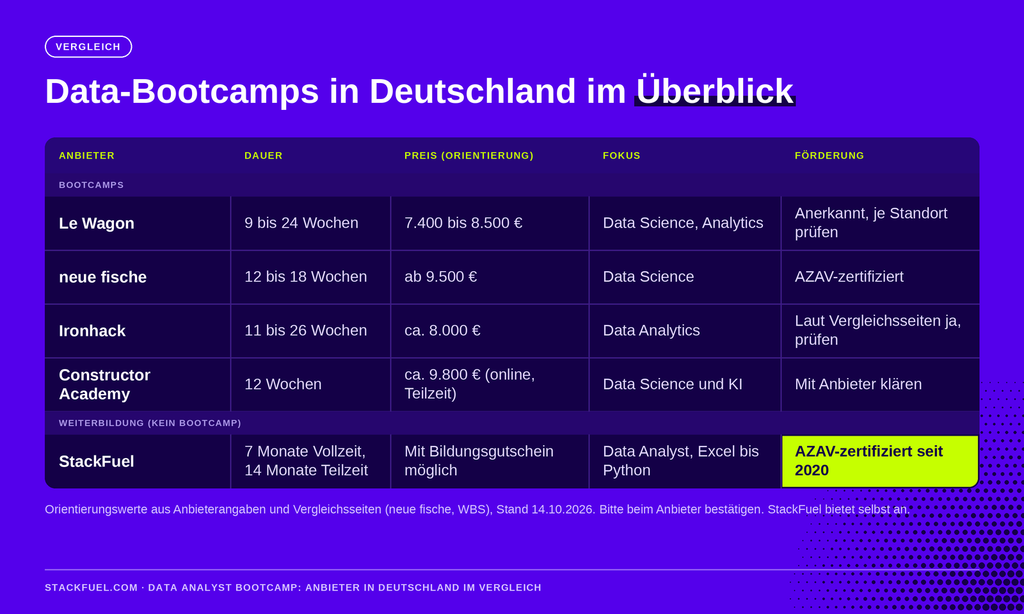
At Le Wagon According to comparison websites, the duration ranges from nine weeks to about 24 weeks, depending on the format, and prices range from 7,400 to 8,500 euros. The courses are reportedly recognized as continuing education; eligibility for funding may depend on the location. The offerings cover data science and analytics.
new fish offers an intensive full-time course—12 or 18 weeks, depending on the source—starting at 9,500 euros. The provider is AZAV-certified, which means an education voucher can be used. The course focuses on data science.
Ironhack Depending on the format, the duration ranges from 11 to 26 weeks, at a cost of approximately 8,000 euros. This price information is from older sources and should be verified. The program focuses on data analytics.
The Constructor Academy offers an „Intensive Course in Data Science & AI,“ which lasts 12 weeks full-time or 22 weeks part-time; the part-time online version costs approximately 9,800 euros. It’s not strictly a data analyst course; it also covers data science and AI. You should check directly to see if financial aid is available.
How much does a boot camp cost, and who pays for it?
The approximate cost ranges from about 7,400 to 9,800 euros for a course lasting a few weeks to a few months. That is a large sum that many people are unwilling or unable to pay on their own.
Funding is only available if the provider is AZAV-certified and your Employment Agency or Job Center approves the education voucher Approved. There is no legal entitlement; the agency decides on a case-by-case basis whether the measure is necessary and appropriate. You can find out which courses you can use your voucher for on the portal my NOW under „Funding with an Education Voucher.“ How to you'll receive the education voucher We've summarized the steps for preparing for the interview in a separate section.
You are currently viewing a placeholder content from YouTube. To access the actual content, click the button below. Please note that doing so will share data with third-party providers.
How can you tell if a boot camp is good?
A name alone doesn't tell you much. These points will help you distinguish between different offers:
- Practice: Do you work with real or realistic data, or just with processed training datasets?
- Project: Will you end up with a project that you can show to employers?
- Supervision: How much feedback do you get, and from whom?
- Job Support: Does the provider offer assistance with resumes, portfolios, and job applications, or does the support end once the course is over?
- Transparency: Does the provider provide transparent graduation rates and statistics, and is it AZAV-certified?
- Fit: Does the curriculum cover data analytics, or is it primarily a data science course?
This last point is often overlooked. Many boot camps are geared toward data science, with a focus on machine learning and Python. To get started as a data analyst, you’ll first need Excel, SQL, and a visualization tool like Power BI. Python comes later.
Who would benefit from a boot camp?
A boot camp is especially worthwhile for people who can put everything else on hold for a few weeks and want to get moving quickly. This is true, for example, if you’re between jobs, if you’ve already had some exposure to data and are looking for structure, or if a tight schedule with fixed deadlines helps you stay on track.
It’s less suitable if you want to study while working a full-time job, if you don’t yet know whether data work interests you at all, or if you have trouble keeping up with the pace of an intensive course. In these cases, it’s a good idea to do a quick test first: Try out Excel and your first SQL queries on your own before spending several thousand euros or using an education voucher. It’s best to figure out beforehand whether this career is right for you: Don't Become a Data Analyst lists the legitimate reasons against it, many of which, upon closer inspection, aren't actually exclusion criteria at all.
What happens after the boot camp?
After the course, the real work begins: You’ll apply for jobs, talk to people in your target field, and develop your project into a portfolio that employers can understand. Expect the job search to take time. Alexander Eckrot advises viewing job applications as a learning process and reaching out when you meet about 70 percent of the requirements listed in a job posting.
If you’re coming from a different profession, you have an advantage: you know the industry from the inside. Applications for roles such as Operations Analyst, Marketing Analyst, or Financial Analyst benefit precisely from this. Ask the provider what specific support is available after the course and how long it lasts.
What a Bootcamp Doesn't Do
A boot camp gives you momentum and structure, but it doesn't get you a job or a professional certification. After a few weeks, you'll know the tools, but you'll still have little experience—and that's what counts when you're applying for jobs. Anyone who thinks the course alone will open doors is in for a disappointment.
What matters most is what you can demonstrate afterward. Alexander Eckrot, Strategic Operations Manager at StackFuel, sums it up: „A project for your application that answers a real-world question is worth more than five learning projects.“ This applies regardless of whether you choose a bootcamp, a training program, or self-study. In the end, what matters is a Data Analyst Portfolio with exactly that kind of project.
On top of that, there’s the time pressure. A condensed course leaves little room to reinforce what you’ve learned, make mistakes, and explore your own questions. People who are studying while working or are new to the world of data often need more time than a boot camp allows for.
Boot camp, continuing education, or self-study: Which path is right for you?
The answer depends on time, money, and funding. The chart summarizes the typical scenarios.
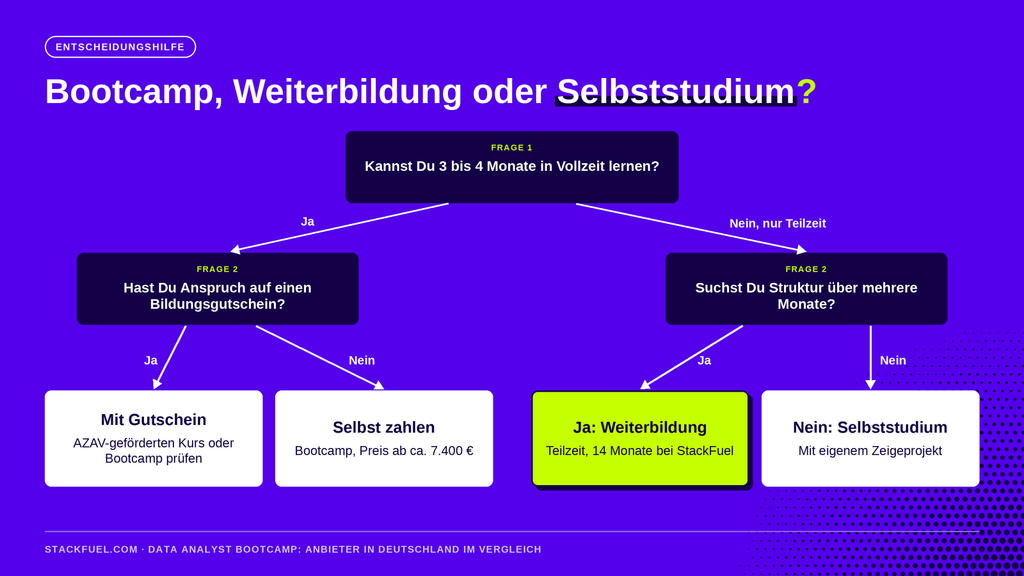
The boot camp is a good fit if you can study full-time for three to four months and either pay for it yourself or receive an educational voucher approved for an accredited provider. The part-time continuing education program is a good fit if you’re studying while working or juggling family obligations and need a structured plan over several months. Self-study is a good fit if you’re disciplined, have a limited budget, and create your own study plan.
There's also a compromise: Start by teaching yourself Excel, and then decide whether a structured course will make the rest of the journey easier for you. The following shows the order in which the tools are introduced: A Roadmap to Becoming a Data Analyst.
What is the alternative with StackFuel?
StackFuel is not a boot camp, but a continuing education program. The data analyst course lasts seven months full-time or 14 months part-time and covers Excel, SQL, Power BI, and object-oriented Python. The program culminates in a portfolio project that you can use in job applications. The learning platform is called DataLab, the Career Service helps you with your job applications, and new cohorts start approximately every nine weeks.
StackFuel has been AZAV-certified since 2020 and has over 8,000 graduates. The completion rate is 93 percent. The trade-off is time: It takes longer than a bootcamp, but you have more time to practice. Funding through the education voucher is possible but not guaranteed.
If a degree program that includes a professional exam might be a better fit for you than a course, it's worth taking a look at the Data Analyst Retraining. And if you're particularly concerned about choosing a career, you'll get a comprehensive overview of the topic, How to become a data analyst.
Frequently Asked Questions About the Data Analyst Bootcamp
How much does a data analyst boot camp cost? According to the provider and comparison websites, the estimated prices range from around 7,400 to 9,800 euros. Prices and formats are subject to change, so be sure to check with the provider for the most up-to-date figures before signing up.
Can I pay for a boot camp with an education voucher? Yes, if the provider is AZAV-certified and the Employment Agency or the Job Center approves the voucher. There is no legal entitlement to it.
How long does a data analyst boot camp last? Depending on the provider and format, about 9 to 26 weeks; full-time courses tend to be toward the lower end of that range. The exact durations vary from source to source.
Is a boot camp enough to become a data analyst? It provides the tools and a project, but no professional certification or work experience. To get started, what matters most is a compelling project and a willingness to apply.
Is a boot camp better than continuing education? It depends. A boot camp is faster and more intensive, while a continuing education program takes longer and is often more compatible with your job. Which path is right for you depends on your time, your budget, and the financial aid available.
Your Next Step
If you're unsure which option is right for your situation, talk to us about it. Simply schedule your free Consultation at StackFuel. Together, we'll look at your background, your target role, and whether a boot camp, continuing education, or another path makes sense—even if it's not part of what we offer.